
Real IT Security Requires You to Get to and Understand the Data…
Digital transformation has reshaped modern enterprises, linking everything within an organisation that can be connected. Cloud platforms, SaaS applications, remote endpoints, APIs, IoT devices and hybrid infrastructure have created extraordinary opportunities for growth and efficiency. However, these extensions have also created an attack surface of unprecedented scale and complexity. In this environment, cyber security is no longer just about firewalls, antivirus software or perimeter defence; it’s about data. More specifically, it’s about the ability to move, normalise, analyse and act upon analytical insights at speed and scale. True cyber resilience now depends on one foundational capability: Creating robust, reliable data pipelines that feed centralised security intelligence systems.
The Modern Threat Landscape is Data-Driven
The ability to transform and integrate data from different sources is the gold standard in IT security. Cyber attackers no longer operate as lone actors running crude scripts; they operate as organised, well-funded groups with advanced tooling, automation and patient reconnaissance techniques. According to IBM’s Cost of a Data Breach Report 2023, the global average cost of a data breach reached $4.45 million, the highest on record. Meanwhile, Mandiant’s M-Trends research consistently shows that attackers often dwell inside compromised environments for weeks or months before detection, quietly escalating privileges and mapping systems. This could be happening right now on your IT network, but unless you know what to look for, you wouldn’t even know.
Modern cyber threats are sophisticated and multi-layered, including:
- Insider threats
- Zero-day exploits
- Supply chain compromises
- Credential stuffing and API abuse
- Ransomware-as-a-service operations
- Phishing campaigns targeting employees
- Living-off-the-land attacks that use legitimate system tools
Threat actors are well-funded, organised and use advanced techniques, which means that no single control you can implement is sufficient to protect against them. Cyber security must operate across infrastructure, applications, networks, endpoints, identities, operations and cloud environments simultaneously. The only way to gain visibility across all these domains is through integrated, normalised data.
Best Practices in Cyber Security Architecture
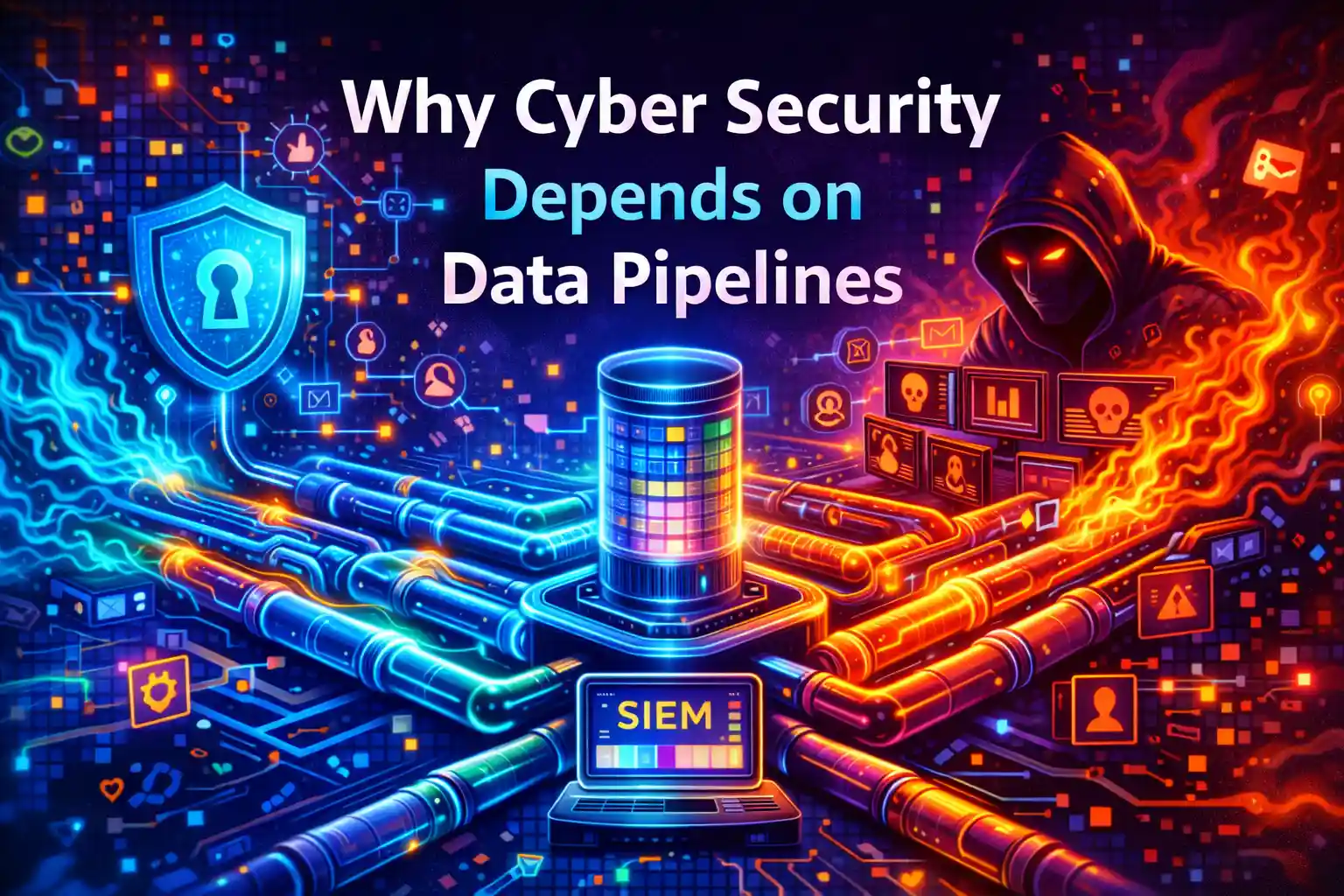
Best practice requires data pipelines feeding a Security Information and Event Management (SIEM) system as follows:
- Data Pipelines: Ingest logs and telemetry from multiple sources.
- Data Transformation and Normalisation: Standardise all data, regardless of source.
- Centralised Data Repository: Aggregates all the data in one place.
- SIEM: A platform to analyse all data and detect threats and anomalies – requires expert human analysts to review – not just AI.
- Alerts: Automation and response workflows isolate and contain threats.
In many mature environments, this architecture may also include:
- SOAR (Security Orchestration, Automation and Response)
- XDR (Extended Detection and Response)
- Data lakes or security data platforms
- Threat intelligence feeds
At its core, effective cyber defence depends on the ability to create reliable pipelines that bring disparate data into one coherent analytical framework. Without this, organisations are effectively blind.
Why Data Pipelines Are Critical to Cyber Resiliency
Modern enterprises generate vast quantities of telemetry from:
- Firewall logs
- SaaS audit trails
- Application logs
- Database queries
- Cloud access logs
- Network traffic data
- Identity provider events
- Operational technology
- Endpoint detection data
If these streams remain siloed, threats remain invisible. A suspicious login attempt may appear benign in isolation but combined with endpoint anomalies and unusual data access patterns, it may reveal credential compromise or lateral movement.
The key is correlation, and this depends on:
- Reliable ingestion
- Accurate transformation
- Schema normalisation
- Time alignment
- Secure storage
- Fast querying capability
When pipelines are poorly designed or brittle, data gaps emerge, and attackers exploit gaps.
Necessary Cyber Techniques

Resilient businesses invest in people, technologies and services that ensure:
- Pipelines can ingest from any source
- Data formats can be transformed automatically
- New sources can be onboarded rapidly
- Highly secure environments can still export necessary telemetry
- Pipelines themselves are monitored for integrity
These tools and techniques allow security teams to spot suspicious behaviours, isolate compromised endpoints, block malicious IPs, revoke credentials and neutralise threats before downtime or data exfiltration occurs.
The More Integrated The Greater the Risk
As organisations digitise further, we see integration increasing with APIs connecting everything, cloud environments spanning multiple regions, microservices communicating continuously, employees working from anywhere and vendors integrating deeply into internal workflows. The paradox is clear: the more sophisticated and integrated your architecture becomes, the harder it is to protect.
Highly secure environments often impose strict segmentation, encryption, identity controls and zero-trust principles. While these measures are necessary, they also make telemetry extraction and aggregation even more complex. Creating data pipelines inside hardened environments requires specialist knowledge of:
- Secure network architecture
- Encryption standards
- Identity and access management
- Cloud-native logging frameworks
- Compliance constraints (e.g., GDPR, ISO 27001, etc.)
This is not a trivial technical task. It requires both engineering skill and security awareness.
The Importance of Internal Capability
No organisation can outsource accountability for its security, and internal capability remains critical. Larger businesses must retain architectural understanding, risk ownership, governance and policy control, and decision-making authority over assets and Intellectual Property (IP). Internal teams understand business context, IP sensitivity and operational risk tolerance. They define what matters most. However, internal capability must be balanced against cost and practical realities, which can be especially critical for smaller organisations, as they are less able to afford the latest security tools and specialist skills to run them.
Managing Costs While Protecting the Crown Jewels
Building a 24/7 Security Operations Centre (SOC) with advanced threat detection expertise is expensive and takes time. Skilled security engineers, data engineers and analysts are scarce and command high salaries. Technology platforms require licensing and continuous monitoring requires round-the-clock staffing. For many small to medium-sized businesses, this model is simply not feasible.
This is where a balanced approach becomes essential:
- Internal teams focus on architecture, governance and strategic oversight.
- Specialist third-party providers deliver operational depth.
- Managed Detection and Response (MDR) services provide 24/7 monitoring.
- External experts help build and maintain secure data pipelines.
This hybrid model ensures that both small and larger organisations alike can protect their IP and infrastructure without overspending on internal capacity they cannot sustainably support.
Why MDR Is Increasingly Essential
Modern attackers are patient and happy to play the long game. They do not always detonate ransomware immediately. Instead, they gain access quietly, escalate privileges, establish persistence, exfiltrate data slowly, map infrastructure and study internal processes. Viruses and backdoors can remain dormant for extended periods. During this dwell time, attackers “sit, watch and survey” before striking.
MDR providers operate around the clock to spot any suspicious activity. They will:
- Monitor telemetry in real time
- Use behavioural analytics and threat intelligence
- Investigate anomalies proactively
- Escalate incidents immediately
- Provide containment guidance
As they serve multiple clients, MDR analysts gain visibility into broader threat patterns and emerging attack techniques. No small or medium-sized organisation can realistically defend against sophisticated, organised threat gangs alone. The scale and automation of modern adversaries demand equally advanced defensive capabilities.
Cyber Security Is Now an Engineering Discipline
Cyber security is no longer simply an IT function, it’s an engineering challenge built on data architecture, integration strategy, observability, automation, analytics and continuous monitoring. AI is often just one small component in this mix, but its role is often overplayed, as the real strength in MDR is the quality of the analysts who can spot potentially nefarious patterns and explain why they think it’s a problem. AI is good at firing off alerts and making lots of noise, but can’t explain itself. Over-reliance on AI without human oversight by quality analysts, who know what they’re looking for and why, is just asking for trouble.
Reliable data pipelines are the foundation for robust cyber security and resilience. Without them, SIEM systems are underfed, blind spots remain and response times increase.
With robust data pipelines in place, organisations gain:
- Visibility
- Correlation
- Faster detection
- Reduced dwell time
- Lower breach costs
- Greater operational resilience
Modern organisations must protect their intellectual property, customer data and operational continuity at all costs. The ability to do this defines their competitive advantage, because protection against advanced threats is a must and not an optional luxury, as JLR found to its cost in 2025. The organisations that will thrive are those that understand this fundamental shift:
Cyber security is now dependent on data pipelines, and those pipelines must be designed, secured and monitored with the same seriousness as the assets they are built to protect.
Find Out How MDR Can Help Your Organisation
Find out more: “SBL Cyber Monitoring.”