How to Make Your Marketing Message Stick …
Most technology companies have a messaging problem. Not because they don’t have anything interesting to say, but because they all seem to be saying the same thing. Ask yourself if your prospective customers know you exist.
How boring must it be for tech buyers to be constantly reading the same phrases from multiple vendors, such as:
- Transform your business
- Unlock growth
- AI-powered innovation
- Next-generation technology
- End-to-end solutions
- Drive efficiency
- Accelerate digital transformation
- Integrated platform
- … and so on and so dull
The problem is that these phrases might sound perfectly acceptable inside your boardroom, but they rarely give a prospective customer a compelling reason to remember one technology company rather than another. It really matters when a tech buyer doesn’t even know or care that you exist. For a tech startup trying to build awareness, generate demand and eventually scale, being understood is not enough. You need to be remembered.
The Answer is Simple but Difficult to Execute
The good news is that memorable marketing isn’t necessarily about bigger budgets, more sophisticated campaigns or clever creative. It starts with developing a message that is clear, relevant, distinctive and consistently focused on what matters to the customer. Good tech marketers focus on the question: Why should the customer care we exist? That sounds simple, right? However, just because something sounds simple doesn’t mean it’s easy to do. In fact, good messaging is often difficult to execute because the tech industry is so addicted to its own hype.
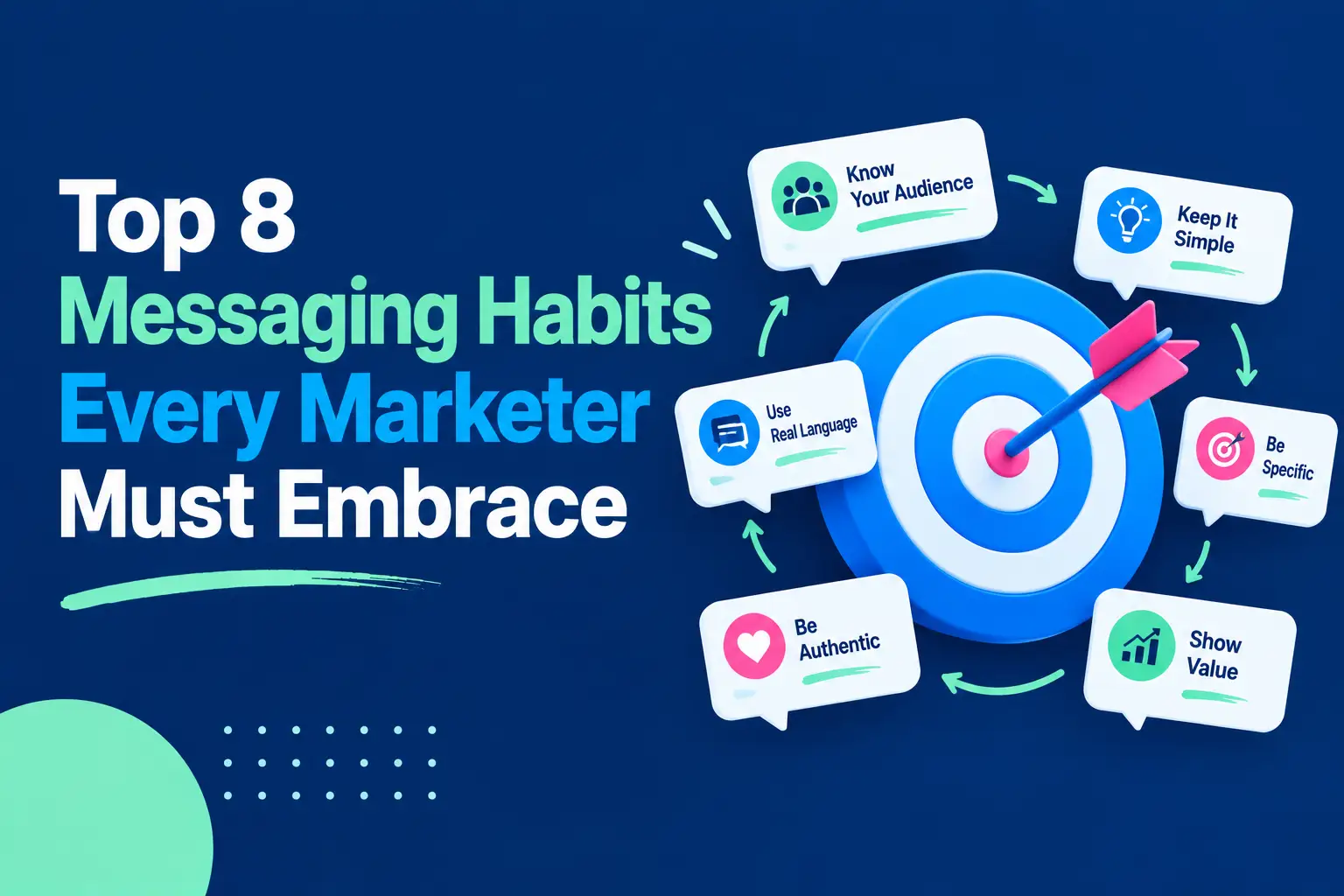
Top 8 Habits Every Tech Marketer Must Embrace
Here are eight habits every tech marketer must embrace if they want their marketing message to stick and have a chance of being remembered by the people that count – the customer.
1. Show up consistently
People cannot remember what they rarely see. This sounds obvious, but consistency is one of the easiest things for a startup to get wrong. A new company launches with one positioning statement, changes it six months later, introduces a different tagline a few months after that and then completely redesigns its website because somebody has decided the messaging is “getting stale”. Meanwhile, the audience is still trying to work out what the company does. Consistency doesn’t mean repeating the same advert forever. It means reinforcing the same fundamental idea often enough that your brand becomes associated with it.
This is closely related to mental availability — the likelihood that a brand comes to mind in relevant buying situations. Research from the Ehrenberg-Bass Institute emphasises the importance of building mental availability and distinctive brand assets over the long term. For a startup, this means deciding what you want to become known for and then consistently reinforcing that idea across your website, social media, advertising, sales presentations and customer stories.
Don’t constantly reinvent your message. Build recognition around it.
2. Say one thing
This may be the hardest discipline for technology marketers, mainly because tech companies have a lot to say. They have features, integrations, APIs, architecture, AI models, dashboards, security credentials, certifications, methodologies and technical differentiators. Unfortunately, they try to put all of them into the message. The result is often a paragraph that says everything but communicates nothing.
Your audience doesn’t need to understand every aspect of your technology before they understand why they should care. It’s much better to start with the one thing you want them to remember.
Here are some examples:
- We help manufacturers reduce production downtime.
- We help SaaS companies reduce customer churn.
- We help financial services companies identify cyber threats faster.
- We help growing businesses make better decisions from their data.
That central idea becomes your memory anchor. The rest of your marketing can then provide evidence and detail. Research from Gartner has repeatedly highlighted the importance of clear, differentiated messaging for technology companies, including the need to connect product capabilities with customer situations and outcomes rather than simply listing features.
The question every tech marketer must ask is: If someone remembers only one thing about us six months from now, what do we want it to be?
3. Share before you sell
Not everybody who encounters your company is ready to buy. In fact, the vast majority aren’t. LinkedIn’s B2B Institute and Ehrenberg-Bass research popularised the 95-5 rule, which argues that around 95% of potential B2B buyers are not currently in-market for a particular category, while around 5% are actively buying. The precise proportion varies by category and purchase cycle, but the underlying point is important: most potential customers aren’t ready to buy today. That makes the relentless “Book a Demo” approach rather limiting as a call to action.
A startup must also be teaching, explaining, challenging assumptions, sharing useful insights and demonstrating expertise. Give people something useful before asking them for something. That might be a practical guide, an original viewpoint, a customer story, a benchmark, research findings or simply an intelligent explanation of a problem they experience. Over time, this builds familiarity and credibility. So, when that person eventually has the problem your product solves, your company has a much better chance of being remembered.
4. Use you own voice
Technology marketing is drowning in corporate language. The irony is that companies often use complicated language in an attempt to sound sophisticated, while their customers are desperately looking for somebody who can explain things simply. Your marketing doesn’t need to sound like a technology analyst report. It needs to sound like a knowledgeable human who understands the customer’s problem.
Say what you mean, use shorter sentences and remove unnecessary jargon. Explain technical concepts in language that makes sense to the person buying the outcome rather than the person who built the technology. This becomes even more important as AI makes it easier for companies to produce enormous volumes of generic content. If everyone can generate a competent-sounding article in seconds, sounding competent is no longer much of a differentiator. What becomes more valuable is your perspective, experience, specific knowledge of the customer and your voice. This is why tech marketers must be careful not to let AI turn their brand into another stream of interchangeable marketing language.
5. Make people feel something
B2B tech marketing doesn’t have to be emotional in the traditional advertising sense, but it does need to matter. A technology purchase might involve security, risk, career reputation, operational pressure, growth ambitions, financial responsibility or the fear of making the wrong decision. Those are human concerns.
Compare: Our platform provides real-time operational analytics, with: Know what’s going wrong before it stops production.
The first statement describes a capability. The second creates a situation the customer can immediately imagine, and that is far more emotive and valuable. Gartner’s research into technology-provider messaging has highlighted the problems as companies focus heavily on features and specifications without connecting them to customer situations, outcomes and stories.
The technology is important, but the customer needs to understand what changes for them because the technology exists.
6. Narrow your audience
“Businesses” isn’t an audience. “SMEs” isn’t an audience. Neither is “organisations looking to digitally transform”. These are all generic terms that offer no granularity or opportunity for deep understanding and engagement. The more precisely you understand the people you are trying to reach, the easier it becomes to develop a message that resonates.
A cybersecurity startup might decide it wants to work with: UK manufacturing companies with 100–1,000 employees where operational technology creates additional cyber risk.That is dramatically more useful from a messaging perspective than saying: We help businesses stay secure in an increasingly complex digital world.
Specificity gives you meaning, differentiation and somewhere to go. You can understand the customer’s environment, vocabulary, problems, priorities and buying triggers. This makes it possible to create examples that feel relevant and explain outcomes that really matter. In this way it’s possible to differentiate yourself from competitors who are trying to appeal to everybody, because attempting to appeal to everybody results in appealing to nobody. This doesn’t necessarily mean restricting the eventual market for your solution. It means giving your marketing enough focus to become meaningful.
7. Document, don’t just produce
Marketing teams are under constant pressure to produce. There is a never-ending production line of blog posts, social posts, videos, emails, eBooks, webinars and so on. However, production isn’t the same thing as marketing effectiveness. A better approach would be for tech marketers to ask: What are we learning?
Rather than blindly producing more content, marketers would be better served to talk to customers, interview prospects, listen to sales calls, read objections, look at lost deals, understand why customers bought and why they didn’t. Capture the language customers really use to describe their problems and document those insights. That information is marketing gold because it helps you develop messaging based on the outside world rather than the assumptions inside your company.
8. Say less, but make it better
The final habit brings everything together. Don’t try to out-explain the competition. What you must do is out-clarify them. Technology companies often believe that if they explain their technology thoroughly enough, customers will eventually understand its value. Imagine if an automotive manufacturer had to explain all the technology in their cars before you could benefit from its capabilities? It’s unnecessary and nobody does it, not least because a test drive would take weeks. Customers don’t have the time or motivation to study your technology, and increasingly, they don’t have to.
Research from 6sense’s 2024 B2B Buyer Experience Report found that 69% of the buying process happens before buyers engage with sellers, while 81% of buyers had already selected a preferred vendor before speaking with a sales representative. Its European research found that buyers typically engage sellers more than two-thirds of the way through the buying process, with 88.8% having largely or completely established their purchase requirements before making contact. That has enormous implications for startup marketing. Your website, content and messaging are no longer supporting the sales team, because they are now part of the sales process before the sales team ever gets involved. The buyer needs to understand what you do, who it’s for, what problem you solve and why your approach matters, without somebody from your company sitting beside them explaining it.
The Founder is Not the Customer
This is perhaps the most important lesson of all. Stop writing marketing for the founder. Founders naturally care about the solution, they built it, understand its architecture, and know how difficult the engineering problem was. They know every feature and every capability and are also understandably proud of it, but none of that makes them the customer.
The customer doesn’t wake up thinking about your technology. They wake up thinking about their business and the challenges they face. They have revenue targets, customers to retain, costs to control, people to manage, risks to reduce, problems to solve and opportunities to exploit. All they want to know is: What does this do for me? That is why good marketing must always be outward-looking, rather than inward-looking.
The founder’s perspective can be invaluable when developing a company’s vision and point of view, but the customer’s perspective must dominate your messaging. If the founder loves a particular phrase but customers don’t understand it, change the phrase. If the product team wants to lead with a technical capability but customers care more about the outcome, then lead with the outcome. If the CEO thinks the company’s differentiation is feature X but customers repeatedly buy because of benefit Y, listen to the customer. The market gets the deciding vote.
Differentiation Starts with What You Say
Technology markets are becoming increasingly specialised. There are cybersecurity companies for almost every conceivable environment, AI platforms serving increasingly narrow use cases, SaaS products targeting specific industries and a myriad of data platforms, automation tools, infrastructure providers and specialist applications. All of them are competing within increasingly crowded and noisy categories. Yet, the casual observer can struggle to tell many of them apart.
That’s because technological differentiation doesn’t automatically create perceived differentiation. You might genuinely have a better product, technology and technical team. You might even have a genuinely unique capability, but if your marketing describes the company using the same language as everyone else, the market may never appreciate the difference.
Make the Customer the Hero
The strongest tech marketing teams don’t make the technology the hero. You must make the customer’s desired outcome the hero. Your product is the mechanism that helps them get there. They don’t need to know or care how your technology works, just that it does what you say. This approach can completely change how a startup communicates, for the better.
Instead of saying: Our AI platform uses proprietary machine learning to analyse thousands of data points, you could say: Find the customers most likely to leave before they decide to go.
Instead of saying: Our cybersecurity platform provides AI-powered detection across IT and OT environments, you could say: Protect your business without losing sight of what’s happening on the factory floor.
The technology hasn’t disappeared, but it has now been put into context, and context is what makes a message meaningful.
Messaging That Sticks is Marketing That Matters
The objective isn’t to create the cleverest marketing message, and it certainly isn’t to impress the founder. Neither is it to demonstrate how much the marketing team knows about the product or to fill every available space with technology jargon nobody understands.
The objective is much simpler: Make the right people understand why they should care you exist.
To do that, you must:
- Understand the customer deeply
- Choose a clear message
- Say something distinctive
- Use your own voice
- Focus on outcomes
- Create emotional relevance
- Show up consistently
- Teach before you sell
- And keep documenting what you learn from the market
The Ehrenberg-Bass research around mental availability reinforces why it’s so important. It found that brands grow when they become easier to recall in relevant buying situations, supported by distinctive and consistently reinforced brand cues. Meanwhile, the 6sense research demonstrates why this work increasingly needs to happen before the sales conversation even starts, because buyers are doing substantial research and forming preferences long before they contact vendors. For a tech startup, that means messaging is far more than a copywriting exercise.
Messaging is a fundamental part of your growth strategy. Customers don’t buy a proposition they don’t understand or remember the company that sounds like everybody else. They certainly don’t buy something simply because the founder thinks it’s brilliant. Customers buy when they understand what you can do for them, why it matters and why your company is worth considering. That is the type of message you can make stick.
Lesson:
Your messaging leads the way in your growth ambitions. This starts with identifying the problem you want to own, understanding the people experiencing it and articulating the outcome you deliver in language they immediately understand. Then repeat it regularly. Not because your audience is stupid, because your audience is busy.
You may want to read: “Why People Remember Some Brands and Forget Others.”