Learning How to Lead on The Job …
Leading a technology startup is very different from building the technology. In the early days, the founder is often the person who does everything. They speak to customers, make product decisions, hire people, close deals, solve operational problems, raise money and probably get involved in far more detail than they should. That may be exactly what a young company needs, but eventually, the business reaches a point where the founder’s greatest contribution is no longer doing more. It’s getting the best out of everyone else. That is the real transition from founder to leader, and it’s worth remembering that leadership isn’t about being the smartest person in the room. In fact, the more a startup grows, the less useful it becomes for the founder to try to have all the answers.
The Founder’s Influence
The founder’s personality also becomes increasingly important. Their mood, behaviour, emotional responses, working habits, personal beliefs and attitude towards risk all influence the culture around them. A calm founder creates a very different environment from an erratic one. A founder who accepts mistakes creates a different organisation from one who looks for somebody to blame. A founder who trusts people to make decisions creates a different company from one who needs to approve everything.
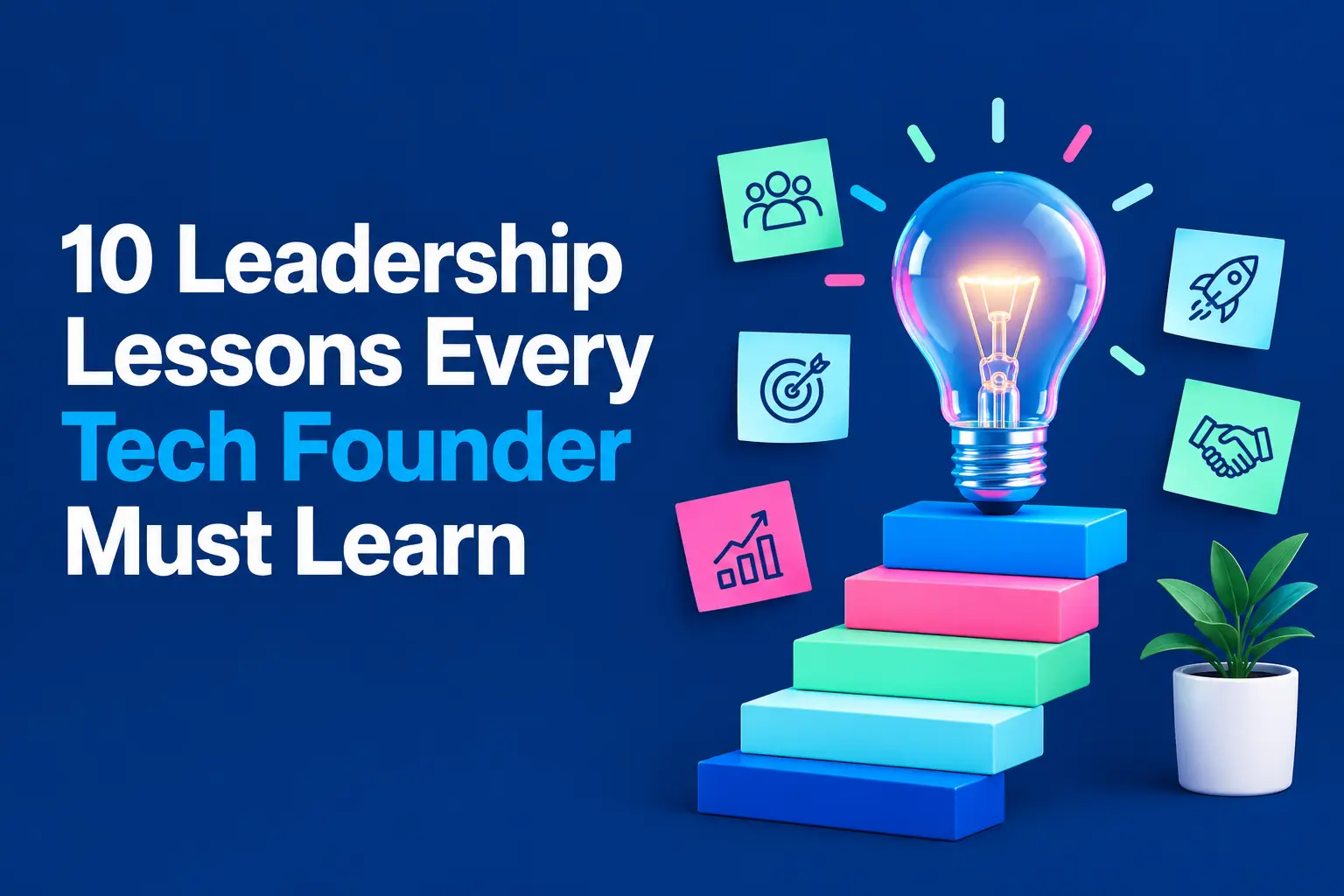
10 Leadership Lessons for Every Founder
Research by Gallup links highly engaged teams with better productivity, profitability, customer loyalty and retention outcomes. So, what leader traits must a founder adopt to get the best results from their team? Here are ten leadership lessons worth taking seriously.
1. Your mood sets the company temperature
Founders sometimes underestimate how closely employees watch them. If the founder walks into the office stressed, angry or visibly frustrated, people notice. If the founder is calm, focused and constructive when something goes wrong, people notice that too. This isn’t just perception. Research into emotional contagion has found evidence that leaders’ moods can influence the moods and behaviour of followers. One study found that followers exposed to positive leader mood behaved more positively, rated their leaders higher and performed better than those exposed to negative leader mood. For a tech founder, this means emotional self-control is a leadership responsibility.
A founder doesn’t have to pretend everything is fine when it isn’t. They can be concerned, disappointed or frustrated, but there is a difference between experiencing an emotion and allowing that emotion to dictate behaviour. If every product problem results in an angry outburst, every missed target produces blame and every setback causes a dramatic change of direction, the team starts operating according to the founder’s mood rather than the company’s strategy. That can be exhausting. Good leaders create stability, particularly when things are unstable.
2. Make decisions with incomplete information
Technology startups rarely have the luxury of perfect information. A decision may need to be made today even though better information will only become available next month. The answer isn’t to wait until you have certainty. A useful founder mindset is to make the best decision possible with the information available, understand the assumptions behind it and be prepared to change course when new evidence appears. The frequently used 80% certainty principle is best treated as a practical heuristic rather than a scientifically established threshold. The important idea is that startups cannot afford to confuse incomplete information with a reason for permanent indecision.
The key is to distinguish between reversible and irreversible decisions. A decision that can easily be changed should usually be made quickly. A decision that could fundamentally alter the company’s finances, reputation or strategic direction deserves considerably more thought. The founder’s job is not to eliminate uncertainty, but to learn to operate in an environment of ambiguity. You must manage uncertainty without becoming paralysed by it.
3. Hire your replacement before you need to
One of the biggest traps for a successful founder is becoming indispensable. At first, being indispensable feels like success, but eventually, it becomes a constraint. If every important decision requires the founder, then the business has a capacity problem. The founder has become the bottleneck. The better approach is to build people up to a position where they can eventually take over responsibilities that currently sit with you. That doesn’t mean you need to hire someone to replace the CEO tomorrow. It means continually asking: “What am I doing today that somebody else should be capable of doing next year?” Then develop that capability.
Delegation also has an important information advantage. Research into organisational delegation suggests that decision-making can improve when authority is placed closer to the people who possess the most relevant, specific information. The person closest to the customer may know more about the customer problem than the CEO. The CTO may know more about the technical issue. The marketing director may know more about the campaign. A founder doesn’t lose authority by recognising that. What you gain is organisational capacity.
4. Address problems before they become crises
Founders are often extremely good at dealing with crises. That’s partly because startups produce plenty of them, but being good at firefighting isn’t the same as being good at leadership. Avoiding difficult issues doesn’t make them disappear, but it does allow them to accumulate interest. A founder must develop a habit of asking: “What am I currently tolerating that I know I shouldn’t?”
That question can reveal uncomfortable truths, including:
- Someone who isn’t performing.
- A senior employee is undermining another department.
- The company’s strategy isn’t working.
- Customers are repeatedly complaining about the same thing.
- The founder themselves is creating the problem.
Leadership requires the courage to deal with reality early.
5. Build trust through small, consistent actions
Trust isn’t built through a company-wide speech about values. It’s built through hundreds of small interactions.
Here are some examples:
- If you say you’ll call someone tomorrow, call them.
- If you promise to investigate something, investigate it.
- If you tell employees that their views matter, listen when they disagree.
- If you make a mistake, acknowledge it.
- If you say people have authority to make decisions, don’t undermine them afterwards.
Consistency matters because employees learn whether leadership can be relied upon by observing behaviour over time. This is particularly important for a founder, given the significant power imbalance. Employees know that the founder can influence their role, career and future in the company. That makes unpredictable behaviour especially damaging. Trust allows people to operate with confidence. Without trust, employees start protecting themselves, which slows the entire operation, restricting creativity and innovation.
In that kind of environment, employees will:
- Cover mistakes.
- Avoid difficult conversations.
- Wait for instructions rather than take initiative.
- Tell the founder what they think the founder wants to hear.
That is precisely the opposite of what a growing technology company needs.
6. Delegate the outcome, not the method
This may be one of the most important lessons for a founder. If you delegate a task but prescribe exactly how the person must complete it, you haven’t really delegated. You’ve outsourced execution. Real delegation sounds more like: Here is what success looks like. Here are the boundaries. You own the outcome. Come to me if you hit a material obstacle. Then get out of the way.
A 2024 study of professional-services firms found that managers were more likely to delegate authority where employees possessed specific knowledge and where decentralisation supported better decision-making. That makes particular sense in technology businesses. For example, your head of engineering may know more about engineering than you do. Your marketing leader may know more about marketing and so on. Let them use that knowledge. Your role is to define what needs to be achieved, not dictate every step used to achieve it.
7. What you tolerate becomes your standard
Founders often talk about company values, but employees learn the real values by watching what happens when somebody violates them. If somebody behaves badly and nothing happens, the organisation learns that the behaviour is acceptable. If a senior executive consistently misses commitments but remains protected because they are considered too important, everyone notices. If someone treats colleagues disrespectfully but delivers good numbers, employees learn that performance excuses behaviour. That is how culture deteriorates, because your silence is a management decision.
What you tolerate eventually becomes normal. This doesn’t mean leaders should punish every mistake. It means there must be a clear distinction between failure and unacceptable behaviour. A person can make a poor decision in good faith and learn from it. Someone who repeatedly treats colleagues badly after being given clear feedback is a different problem. Founders need the courage to maintain standards even when the person involved is commercially important.
8. Have difficult conversations quickly
Nobody enjoys difficult conversations, but delaying them rarely makes them easier. If an employee isn’t performing, give them clear feedback. If a senior leader’s behaviour is damaging the team, address it. If two executives aren’t working together effectively, intervene. If somebody is repeatedly failing to deliver, don’t spend six months hoping things will magically improve. This is particularly important in a startup because every employee has a disproportionate impact when the organisation is small.
One dysfunctional senior employee can affect an entire leadership team. One poor manager can damage the experience of an entire department. One founder who refuses to deal with a problem can allow it to spread. “Get the wrong people off your bus” is deliberately blunt, but there is an important principle behind it: you cannot build a high-performing organisation while continually accepting behaviour that undermines it. Difficult conversations should be fair, specific and respectful, but they must happen.
9. Show vulnerability when you’re wrong
Founders are often expected to project confidence. That’s reasonable, because people need leadership, especially during uncertain periods, but confidence doesn’t mean pretending to know everything. One of the most powerful things a founder can say is: I got that wrong. It demonstrates that mistakes aren’t fatal. It tells employees that they don’t need to pretend to be perfect. It encourages people to raise problems earlier and it makes it easier for others to admit when they have made mistakes too.
That is closely connected to psychological safety — the ability to speak up, ask questions, admit errors and raise concerns without fear of interpersonal punishment. Innovation requires experimentation and experimentation produces failures. If people are terrified of being blamed for failure, they will optimise for safety instead of learning. A founder needs to demonstrate that accountability and vulnerability can coexist. “I made the wrong call. Here’s what I’ve learned. What do you think we should do differently?” That is leadership.
10. Invest in your people’s growth, not just your business
A startup needs to grow, but the people inside it need to grow too. If employees remain in the same roles, performing the same tasks, without developing new capabilities or taking on greater responsibility, eventually some of your best people will look elsewhere. This is particularly important in technology because skills change rapidly. The capabilities that made someone valuable three years ago may not be the capabilities the company needs three years from now.
LinkedIn’s 2025 Workplace Learning Report found that career progress is the number one motivation to learn, while organisations with more mature career-development practices reported stronger confidence around profitability and talent attraction and retention. The UK findings are particularly relevant to technology startups: 57% of UK learning and development professionals said executives were concerned employees didn’t have the skills required to execute business strategy.
For a founder, developing people is a strategic investment. Give people increasingly difficult problems to solve and create opportunities to lead. Provide mentoring and let people learn from mistakes. Promote from within when the capability exists, and importantly, don’t assume your best employees want only more money. Many want greater responsibility, mastery, career progression and the opportunity to have meaningful impact.
The Founder Sets the Emotional Standard
All ten lessons ultimately connect to one thing: A founder’s behaviour becomes a reference point for the organisation. That is why personality matters so much in startup leadership.
For example:
- A founder who is naturally impatient may need to learn to pause.
- A highly emotional founder may need mechanisms for managing their reactions.
- A founder who believes they can do everything may need to learn to trust specialists.
- A founder who is uncomfortable with mistakes may need to become more comfortable with experimentation.
- A founder who has always made decisions alone may need to learn how to build consensus without surrendering authority.
None of this means founders need to change their personality completely. It means they need to understand how their personality affects everyone around them. That level of self-awareness can be invaluable. An erratic founder can create an erratic company, whereas a calm founder can create stability. That is why leadership is ultimately about much more than strategy.
The Goal is to Build a Company That Can Outgrow Its Founder
The greatest leadership achievement for a technology founder is creating a company where talented people are confident enough to make decisions themselves. That requires the founder to relinquish some control. Not all control. The founder must control the direction of travel, the ambition, the standards and the outcomes, but they don’t need to control every detail of the journey. Research on delegation supports this principle: autonomy can improve decision-making by placing authority closer to people with relevant local knowledge, although effective delegation still requires appropriate boundaries and accountability.
A founder needs to build an organisation based on interdependency rather than dependency. People must collaborate, depend on one another, challenge assumptions, share knowledge and solve problems together. They shouldn’t need to call the founder every time something unexpected happens. That is when a startup starts becoming a real organisation.
Leadership is Most Visible When Things Go Wrong
Anyone can look like a good leader when revenue is growing, customers are happy and everyone is celebrating. The real test is what happens when something goes wrong. Does the founder lash out or blame somebody and does everyone retreat into self-protection? Alternatively, does the leader stop, understand the situation, accept responsibility where appropriate and ask: “What do we need to learn, and what do we do next?” That response becomes a cultural signal and people will remember it. They learn from it and will replicate it. For a startup founder, the message is that your team doesn’t need you to have all the answers.
What your team needs from you is:
- To create the conditions in which they can find the answers.
- Clarity.
- Trust.
- Consistency.
- Accountability without fear.
- Freedom to make reasonable mistakes.
- To know that they can challenge you.
- Opportunities to grow.
- To know that when the pressure is on, their leader will remain the leader — not become another problem they must manage.
The hardest part of leadership is remaining consistent with your principles when the pressure is on. For a technology founder, that may be the most important leadership lesson of all.
Lesson:
Founders who focus on their leadership style by developing their ability to respond consistently to every situation will help build trust, loyalty and motivation. Aligning your leadership style with the culture you want to develop in the business is how you get people to follow you and believe in what you tell them.
You may want to read: “Key Leadership Principles for Tech Founders.”