Does Your Pipeline Have a Single Point of Failure? …
It’s not uncommon for B2B tech startups to be heavily dependent on a single lead source in the early months and even years. Money is tight, you may not have a fully functioning marketing team, and you haven’t tried and tested different channels yet. You are still working on your messaging, finding your place in the market, achieving product-market fit and the team is focused on serving your first clients. Most founders will use their existing professional contacts to generate referral opportunities, because it’s the cheapest and most effective way to win new business at the beginning. However, the contact names in anyone’s black book will eventually run dry, and along with them so too will any immediate referral opportunities. At some point, to sustain a growing business, you will have to generate new leads from cold contacts via different channels. This is why relying on a lead source is not a good medium-term strategy. Even if something is working today, you must plan for tomorrow, when different tactics may be necessary.
Don’t Be Single-Minded
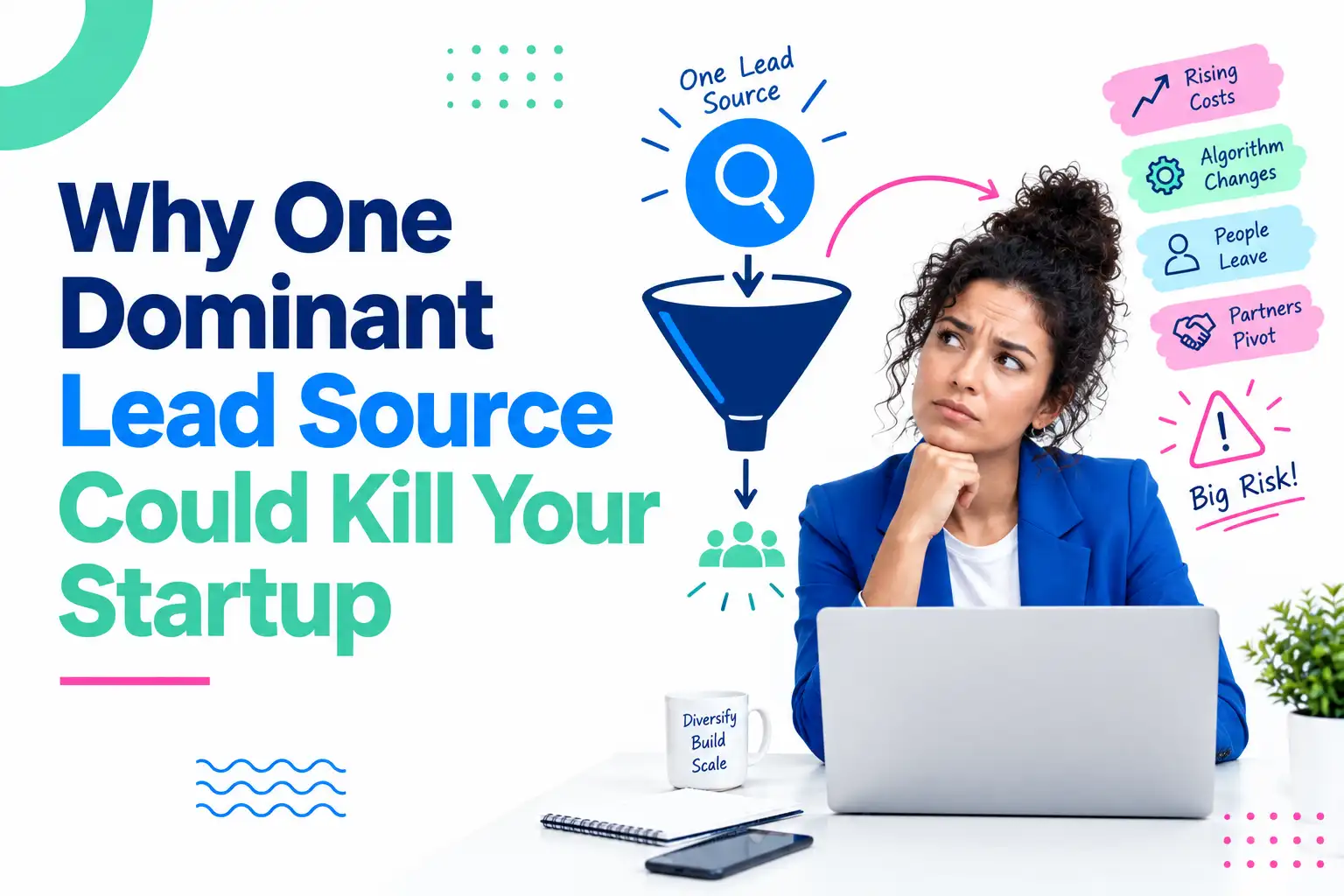
The problem isn’t so much that having a dominant lead source is bad. The problem starts when you become dependent on it. Different lead channels change, costs rise, algorithms update, people leave, partners alter their priorities, competitors enter the market, buyer behaviour shifts, budgets get cut and platforms change their rules. When one channel is responsible for most of your pipeline, a change in that channel doesn’t merely affect marketing performance. This is a potential existential threat that threatens the entire business.
The Lead Trap
If 70% or more of your pipeline comes from one lead source, even if you have a growth engine, you also have a vulnerability issue. It may not be a problem right now, but this could be a severe growth issue in the future. A single channel can be incredibly effective in the early stages. It could be that sponsored posts suddenly start producing qualified leads, an SDR becomes exceptionally good at opening enterprise accounts, a closely aligned technology partner starts referring customers every month, or your content begins ranking for a handful of highly valuable search terms. The temptation is obvious: keep investing in what works. This may make sense for a while, but that is exactly where the lead trap begins.
The Danger of Confusing Predictability with Resilience
Early-stage startups need focus, and trying to build ten different lead-generation channels simultaneously is usually a recipe for mediocre execution. A startup with a small marketing team and limited budget cannot realistically become brilliant at paid search, SEO, outbound, events, partnerships, social, content, webinars, communities, referrals and every other possible acquisition route at the same time. For this reason, concentrating resources initially can be sensible, but what happens when concentration becomes dependency?
There is a huge difference between saying, “Paid search is currently our most productive acquisition channel,” and, “Without paid search, our pipeline disappears.”
The first statement is a marketing observation and the second is a business risk. A resilient go-to-market strategy therefore isn’t about making every channel contribute the same amount. It is about spreading your risk and making sure that no single channel has the power to cripple the company. B2B buyers don’t use one channel, so why should you? The behaviour of B2B buyers makes channel dependency increasingly difficult to justify. McKinsey’s 2024 B2B Pulse research found that B2B customers use an average of 10 interaction channels during their buying journey, compared with five in 2016.
The research also found that more than half of respondents wanted a genuinely omnichannel experience in which they could move between channels seamlessly. That means your potential customers aren’t living inside one channel. They may discover your company through search, read your website, watch a video, see someone mention you on LinkedIn, attend one of your webinars, speak to a colleague, read a third-party review and eventually talk to sales. The journey is non-linear, fragmented and increasingly unpredictable. Your go-to-market strategy needs to recognise that reality.
McKinsey’s research also found that 42% of B2B buyers used more than 11 different touchpoints during their journey. If your company has built its acquisition model around one of those touchpoints, you are effectively betting that your customers’ behaviour will remain stable indefinitely, and that’s a dangerous assumption.
The 70/30 Problem
The idea that 70% of pipeline coming from one source automatically means a business is unhealthy is too simplistic. There are businesses where 70% from one channel may be entirely rational. The real question is: What happens if that channel stops working tomorrow?
Imagine a SaaS startup generating £5 million of annual pipeline. If £3.5 million comes from paid search, the company may look extremely successful, but what if the cost per lead doubles, Google changes how its search results are displayed, a competitor aggressively bids on the same keywords or the company’s target buyers increasingly use AI tools rather than traditional search to research vendors? Suddenly that £3.5 million isn’t a dependable asset but has become an exposure.
Gartner reported in 2025 that digital channels accounted for 61.1% of total marketing spend, with paid online channels representing 69% of digital spend. Paid search alone represented 13.9% of total digital spend. That doesn’t mean paid channels are bad. It demonstrates something more important: Digital acquisition has become sufficiently important that changes in digital behaviour, platforms and economics can have significant consequences for go-to-market teams. The answer isn’t to abandon paid acquisition. The answer is not to become dependent upon it.
Your Best Lead Source Today May Not Be Your Best Tomorrow
This is particularly important for technology startups because their markets are moving quickly. Consider some of the common dependencies:
- Paid Search Dependency: Costs increase, competition intensifies or buyer search behaviour changes.
- SEO Dependency: Search algorithms change, competitors publish more content or AI changes how buyers discover information.
- SDR Dependency: Your best SDR leaves and suddenly a significant percentage of pipeline leaves with them.
- Partner Dependency: Your largest referral partner changes strategy, gets acquired, launches a competing product or just stops prioritising your solution.
- Events Dependency: Budgets are cut, attendance declines or your target market changes where it wants to engage.
- Founder-Led Sales Dependency: The founder becomes the bottleneck because the company’s credibility and relationships haven’t been transferred into a repeatable commercial process.
- One Major Customer Ecosystem Dependency: An integration, marketplace or technology platform becomes the primary route to customers — until that platform changes its commercial model.
None of these channels is inherently bad. The weakness comes from allowing one to become indispensable.
Buyers Already Tell Us They Want Multiple Routes
Gartner’s 2026 research provides another useful warning. A survey of 645 B2B buyers, conducted in August and September 2025, found that buyers used an average of seven information sources during a recent purchase. Forty-five percent said they used generative AI to gather information about vendors and products. At the same time, 69% said they preferred to validate AI-generated insights with sales representatives. The message is worthy of note: Digital research isn’t replacing human engagement, human engagement isn’t replacing digital research and AI isn’t replacing either. The modern B2B buying journey is becoming more distributed, not less. A startup therefore needs a go-to-market system that can put useful information and credible engagement in front of buyers through multiple routes.
Diversification Doesn’t Mean Doing Everything
This is where many startups get diversification wrong. Not relying on one channel does not mean launching everything, including:
- Google Ads
- SEO
- Cold Email
- Events
- Podcasts
- Webinars
- Partners
- PR
- Communities
- YouTube
- Direct mail
- Influencers
There is no benefit to the marketing team doing 15 things badly. That’s not true diversification, but it is a significant distraction.
A Resilient GTM Strategy Is Sequenced as Follows:
Step One: Make One Channel Work
Find a channel that fits your ICP, economics and buying process. Understand it, measure it and build repeatability. Then work out the conversion rates, sales cycle, cost and quality of opportunities it produces. Don’t diversify because someone told you that you need five channels. Diversify because you understand the first channel well enough to know what you need next.
Step Two: Build a Complementary Second Channel
The second channel should ideally behave differently from the first. If paid search is your primary acquisition mechanism, perhaps build organic authority through SEO, thought leadership and useful content. If outbound is dominant, develop inbound demand and brand recognition. If partners dominate, build direct customer relationships. If events dominate, build an always-on digital engagement engine. Rather than simply adding another source of leads, this is about adding another source of resilience.
Step Three: Build Channels That Compound
Some acquisition channels produce leads immediately, whereas many others take time. That creates a dangerous temptation to keep funding only the channels with immediate attribution, but brand, content, SEO, community, customer advocacy, partnerships and referrals can create assets that accumulate over time. McKinsey’s B2B research has repeatedly found that companies using broader channel models can outperform more narrowly focused approaches. Its research found that 72% of B2B companies marketing through seven or more channels gained market share in its 2021 study. That doesn’t mean you must have at least seven channels, as many startups cannot finance and sustain that level of activity. This shows that channel breadth can be associated with commercial growth.
The Real Objective is Pipeline Resilience
The question tech founders and marketing leaders should be asking isn’t which channel generates the most leads? Rather, a better question is to ask how much future revenue depends on something you don’t control.
For example, you don’t control:
- Advertising Auctions
- Algorithms
- Referral Partners
- Whether your best salesperson stays
- Buyers suddenly change how they research technology
What you can control is whether your entire pipeline depends on any one of the above.
Build a GTM Portfolio
Think about your go-to-market engine like an investment portfolio. You don’t necessarily want equal investment in every asset, but you do want the right combination of assets with different characteristics. One might generate immediate demand, another might create long-term organic demand, another might create credibility, another might create relationships, another might provide access to accounts that are difficult to reach through conventional marketing and another might turn existing customers into advocates.
The portfolio becomes stronger because the individual components behave differently, which is what resilience means. This becomes particularly important when your startup starts scaling. At £500,000 of revenue, a founder may be able to personally compensate for a weak acquisition channel, but at £5 million that becomes much harder. At £20 million, a structural weakness in the GTM engine can become enormously expensive. The further a business scales, the more dangerous it becomes to have a single point of failure.
Ask the Uncomfortable Question
Every tech startup should periodically conduct a simple exercise: Turn off your biggest lead source. Not permanently, just long enough to model the scenario, so you can see what happens if:
- Google disappears tomorrow
- Your biggest partner stops referring business
- Your top SDR resigns
- Your event programme disappears
- Your organic traffic falls by 50%
- The founder stops taking sales calls
Then calculate the impact on:
- Leads
- Qualified opportunities
- Pipeline
- Revenue
- CAC
- Sales capacity
- Growth targets
You may discover that your supposedly successful GTM engine has a surprisingly large single point of failure and discovering that while you still have time to fix it is enormously valuable.
Don’t Diversify Randomly – Diversify Deliberately
The best startups don’t abandon what works. What they exploit it, then they deliberately build the next channel and the one after that. First make one channel predictable, before building the next one. The objective is not to build a marketing plan that looks impressive because it has a long list of channels, but to build resilience that means the business becomes progressively harder to knock over.
McKinsey’s latest B2B research reinforces the direction of travel: buyers now expect to interact with suppliers across multiple channels and report using an average of 10 channels throughout the buying journey. Your customers are already diversified, and competitors are increasingly adapting to that behaviour. This means your startup should too. A lead engine that produces pipeline is useful, but a lead engine that can survive change is a strategic asset.
Lesson:
If turning off one lead channel tomorrow would make your revenue forecast collapse, then you don’t have a diversified go-to-market strategy. What you have is a single point of failure.
You may want to read: “Why Startups Must Take Target Data Seriously.”