
How Pirate Metrics Help Cut Through the Noise …
For many startups, one of the biggest challenges is knowing which metrics actually matter. Founders are bombarded with dashboards full of website traffic, social media engagement, impressions, clicks and downloads, yet many still struggle to answer a simple question: Is the business getting healthier? Data overload doesn’t help when marketing teams focus too much time on monitoring metrics rather than generating new leads. This is precisely the problem that the AARRR framework was designed to solve.
Commonly known as Pirate Metrics, AARRR provides a structured method for measuring the effectiveness of a startup’s entire customer journey, from first contact through to customer advocacy. Instead of focusing on vanity metrics, the framework helps founders identify where growth is being constrained and where improvement efforts will generate the greatest return on investment. Nearly two decades after its creation, AARRR remains one of the most widely used growth frameworks in the startup ecosystem because of its simplicity, practicality and ability to reveal the true drivers of business performance.
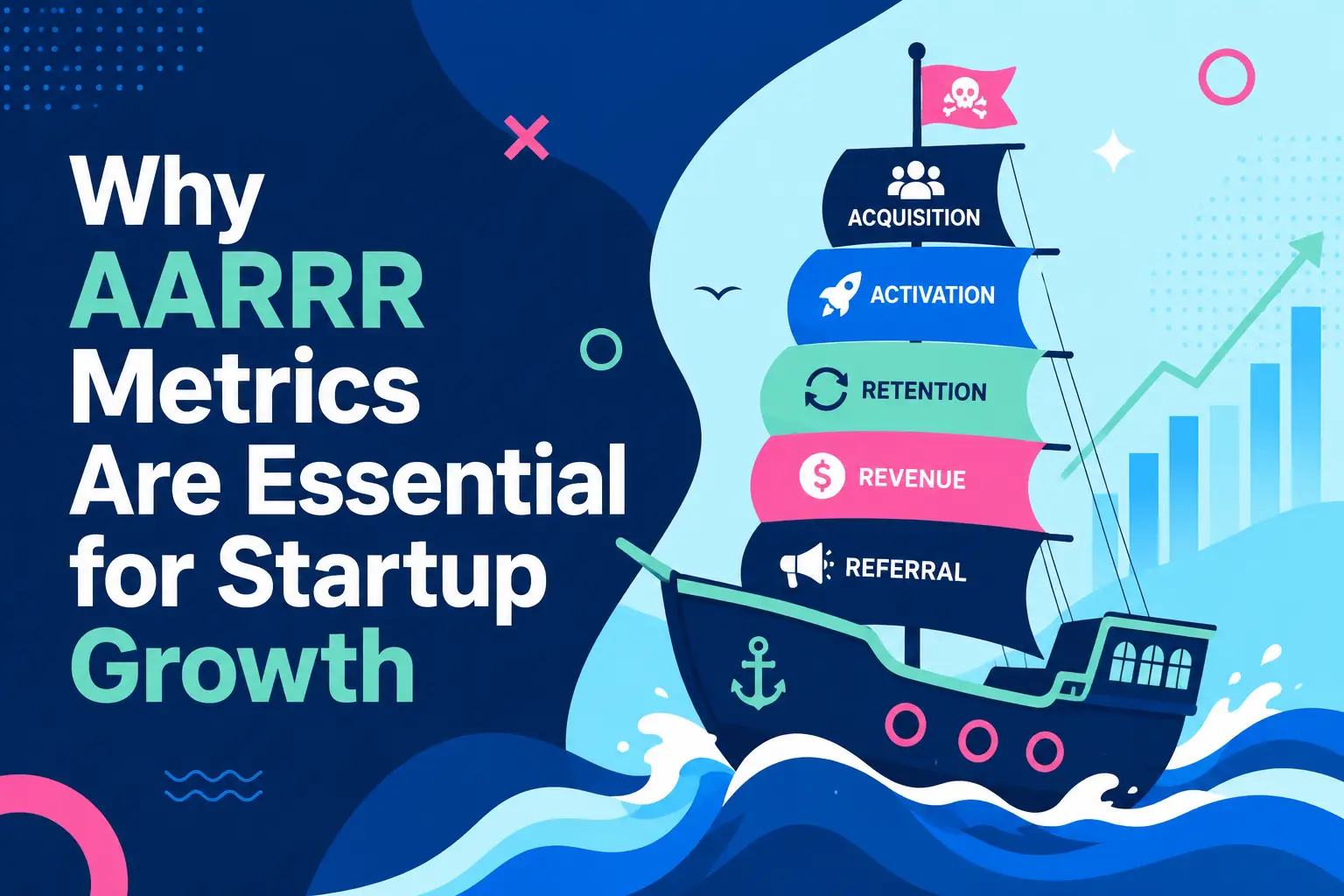
What Are AARRR Metrics
AARRR is an acronym representing five critical stages of the customer lifecycle:
– Acquisition
– Activation
– Retention
– Revenue
– Referral
The framework was created in 2007 by venture capitalist and entrepreneur Dave McClure, founder of startup accelerator 500 Startups. McClure first introduced the concept during a presentation titled “Startup Metrics for Pirates,” naming the framework after the pirate-like pronunciation of the acronym: “Arrr!” The idea was to stop startups measuring activity rather than progress. Metrics such as page views, downloads and social followers often looked impressive but offered little insight into whether the company was achieving sustainable growth.
Why Startups Need Pirate Metrics
The AARRR framework shifts attention towards customer behaviour and commercial outcomes. Nearly twenty years later, it remains one of the most influential growth models used by startups, SaaS businesses and digital platforms worldwide. One of the most dangerous mistakes startups make is assuming that more leads automatically create more growth. Imagine a startup generating 20,000 website visitors each month but converting only 1% into meaningful sales opportunities. In this situation, investing additional budget into advertising may simply amplify an existing problem. AARRR helps founders identify where the bottleneck exists.
For example:
- Acquisition may be strong.
- Activation may be weak.
- Retention may be poor.
- Referral activity may be non-existent.
Without understanding the full customer journey, businesses often spend money fixing the wrong problem. The framework encourages founders to identify the weakest link in the chain and address it before scaling further.
What AARRR Means:
Acquisition: How Do Customers Find You?
Acquisition measures the effectiveness of attracting potential customers to your business.
Typical metrics include:
- Website visitors
- Organic traffic
- Cost per click
- Cost per lead
- Social media traffic
- Content engagement
- Search rankings
- Email subscribers
For example, a cybersecurity startup may generate 10,000 monthly website visitors through SEO, LinkedIn campaigns and industry webinars. Many founders obsess over acquisition because it is visible and relatively easy to improve. However, acquisition is only valuable if those visitors subsequently move through the rest of the funnel. The objective is not simply to generate traffic but to generate the right traffic.
Activation: Do Customers Experience Value?
Activation measures whether prospects have a meaningful first experience with your business. This is often described as the customer’s first “aha” moment. For a SaaS company, activation may occur when a user successfully completes onboarding and experiences the product’s value for the first time.
Metrics commonly include:
- Trial registrations
- Demo requests
- Onboarding completion rates
- Time to first value
- User engagement rates
Consider two startups that each generate 1,000 trial users per month.
- Startup A activates 10% of users.
- Startup B activates 40%.
Although acquisition performance is identical, Startup B has effectively created four times the growth potential without increasing marketing spend. This is why many growth experts argue that activation is frequently a more important lever than acquisition.
Retention: Do Customers Keep Coming Back?
Retention measures whether customers continue using your product or service over time. Many investors consider retention to be the ultimate test of product-market fit.
If customers repeatedly return and continue paying for your solution, you are likely solving a genuine business problem.
Typical retention metrics include:
- Customer retention rate
- Churn rate
- Daily active users
- Monthly active users
- Renewal rates
- Expansion revenue
A startup with exceptional acquisition but poor retention resembles a bucket full of holes. No matter how much water is poured in, the bucket never fills. Several experienced SaaS founders argue that retention is the single most important stage of the framework because nothing else matters if customers do not remain engaged.
Revenue: Are Customers Paying?
Revenue measures how effectively customer activity translates into commercial value.
For subscription businesses, common metrics include:
- Monthly recurring revenue (MRR)
- Annual recurring revenue (ARR)
- Customer lifetime value
- Average contract value
- Conversion rates
- Upsell and cross-sell revenue
Revenue metrics help founders understand not only whether customers are buying, but whether the business model itself is economically sustainable. A startup that acquires thousands of users but struggles to monetise them effectively may still face significant long-term challenges. Revenue provides validation that customers are willing to exchange money for the value being delivered.
Referral: Are Customers Recommending You?
Referral measures customer advocacy. In simple terms, do your customers like you enough to tell other people about you?
Common referral metrics include:
- Referral rates
- Net Promoter Score (NPS)
- Reviews
- Customer testimonials
- Word-of-mouth leads
- Viral coefficient
Referral is often the stage where startups experience exponential growth. One of the most famous examples comes from Dropbox. Early in its development, Dropbox discovered that paid acquisition costs were becoming unsustainable. The company introduced a referral programme that rewarded users with additional storage space for introducing new customers. The results were remarkable. Sign-ups increased by approximately 60%, while referral-driven growth became a major component of customer acquisition. What had previously been a costly acquisition problem became a highly scalable growth engine.
Using AARRR for Continuous Improvement
The true power of AARRR lies not in measurement alone but in ongoing optimisation.
A practical approach is to review the five stages every month and ask:
- Which metric is weakest?
- Which conversion point is leaking customers?
- Which improvement would have the greatest impact?
For example:
10,000 visitors
↓
500 trial users
↓
100 activated users
↓
60 retained users
↓
15 paying customers
↓
3 referrals
The largest drop occurs between visitors and trial users. This suggests the startup must focus on improving acquisition quality, website messaging or conversion optimisation before investing elsewhere. Once that bottleneck is resolved, attention can shift to the next weakest stage. This continuous cycle of improvement enables startups to allocate resources more effectively and maximise return on investment.
AARRR and Product-Market Fit
One of the most valuable applications of AARRR is measuring progress towards product-market fit.
When startups approach product-market fit, they often observe:
- Higher activation rates
- Improved retention
- Increasing recurring revenue
- More customer referrals
- Lower acquisition costs
Momentum then begins to build naturally, as customers become advocates, sales cycles shorten and growth becomes easier to sustain. Rather than constantly pushing the business uphill, founders begin to feel market demand pulling the company forward.
Pirate Vibes
The brilliance of AARRR lies in its simplicity. Rather than drowning in dozens of disconnected KPIs, founders can focus on five interconnected stages that determine business success. The framework helps startups avoid vanity metrics, identify bottlenecks and prioritise improvement initiatives that generate meaningful commercial outcomes. Nearly twenty years after Dave McClure introduced Pirate Metrics, the framework remains one of the most effective tools available for understanding growth, improving performance and accelerating the journey towards product-market fit. For startups seeking sustainable growth, AARRR is not just a reporting framework but a practical roadmap for building a stronger, more scalable business.
You may want to read: “The Importance of Culture for Tech Startups.”