Not Just About Corporate Values …
There is an important distinction to make about psychographic information, and that is it must not be limited to the values an organisation publishes on its website. Whilst this may be helpful as a starting point you cannot fully determine what they believe until you dig a little deeper. You may need to explore more layers of information and won’t know what they are about until and unless you speak with them and learn from them directly. Every company will say it values innovation, customers and employees, but the real insight often comes from behaviour.
Here are some behavioural indicators to consider:
- Does the organisation invest in innovation?
- Does it experiment?
- Does it adopt emerging technologies early?
- Does leadership publicly discuss risk?
- Does it invest heavily in employee development?
- Does it make bold acquisitions?
- Does it prioritise sustainability when making procurement decisions?
- Does it favour established vendors?
Behaviour provides evidence of belief. This is where marketing and sales research becomes particularly valuable.

Definition of Psychographics
In B2B tech marketing, psychographics is the consideration of the psychological, emotional and behavioural traits that drive decision-makers. While firmographics and demographics reveal who a company is (size, industry, revenue, etc.), psychographics reveal why and how tech buyers make choices, focusing on risk tolerance, innovation drive and operational priorities.
Turn Insight into Messaging
Collecting psychographic information is pointless if it simply sits in a spreadsheet. The objective is to use it.
Once marketing and sales understand what matters to a target account, that insight should influence:
- Messaging: What language will resonate with this organisation?
- Content: What subjects are likely to generate engagement?
- Proof points: Which customer stories and outcomes will carry the most credibility?
- Events: What type of event or experience would appeal to the target audience?
- Sales engagement: How should the sales team approach the account?
- Value proposition: Which aspects of the solution should be prioritised?
- Timing: What organisational developments might create the right moment for engagement?
This turns psychographic information from a research exercise into a commercial asset.
Psychographics Shorten Your Sales Cycle
The ultimate benefit is not simply better marketing, but potentially faster revenue generation. When a startup demonstrates a genuine understanding of what a prospect cares about, it can establish relevance much faster.
The conversation moves away from:
- “Let me tell you about our product.”
Instead, you can move towards a conversation like this:
- “We understand the challenge you’re trying to solve and why it matters to your organisation.”
That creates credibility and credibility builds trust. Trust can accelerate engagement, and stronger engagement can help reduce the time it takes to progress a qualified opportunity. Of course, psychographic alignment cannot magically eliminate a 12-month procurement process, but it can improve the quality of conversations that happen along the way.
The Competitive Advantage of Alignment
Technology markets are challenging both for new entrants and incumbent vendors alike. They increasingly overlap with adjacent segments and confuse prospects, resulting in meaningless messaging and overcrowding. This turns prospects off and creates barriers startups must overcome. Competitors often offer broadly similar functionality, so that feature differentiation becomes harder. One critical way startups can create meaningful differentiation is through relevance. A competitor may have an excellent product, but if your startup understands the prospect’s priorities, culture, beliefs and objectives more deeply, your message can resonate more accurately and feel significantly more relevant. Relevance matters, because people pay attention to messages that reflect their world.
Your Secret Weapon To Build Credibility and Trust
For B2B tech startups, the Ideal Customer Profile must evolve beyond a collection of firmographic characteristics.
Let’s break down the important factors:
- Understanding who the customer is – yes, this is important.
- Understanding what the customer does – yes, this is even better.
- But understanding what the customer believes and values – yes, this is next level thinking and can create an entirely different level of insight.
Psychographic information allows your startup to identify organisations that are not simply capable of buying a solution but are more naturally aligned with you because you have a similar worldview. This means they better identify with problem you solve and the value your solution provides. Remember, you are not just aligning a solution with a prospect, you are aligning your company with a customer, and that is powerful. That alignment can improve targeting, sharpen messaging, strengthen ABM, create trust faster and ultimately help shorten the sales cycle. This isn’t something marketing can achieve alone; it must work seamlessly with the sales team to achieve this level of sophistication.
Making Psychographics Work
Founders, marketing and sales need to work together to build the picture. Marketing brings market intelligence and engagement data, while sales bring direct customer experience and commercial insight. Founders bring the strategic understanding of why the company exists and the problem it is trying to solve. Together, this team can identify the characteristics that make a customer genuinely valuable. The result is a much more sophisticated approach to ICP and ABM, but the goal isn’t simply to find companies that look like good prospects; it is to find organisations where the problem, the priorities, the behaviour and the beliefs all align with your solution, your people and your business. When that happens, selling becomes less about convincing someone to buy and more about demonstrating why your proposition (solution + company) naturally fits what they are trying to achieve. Every B2B technology startup that strives to achieve that kind of alignment, will find it can be a powerful competitive advantage.
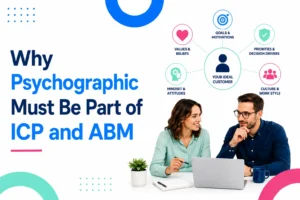
You may want to read: “Why Psychographic Must Be Part of ICP and ABM.”