What Do You Believe? …
Most B2B technology startups understand the importance of defining their Ideal Customer Profile (ICP), because they know the importance of identifying the companies most likely to need their solution. For example, they understand the importance of factors such as industry, company size, revenue, geography, technology stack, growth rate and organisational structure. Many also use this data as a starting point for Account-Based Marketing (ABM), where marketing and sales teams work together to identify and engage a defined group of high-value target accounts. This core information is often enriched with other specific details, one of which can often get overlooked by our fixation on raw data but can be very helpful during the sales process. What is that often-missed piece of information from the process? What does the target prospect organisation believe?
What is Psychographic Information?
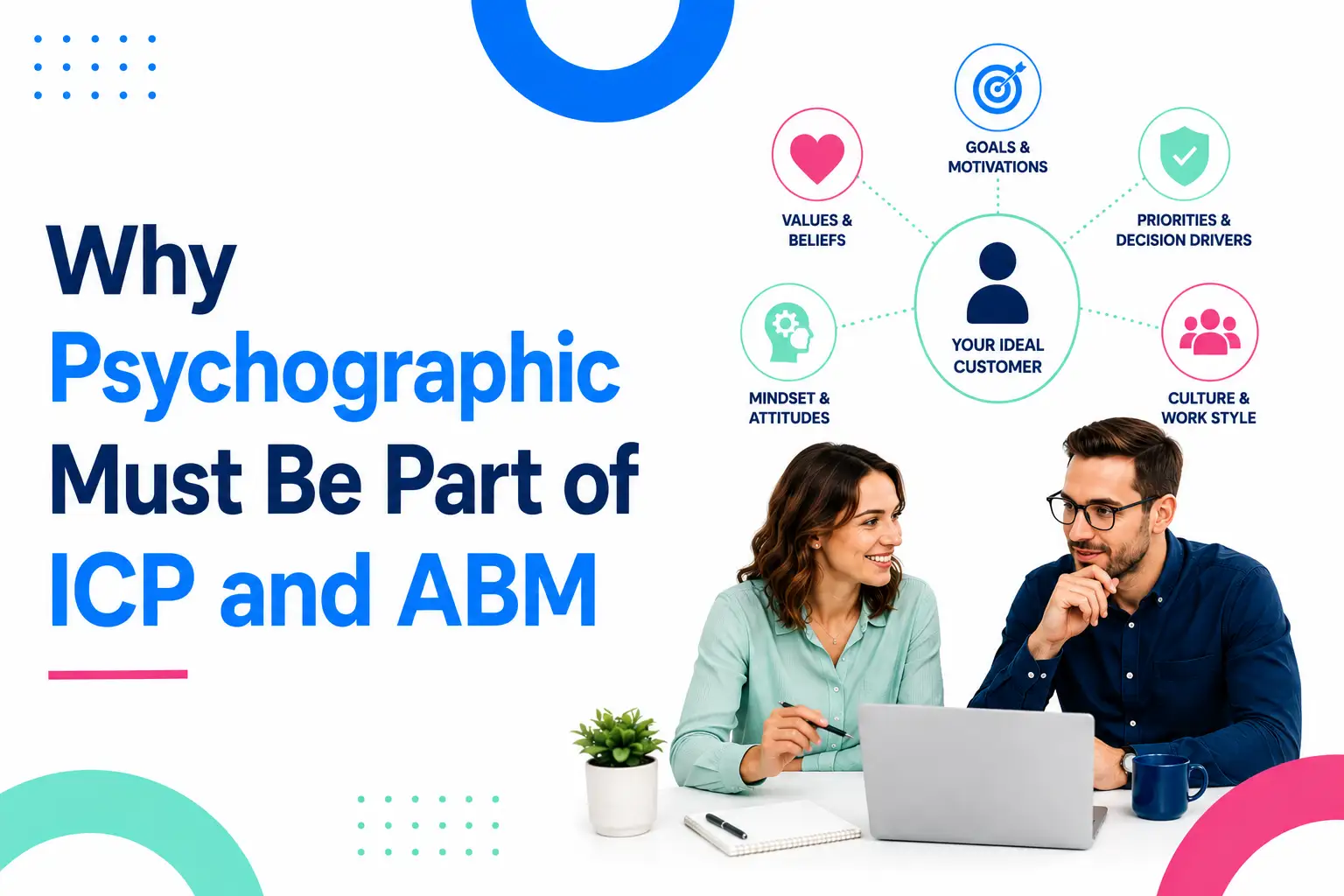
Psychographic information is becoming increasingly important for B2B technology startups trying to differentiate themselves from competitors. Understanding the values, attitudes, priorities, behaviours and beliefs of a target organisation can be just as important as understanding its size, sector or technology infrastructure.
Why is Psychographic Information Important?
Businesses don’t make decisions based solely on what they are. They also make decisions based on what they believe, what they value and how they want to operate. Understanding that can fundamentally change how a startup approaches a prospect.
Traditional ICP development tends to focus heavily on demographic and firmographic information. For a B2B technology company, this might include:
- Industry
- Number of employees
- Revenue
- Location
- Number of offices
- Technology environment
- Growth rate
- Ownership structure
- Existing suppliers
- IT infrastructure
These characteristics help determine whether an organisation is a potential fit. Behavioural information adds another layer. For example, has the company recently raised investment? Is it expanding internationally? Has it acquired another business? Has it appointed a new CIO? Is it replacing an existing technology platform?
These events can indicate propensity to buy. Psychographics then add another dimension altogether.
Psychographic information helps answer questions such as:
- What does this organisation value?
- How does it make decisions?
- Is it an innovator or a conservative adopter?
- Does it prioritise speed or control?
- Is experimentation encouraged?
- How important is sustainability?
- Does it prioritise security and resilience?
- How much importance does it place on customer experience?
- Does it value independence or prefer established suppliers?
- Is it comfortable taking risks?
- What kind of culture does it want to create?
This information can be incredibly powerful because two companies can look identical on paper but have very different approaches to doing business and outlooks that prioritises different things. This means that despite the similarities to the casual observer, their expectations from a technology vendor could differ wildly.
Consider This Example:
Imagine a technology startup selling an AI-powered automation platform. Its ICP might specify organisations with:
– 500–2,000 employees
– £100m–£500m turnover
– Multiple operating locations
– A large customer service operation
– A complex technology environment
– Significant pressure to reduce operating costs
On paper, two companies might look almost identical, and both fit the defined ICP. Both have the problem the startup solves, the budget and the right technology infrastructure, but one organisation has a culture of experimentation. Its leadership actively encourages teams to test new technologies, move quickly and challenge established ways of working. The other organisation is highly risk-averse, prioritising governance, stability, predictability and compliance. New technology is introduced cautiously and only after extensive testing and approval.
The startup may technically be able to sell to both, but the route to winning them will be completely different. That is why psychographics matter, and is why your ICP must go beyond the simple question of: “Who Can Buy?”
Update Your ICP
Now we are beginning to understand that an ICP should not simply answer:
- “Who can buy our product?”
It should help answer:
- “Who is most likely to buy our product, value it, implement it successfully and become a long-term customer?”
That is a much more powerful definition.
Who Are Your Best Customers?
A startup’s best customers are rarely determined solely by budget or company size. They are often organisations whose objectives, culture and priorities align closely with the value the startup provides. For example, a cybersecurity company whose proposition is built around helping organisations become more resilient wants to find prospects that genuinely value resilience, proactive risk management and continuous improvement. They will be far more receptive to the proposition than a company that views cybersecurity purely as a compliance requirement. Both have a cybersecurity problem, but only one may have the right mindset to solve it.
Shared Values Can Accelerate Trust
B2B technology sales can involve lengthy buying cycles. There may be multiple stakeholders, procurement processes, technical evaluations, security reviews and budget approvals. For this reason, building trust quickly by demonstrating expertise and close alignment, becomes enormously important. This is where psychographic information can help accelerate that trust. If a startup understands what matters to its target organisation, its messaging can move beyond generic product benefits.
For example:
Instead of saying:
- “Our platform improves operational efficiency.”
You might communicate:
- “For organisations that believe automation should empower people rather than simply reduce headcount, our platform helps teams eliminate repetitive work while retaining human oversight.”
That is a fundamentally different conversation. The second message reflects a belief and gives the prospect something to identify with. It also gives the startup a potential point of differentiation that competitors may not be communicating. This is why whenever I work with a tech startup to develop its brand messaging, we always create a list of beliefs for the company that aligns with its core values.
Find Your Natural Customers
This is particularly important for early-stage technology companies because startups have limited budgets and small sales teams. You cannot afford to pursue every organisation that might theoretically buy a solution, so the go-to-market activity must be highly targeted by focusing where you have the strongest probability of success. Psychographics can help identify what might be described as your startup’s natural customers.
Natural customers are organisations where the problem exists, the commercial opportunity is real and the company’s worldview is compatible with both the solution and your startup’s beliefs (solution + company). For example, a startup offering a highly innovative technology platform might find that its best customers are organisations that actively reward experimentation and early adoption.
Another startup may discover that its strongest market consists of businesses that prioritise stability, governance and risk reduction. Neither is necessarily better; you just need to recognise where you have the best fit and opportunity for success based on your alignment. These are simply different organisations with different motivations. The startup that understands this can build its marketing and sales strategy accordingly.
ABM Becomes More Powerful
Psychographic information can take Account-Based Marketing to another level. Traditional ABM might identify a list of 100 target accounts based on firmographic and behavioural criteria. Marketing then develops campaigns designed around the common characteristics of those accounts. Adding psychographic information helps your strategy become considerably more nuanced.
Instead of simply asking:
- “What do these companies have in common?”
Your team asks:
- “What do these companies believe, value and prioritise?”
Perhaps 30 of the target accounts are highly innovation-focused and another 25 put exceptional emphasis on security and resilience. A further group is heavily focused on sustainability. Others may be primarily motivated by cost efficiency or customer experience. The startup can then develop different messaging frameworks for each group. The result is still ABM, but it’s much more sophisticated.
Marketing Cannot Do This Alone
One of the biggest mistakes startups can make is treating ICP development as a marketing exercise. It isn’t. An accurate ICP and ABM strategy must be a cross-functional activity including marketing and sales teams. Marketing may have access to market research, campaign data, website behaviour and customer engagement information. Sales has something equally valuable: conversations with real customers. Salespeople hear why customers buy and why prospects don’t. They understand objections and which competitors are being considered. They understand the internal politics of buying decisions and often know what a customer cares about rather than what the company says it cares about publicly. Combining these perspectives creates a much richer picture.
Start With Your Existing Customers
One of the best ways for a startup to develop psychographic insight is to examine its existing customers.
Don’t simply ask:
- “What size are our best customers?”
Instead, ask:
- Why did they choose us?
- What problem were they trying to solve?
- What changed internally before they bought?
- What did the decision-maker care about?
- What did the wider buying group care about?
- What risks were they trying to avoid?
- What did they expect from the relationship?
- What values influenced the decision?
- What made them trust us?
- Why did they reject alternative solutions?
By analysing this information, it’s possible to determine:
- What characteristics do our best customers share?
Patterns will begin to emerge, and those patterns can then be incorporated into your marketing strategy, planning and tactics. In this way, psychographics can enhance your go-to-market activity by highlighting who your best-fit prospects are, messaging them more effectively and giving your sales team an advantage over the competition.
You may want to read: “Why Modern Marketing Must Embrace Psychographics.”