The Psychology of a Tech Founder …
There is a certain type of person who decides to start a technology company. They are usually ambitious, highly independent, comfortable with uncertainty and convinced that they can do something differently from everyone else. They have to be. Building a startup is an irrational undertaking in many respects. You are asking people to believe in an idea that may not yet have customers, revenue or proof. You are asking employees to join you even though established companies can offer greater security. You may be asking investors to put money behind a proposition that could take years to mature. With all that in mind, perhaps it is unsurprising that founders often have unusual psychological characteristics. The interesting part is that the same traits that can make someone a brilliant founder may also be destructive, unless kept in check, especially as the company grows.
Make or Break Founder Traits, Traps and Tendencies
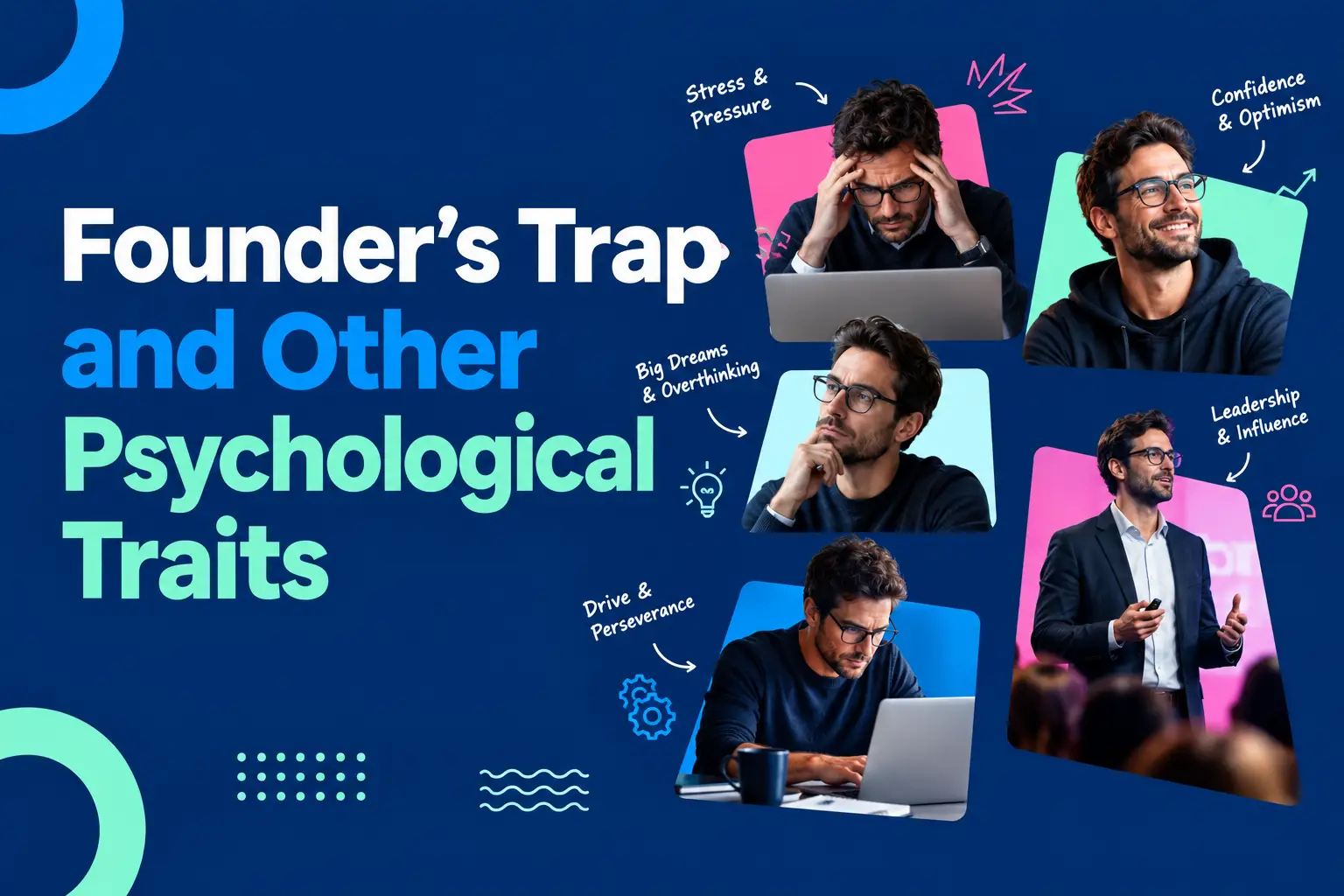
Founders must balance their personal traits to get the best out of themselves for the benefit of the startup, rather than allowing the negative aspects to take over and risk everything. Confidence can become arrogance, independence can become an inability to delegate, creativity can become distraction, persistence can become stubbornness, optimism can become delusion and passion can become blindness. What starts as an advantage can eventually become a serious liability.
This is not about diagnosing founders, as introversion is not a disorder, autism is not a personality flaw, ADHD is not a character defect, narcissistic traits are not the same thing as narcissistic personality disorder. Rather, these are traits, tendencies, conditions and behavioural patterns that can influence how founders think and behave. It helps to understand them and make allowances for them, but also to know when they have crossed into dangerous territory and need to be reined in.
What Research Says About How Founders Think and Behave
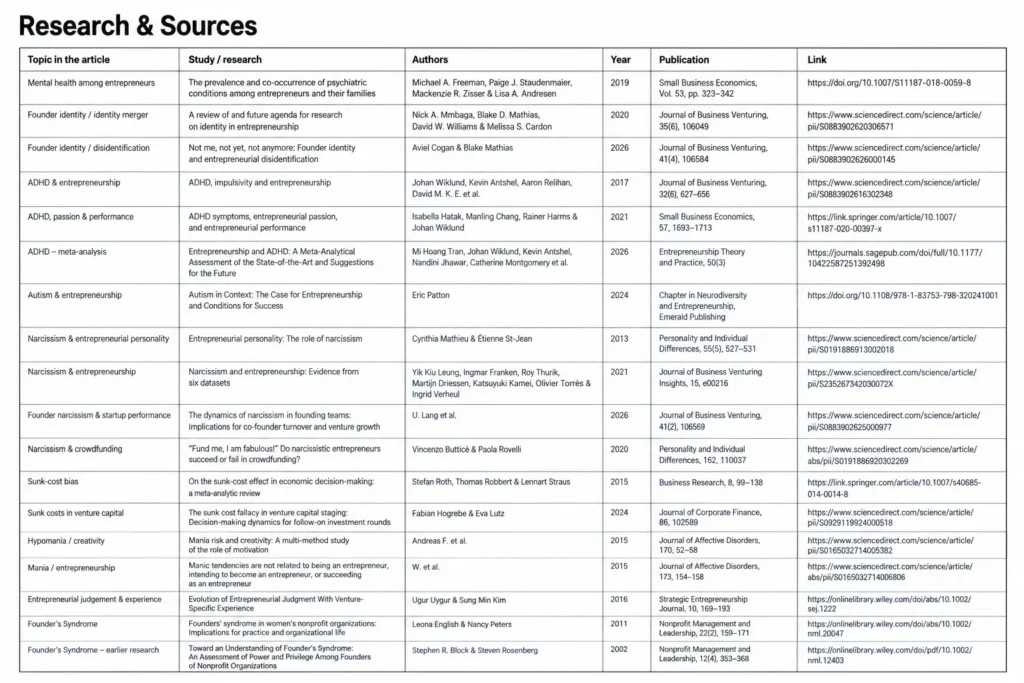
Research into entrepreneurship increasingly recognises that founders are psychologically heterogeneous rather than fitting one standard personality type. A major review of 180 studies by Mmbaga et al. in their 2020 systematic review on entrepreneurial identity found a diverse and rapidly developing research field rather than a single universal “entrepreneur personality.” At the same time, meta-analysis shows that entrepreneurs tend, on average, to display higher openness, conscientiousness and extraversion, alongside lower agreeableness and neuroticism, than managers.
Another study of 242 entrepreneurs by Freeman et al. in their 2019 study is particularly revealing. Researchers found that 72% of the entrepreneurs in their sample were directly or indirectly affected by mental-health differences, including 49% reporting a personal mental-health history. Thirty percent reported depression, 29% ADHD and 11% bipolar disorder; 32% reported two or more conditions. The study has important limitations — it was a self-report sample and should not be treated as representative of all founders — but it demonstrates why founder psychology deserves more serious attention.
The Top 14 Founder Psychological Traits
1. The Founder’s Trap
This is perhaps the most recognisable of all founder traits. The founder built the company, so they know the product better than anyone. They made the first sale, hired the first employee, negotiated the first contract and probably designed the first website. They naturally assume they should remain involved in everything, and that is when the founder’s trap appears, because the founder becomes the bottleneck. Every significant decision requires their approval. For example, marketing needs their sign-off, product needs their sign-off and sales needs their sign-off.
Consequently, people are afraid to make decisions because they know the founder will simply reverse them. The irony is that the founder’s greatest strength — personal involvement — eventually becomes the company’s greatest weakness. The solution is not to become less passionate, but to change the role of the passion. The founder must increasingly own purpose, vision, strategy, capital allocation and culture while allowing functional leaders to run their functions. If you hire a CMO, let them be the CMO. If you hire a CTO, let them be the CTO. If you don’t trust them to make decisions, you either hired the wrong person, or you are getting in the way.
2. Founder-Venture Identity Merger
This is more profound than simple attachment to the business. It happens when the founder stops seeing the company as something they own and starts seeing it as an extension of themselves. The company is no longer theirbusiness; it has merged with them into a single entity. Now that the company is them, a bad quarter becomes personal failure, competitors’ criticism becomes a personal attack, customer rejection becomes evidence that the founder is inadequate, and so on.
Academic research increasingly recognises founder identity as an important dimension of entrepreneurship. Founders can develop powerful identity-based connections with their ventures, influencing decisions, goals and responses to organisational tensions. This is where the founder’s trap becomes emotional rather than organisational. The best defence is psychological separation. Ask yourself: “If I didn’t own this company, what would I advise the CEO to do?” That single question can expose an enormous amount of founder bias.
3. The Introvert Founder
Being an introvert is not a problem in and of itself. In fact, in the emerging age of tech founders with engineering backgrounds, it has become very common. Introverted founders can bring enormous strengths: deep concentration, thoughtful decision-making, listening skills and the ability to work independently. The problem occurs when introversion becomes avoidance. A founder who hates networking may avoid investors. A founder who dislikes public speaking may avoid conferences. A founder who prefers technology to conversation may spend six months improving the product rather than talking to customers. A founder who prefers engineering challenges may avoid front-office demands to the detriment of marketing and sales. A founder who prefers a collegiate environment will avoid conflict and never solve internal issues.
That is dangerous, as entrepreneurship requires communication. The solution is not to become an extrovert, but to build a system around the weakness. Partner with a commercially strong co-founder, hire a salesperson, work with a marketing leader who can create market presence and prepare properly for customer and investor meetings. You don’t have to become someone you’re not; you just need to make sure your personality does not prevent the company from doing what it needs to do.
4. The Neurodivergent Founder — Including ADHD and Autism
This area needs particularly careful treatment. ADHD and autism are not “founder personality types”, and being neurodivergent should not be presented as something that needs fixing. There is, however, growing research into how neurodivergent characteristics can interact with entrepreneurship. ADHD is particularly interesting. A 2026 meta-analysis covering 47 studies and 298 effect sizes found that hyperactivity/impulsivity was positively associated with entrepreneurial attitudes and behaviours, while inattention was negatively associated with post-launch outcomes. Overall ADHD symptoms and diagnosis were positively associated with entrepreneurial behaviour but negatively associated with outcomes. Earlier research found similar complexity. ADHD-related impulsivity and hyperactivity can support entrepreneurial action, while inattention, urgency and difficulty completing repetitive tasks can create problems later.
The answer is not to suppress the strengths but to design the business around the weaknesses. Administrative discipline, financial control, project management, operational routines and follow-through can be delegated or systemised. Autistic founders can similarly bring deep expertise, intense focus and a strong preference for systems and logic. Research into autism and entrepreneurship is still relatively young, but emerging work highlights both entrepreneurship as a potentially good contextual fit and the importance of support networks. Ask yourself: “How do we build an organisation that allows this founder’s strengths to create value without allowing predictable weaknesses to damage the company?”
5. Shiny New Toy Syndrome
This is the founder who wakes up on Monday with one strategy and arrives on Friday with four new ones. New market, product, feature, AI opportunity, partnership, geography and business model. The problem is not a lack of ideas but an inability to distinguish between an interesting idea and a strategically valuable idea. Entrepreneurial personality research consistently associates entrepreneurship with openness and innovativeness. Those are valuable traits, but unrestricted openness can become a distraction. The solution is brutal prioritisation and focus. Every new idea must compete against the current strategy for money, people and attention, and based on those strict criteria, most will lose.
6. Hyper-Autonomy and Control Fixation
Some founders are almost constitutionally independent. They built the business because they didn’t want someone else telling them what to do. Then they hire 50 people and continue behaving as though nobody should tell them what to do. This creates control fixation, as delegation or external investment becomes threatening. The founder believes that nobody can do something better than they can and will never concede control. The organisation becomes overly dependent on one person and not for the right reasons. The answer is to recognise that independence is useful during the early stages of a business, but interdependence is essential at scale. You don’t build a successful company by proving you can do everything. Instead, this is done by creating an organisation where other people can do things exceptionally well.
7. Subclinical Narcissism
This one deserves nuance. Narcissistic Personality Disorder is a clinical diagnosis and must not be casually applied to entrepreneurs. However, narcissistic traits — confidence, status-seeking, self-belief, charisma and a desire to win — can certainly appear in entrepreneurial behaviour. Research has found associations between narcissistic traits and entrepreneurial activity. A study involving 4,798 respondents across three countries found narcissism positively associated with entrepreneurship, particularly in the early stages, and that makes intuitive sense. Someone who believes strongly in themselves may be more willing to tell investors: “I can build this.” The danger comes when confidence becomes an inability to hear criticism.
Recent research on 911 US technology startups found that higher average narcissism within founding teams was associated with greater co-founder turnover and lower venture growth, although diversity in narcissism across the team could mitigate some of the negative effects. The lesson is not to eliminate confidence, but to surround confidence with challenge. Founders need people who can tell them when they’re wrong.
8. Imposter Syndrome
The opposite problem is equally common when founders think: “They are going to find me out.” An example may go like this: A founder has raised money, hired talented people and perhaps built a substantial company, but still feels like they are pretending. Imposter feelings can create extraordinary drive, such as working harder, reading more, obsessive preparation and a refusal to accept mediocrity, but they can also create exhaustion and poor delegation. Burnout can impact the founder and the team around them. The solution is to separate competence from omniscience, because you don’t need to know everything. You need to know what you know, what you don’t know and who knows the things you don’t. Hiring people smarter than you is not evidence that you’re a fraud, but it’s evidence that you’re building a company with ambition.
9. Hypomanic Energy and the “Always On” Founder
Some founders operate at extraordinary intensity. They have endless ideas, get little sleep, talk rapidly, work constantly and make decisions at speed. There can be enormous energy in this state, but we need to distinguish between high energy, entrepreneurial temperament and clinical hypomania. They are not synonymous. Research on bipolar-spectrum and hypomanic traits suggests some overlap with entrepreneurial characteristics such as ambition, optimism, creativity and risk tolerance, but the relationship is complex rather than a simple “bipolar equals successful entrepreneur” story.
The danger is that founders can romanticise instability:
- “I only need four hours’ sleep.”
- “Pressure makes me better.”
- “I’m at my best when everything is on fire.”
Maybe, but companies eventually need sustainable performance rather than repeated adrenaline. If changes in sleep, mood, energy or behaviour become extreme or disruptive, the answer is professional support, not another productivity hack.
10. Optimism Bias and the “Delulu” Founder
Every startup requires optimism because nobody starts a company by calculating that the probability of success is zero. The problem arises when this turns into irrational optimism that cannot be supported by evidence.
Examples of irrational optimism include when a founder believes:
- The deal will close.
- The investor will invest.
- The product will launch next month.
- The customer will renew.
- The market will explode.
- The competitor won’t matter.
- The cash will last.
Unfortunately, when reality contradicts the assumption, the answer is simply to move the assumption. Entrepreneurship research has long identified overconfidence and optimism as important cognitive biases that can affect entrepreneurial decision-making. The solution is not pessimism, but instead a focus on evidence-based optimism. Keep the vision but challenge the assumptions.
11. Planning Fallacy
The planning fallacy is the founder’s tendency to believe that everything will happen faster than it will. The product will launch in three months, the enterprise deal will close in six weeks, the website will be finished next Friday and the international expansion will take three months. It rarely does. Research on entrepreneurial cognition has specifically identified the planning fallacy as a tendency to underestimate the time required to complete projects or overestimate the amount of work that can be achieved in a given period. The solution is simple but uncomfortable: Use evidence from what actually happened. If the last ten enterprise deals took five months, stop forecasting the next one at six weeks because you desperately need it to close.
12. Passion Blindness and Leading from the Gut Gone Wrong
Passion is essential to entrepreneurship, but it can become dangerous when it overrides evidence.
Examples of passion blindness include:
- The founder loves the product, but customers don’t.
- The founder thinks the market is enormous, but the numbers say otherwise.
- The founder believes the new feature will transform the business, but nobody uses it.
Similarly, “gut instinct” can be valuable when it represents accumulated experience. However, gut instinct can also be anxiety, fear, ego or excitement wearing a clever disguise. Before making a major emotional decision, ask: “What evidence would convince me that I am wrong?” If the answer is “nothing”, you aren’t following your gut, as you’re most likely protecting your ego.
13. Sunk Cost and the Founder Who Cannot Let Go
This is where founders can become trapped by their own history. They have spent two years building something, invested £2 million, hired a team, told investors how important it is and publicly defended it, but now the evidence says it isn’t working. So, they invest another £500,000. Then another. This is the sunk-cost fallacy. Research consistently demonstrates that sunk costs can distort economic decisions. More recent research involving over 30,000 venture capital investment decisions found that previous capital investment and monitoring intensity increased the probability of continued investment. The solution is to establish kill criteria before you need them. Decide in advance: “If X hasn’t happened by Y date, we stop.” That makes it much easier to kill an initiative without feeling as though you are admitting personal failure.
14. The Founder Status-Quo Paradox
This one is particularly ironic. The founder built the company to disrupt the status quo. Then the company becomes successful, and suddenly the founder becomes the person defending the status quo. The product that made them successful becomes sacred, the original business model becomes untouchable, new technology is dismissed, competitors are underestimated and customers asking for change are told they don’t understand the vision. The entrepreneur has become the establishment they originally wanted to destroy. The antidote to this is deliberately asking: “If somebody else had built this company today, what would they do differently?” That question can be uncomfortable, but it can also save the company.
The Founder’s Trap is Ultimately Emotional
All these behaviours have one thing in common: they become dangerous when the founder’s psychology takes precedence over the company’s strategy. That is the essence of the founder’s trap.
The founder stops asking:
- “What is best for the company?”
And starts asking:
- “What protects my idea, my reputation, my identity, my investment or my ego?”
That is where business judgement starts to disappear.
A founder can be introverted and successful. ADHD can coexist with exceptional entrepreneurship. An autistic founder can build a brilliant technology company. Confidence can be hugely valuable. Narcissistic traits can provide the self-belief required to start something nobody else believes in. Extreme optimism can sustain a founder through years of rejection. High energy can produce extraordinary execution. Passion can be infectious. None of these characteristics is automatically good or bad. Context determines whether the trait becomes an asset or a liability. The answer isn’t to create a founder without personality, because that would probably make them a terrible founder.
The answer is to build a company that contains the founder’s weaknesses and amplifies their strengths.
The following steps will help a founder avoid any psychological limitations:
- Hire people who challenge you.
- Delegate properly.
- Create decision-making frameworks.
- Use data to challenge instinct.
- Separate personal identity from company performance.
- Set kill criteria before investing.
- Protect sleep and health.
- Create a leadership team capable of telling you when you are wrong.
- Perhaps most importantly, learn to say: “This is my company, but it is not me.”
That last point may be one of the hardest psychological transitions a founder ever makes. It may also be one of the most important.
Lesson:
The best expression for an entrepreneur making emotional decisions is founder’s trap. While this term traditionally refers to a founder’s inability to delegate as a company grows, it is widely used in psychology and venture capital to describe when an entrepreneur’s personal identity is so deeply intertwined with their business that every business choice becomes an emotional, high-stakes reaction.
You may want to read: “Why Startups Must Take Target Data Seriously.”