
Piggyback on Bigger Brands …
Forming strategic partnerships and aligning within ecosystems can be a powerful way to drive growth, enhance credibility and expand your reach. B2B tech startups with limited resources may use partnerships to share expertise, scale more quickly and gain access to target prospects. It’s important to know how you can effectively make the best use of partnerships and the joint marketing strategies that amplify the impact of such relationships. For startups with no brand equity, it can be a significant benefit to collaborate with established businesses whose brands are well-known and respected in the market.
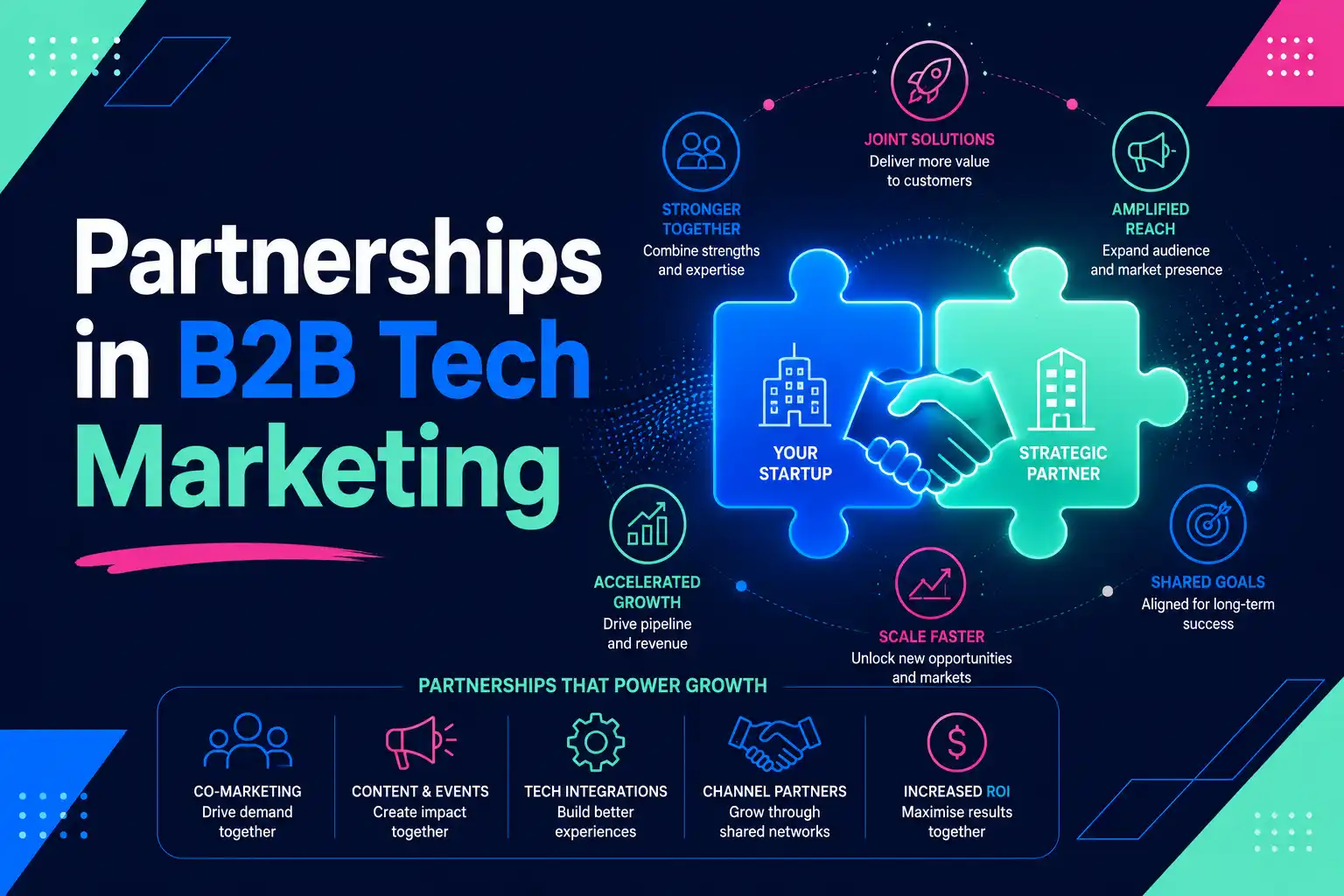
Why Strategic Partnerships Matter
It’s extremely challenging to penetrate new markets and build credibility quickly, but especially for small businesses. Strategic partnerships facilitate collaboration with other businesses, enhancing your offering and providing customers with more comprehensive solutions. For example, a cloud software company might partner with a cybersecurity firm to ensure its clients receive both top-tier software and robust security features. Through such collaborations, you may bundle services that solve broader problems for customers, resulting in a more attractive offering. Aligning with industry leaders sends a strong message to potential clients and investors that your solutions are trustworthy, valuable and may appeal to an existing user base.
Types of Strategic Partnerships for B2B Tech Startups
The tech industry was built on partnerships and still depends on these relationships today. The key thing that has changed is that these corporate connections are now more integrated and seamless than ever, making it much easier for customers to access and benefit from the added value such collaborations offer.
Strategic partnerships in B2B tech can take many forms. Here are some common types:
- Technology Alliances: Companies collaborate to develop or integrate products and services. These alliances often result in bundled solutions that offer greater value to customers.
- Co-Marketing Partnerships: Companies collaborate on joint marketing efforts, sharing resources and audiences. This might involve webinars, exhibitions, joint content creation or combined social media campaigns.
- Reseller Partnerships: A company allows another organisation to resell its products or services, expanding reach without the need for recruiting direct sales teams in new regions or industries.
- Channel Partnerships: Through these partnerships, companies work with third-party distributors or service providers to bring their solutions to market, especially in industries or markets they cannot access on their own.
The Role of Ecosystems in B2B Tech Marketing
Ecosystems are generally created by larger tech companies to enrich the customer experience beyond the standard solution. It provides access to a vast array of technologies that are certified to work with the vendor’s platform but offer granular functionality for specific but aligned activities. They offer a win-win-win relationship between the vendor, partner and the customer. If done well, this results in a multiplier effect, where the customer has so much extra value that they are vested to the platform in a long-term committed relationship.
Ecosystems go beyond one-on-one partnerships as they consist of networks of companies that collaborate to deliver solutions, share knowledge and co-create value for the end user. Tech ecosystems, such as those promoted by major platforms like AWS, Microsoft Azure or Salesforce, have proved critical in the B2B world. They provide startups with an opportunity to integrate their solutions into already established and popular platforms, giving them access to a built-in customer base and additional tools that complement their own products.
For example, tech firms such as Microsoft, AWS and Salesforce have built extensive partner ecosystems where third-party developers can build solutions that extend the core functionality of the platforms. The theory is that by tapping into such ecosystems, B2B tech startups can reach a global audience with less effort, leveraging the platform’s existing trust and reach. This is based on the same principle as exemplified in the consumer world by the Apple App Store and Google Play Store. Smartphone functionality now goes far beyond what was delivered in the box by the manufacturer, thanks to thousands of apps developed to provide specific services.
Marketing Partnerships and Ecosystems
Once partnerships are established, marketing them effectively is key to amplifying their impact. Here’s how your B2B tech startup can leverage partnerships and ecosystems to extend marketing efforts:
- Joint Marketing Campaigns: Collaborate on content that highlights the combined strengths of both partners. Co-branded white papers or webinars can demonstrate how the partnership benefits customers and solves real business challenges.
- Referral Programs: Create a referral program that rewards partners for bringing in new business. This approach incentivises your partner’s sales teams to promote your product.
- Customer Success Stories: Showcase success stories where your partnership has created real value for clients. Highlight how two companies worked together to solve complex problems, as this will help validate the partnership and build trust with potential clients.
- Ecosystem Listings and Certifications: If you’re part of a larger ecosystem, you benefit by making sure your solution is listed on partner directories and marketplaces, such as AWS Marketplace or Microsoft AppSource. Earning certifications from the ecosystem platform (e.g., “Certified Salesforce Partner”) adds an extra layer of credibility.
- Event Co-Sponsorships: Host or sponsor events with your partners, such as virtual summits, trade shows, industry conferences or roundtables. These events can be used to position both companies as thought leaders in the industry and provide a platform for sharing knowledge and generating sales opportunities.
- Social Proof: Partnerships with well-known companies can give your startup the ability to use social proof in your marketing. Displaying partner logos on your website or referencing them in customer communications can help build trust quickly and show that your company is part of a broader, trusted network.
Measuring the Impact of Partnerships
To make sure that partnerships are delivering value, it’s helpful to track performance. B2B tech startups must use Key Performance Indicators (KPIs) to measure the effectiveness of marketing activity, and some of the same metrics can be used to evaluate your partnerships.
Here are the main ones:
- Lead Generation: Track the number of leads generated through joint marketing efforts and partner referrals.
- Brand Awareness: Evaluate how co-branded content and events contribute to brand visibility, web traffic and social media engagement.
- Pipeline Contribution and Acceleration: Determine how partnerships help increase the sales pipeline and accelerate the sales cycle by providing customers with a more comprehensive solution.
- Revenue Growth: Measure the impact of partnerships on overall sales growth and the average deal size, especially for deals influenced by the partnership.
- Customer Acquisition Costs (CAC): Partnerships should ideally lower CAC by allowing you to tap into new opportunities and customer bases with shared resources.
Building Long-Term Value
While partnerships can bring immediate results, the real power lies in long-term collaboration. Successful B2B tech partnerships should evolve over time, with both companies investing in the relationship and continuously finding new ways to create value. Nurturing these relationships by regularly revisiting shared goals, evaluating mutual performance and exploring new opportunities for collaboration will help build trust and improve results. Building a strong reputation within a tech ecosystem could attract additional partnerships down the line. Partnership can create a virtuous cycle where collaboration leads to greater visibility, resulting in new partners and opportunities.
You may want to read: “How to Define Your Target Market.”