People Buy What They See, Understand and Connect With …
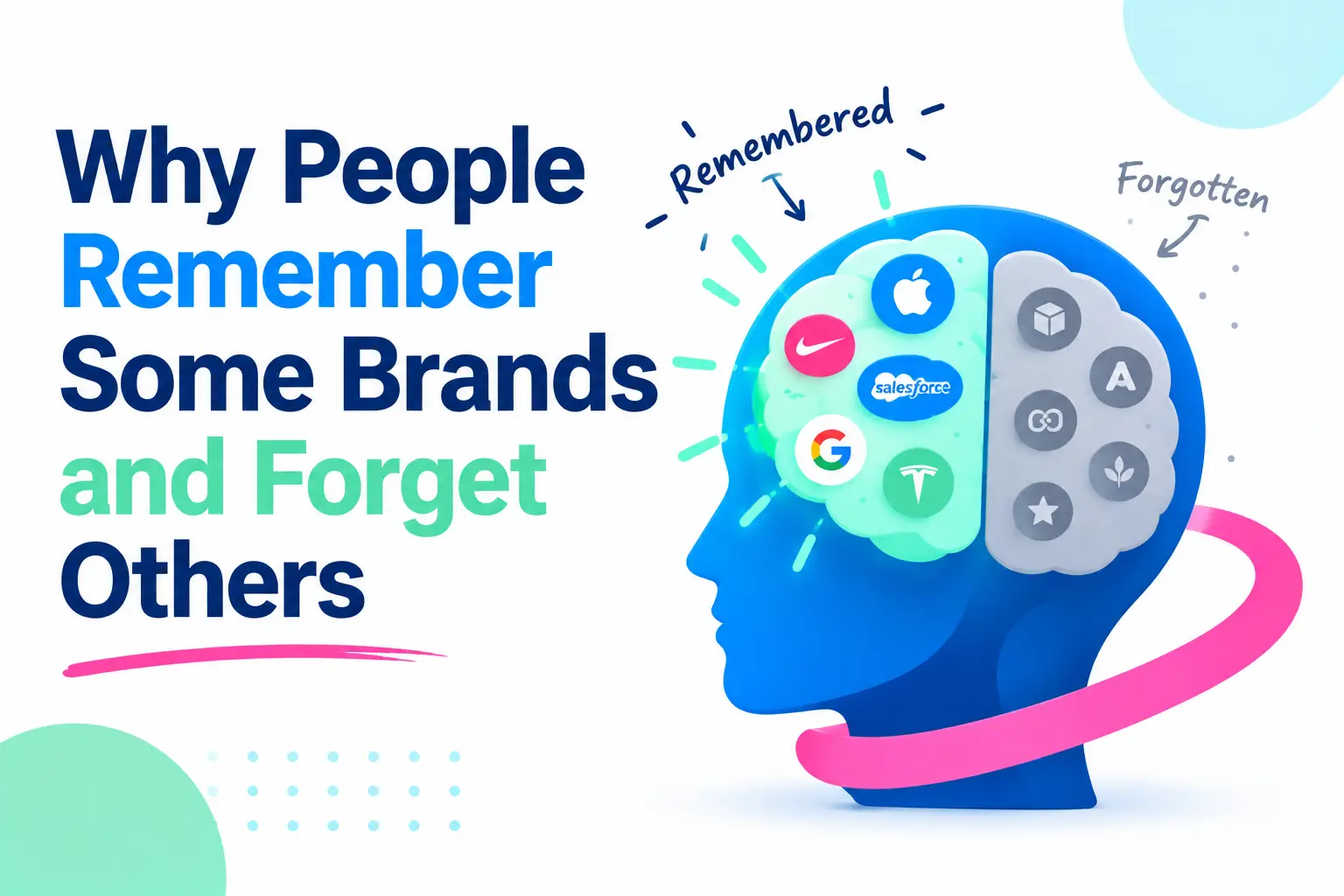
Some tech brands seem to stick in your mind almost effortlessly. You see a colour, hear a phrase, recognise a visual device or encounter a particular idea and immediately know which company it belongs to. Other brands can spend thousands on advertising, publish endless content and launch clever campaigns, yet still struggle to become recognisable. Why is that? The difference is rarely simply that one company has a better logo, a bigger advertising budget or a more sophisticated product. Memorable brands make it easier for people to recognise, understand and recall them when a relevant need eventually arises. For technology startups, this matters enormously, because building awareness is not just about generating leads today.
Are Your Prospects Available?
Small businesses must create enough mental availability that when a potential customer eventually enters the market, your company is one of the brands they remember. That is particularly important in B2B technology, where buying cycles for large solutions can be long and complex.
People Don’t Remember Everything
Our brains are constantly filtering information from the constant bombardment. Every day, your customers encounter websites, LinkedIn posts, emails, adverts, podcasts, sales messages, product announcements, webinars and countless other communications. A tech startup cannot realistically expect its audience to remember everything it publishes. The objective therefore shouldn’t be to communicate more. It should be to communicate more memorably. This is where simplicity becomes important.
A startup might describe itself as: “An AI-powered, next-generation, end-to-end intelligent platform enabling businesses to transform their digital operations.” It sounds impressive, but what is somebody supposed to remember from this word salad?
Compare that with a much simpler proposition: “We help manufacturers prevent cyber attacks from disrupting production.”
The second statement gives the audience something concrete to associate with the company. The lesson isn’t that every startup needs a five-word slogan. What we must recognise is that clarity creates something the brain can attach to the brand.
Repetition Builds Memory
One of the biggest mistakes startups make is constantly changing their message. A new campaign launches and the positioning changes. A new salesperson joins and describes the product differently. The website is rewritten every 30 days. A new marketing agency then puts their own slant on it and introduces a new tagline. Then the company decides it needs to “freshen things up” six months later. The result can be a stream of perfectly reasonable messages that never have enough time to become associated with the brand. Your messaging must be meaningful and memorable, and to achieve that it must also be consistent.
Repetition does not necessarily mean showing somebody exactly the same advert forever. It means repeatedly reinforcing the same underlying idea. If your startup wants to become known for helping businesses solve a particular problem, that problem should appear consistently across your website, social content, presentations, advertising, sales material and customer stories. In this way and over time, the association becomes stronger.
Research from the Ehrenberg-Bass Institute emphasises the importance of distinctive brand assets — elements such as colours, logos, imagery, characters and other recognisable devices that can help people identify a brand. Crucially, these assets need to become both distinctive and associated with the brand through repeated exposure. For a startup, that means consistency isn’t boring. In fact, it’s essential and consistency is an investment in recognition.
Emotion Still Matters in B2B Technology
Technology companies sometimes assume that B2B buyers make purely rational decisions. They don’t and never have done. Of course, technical capability, security, functionality, integration, price and ROI matter. However, it’s people who make decisions, and people respond to emotion, confidence, risk, trust and perceived relevance. Many businesses still don’t understand that selling to other businesses is selling P2P (person-to-person).
Think about the difference between saying: “Our platform uses advanced machine-learning algorithms to analyse operational data.” And compare this to: “Know what’s going wrong before your production line stops.”
The underlying technology might be identical. The second message connects the technology to something the customer cares about. This is particularly important for startups because they often lack the reputation and recognition enjoyed by established competitors. A technically impressive product does not automatically create a memorable brand.
Your marketing needs to answer a simple question: Why should someone care?
Distinctiveness Is More Than Having a Nice Logo
A common misconception is that brand differentiation means creating a better-looking visual identity. Visual identity certainly matters, but distinctiveness goes much further.
Your brand can become recognisable through a combination of:
- A consistent colour palette
- A distinctive visual style
- A recognisable tone of voice
- Repeated phrases or concepts
- A particular point of view
- A memorable founder perspective
- A recognisable way of explaining complex subjects
- Consistent content themes
- Unique customer stories
- Distinctive advertising or creative devices
Over time, these elements can become mental shortcuts. The Ehrenberg-Bass Institute describes distinctive assets as non-brand-name elements that can uniquely signal a brand. Its research also stresses that simply using an asset isn’t enough: marketers need to build its association with the brand over time. The purpose is not to invent something revolutionary, but to own a recognisable territory.
Stop Trying to Say Everything
Tech startups frequently suffer from the “everything platform” problem. Their website attempts to explain every feature, every integration, every technical capability and every possible use case. The result can be impressive technically but forgettable commercially. Your audience doesn’t necessarily need to understand everything you do the very first time they see you. What they need is a reason to remember you.
That reason might be something like:
- The cybersecurity company that understands both IT and OT.
- The analytics platform that helps SaaS companies predict churn.
- The technology partner that makes complex cloud infrastructure easier to manage.
- The AI platform that helps sales teams identify their highest-value opportunities.
These statements aren’t necessarily complete descriptions of the businesses. They are memory anchors. Once somebody remembers the anchor, you have somewhere to build from.
The 95% Problem for B2B Tech Startups
Research published by LinkedIn’s B2B Institute, drawing on Ehrenberg-Bass research, popularised the “95-5” concept: roughly 95% of potential B2B buyers are not actively in the market for a particular category at any given time, while around 5% are actively buying. The precise ratio varies between categories, but the broader point is important: most potential customers aren’t ready to buy today.
That creates a problem for startups that measure marketing almost exclusively through immediate leads. If somebody doesn’t need your product today, asking them to book a demo is unlikely to be the most useful interaction. However, that person could need your product in six months, next year, when their existing supplier fails or when their business reaches a new stage of growth. The job of marketing is partly to ensure that when the buying situation eventually occurs, your brand is available in their memory. LinkedIn’s B2B Institute describes this as building mental availability — making a brand easier to recall in relevant buying situations. For a startup trying to scale, this must be a marketing priority.
Make Your Brand Easy to Find AND Easy to Remember
Awareness alone isn’t enough. A potential customer might have heard your company name but have no idea what you do. Alternatively, they might understand what you do but have no reason to remember you. Strong startup marketing needs both.
The purpose of brand awareness is to create the following impression with target customers:
- Recognition: “I’ve heard of them.”
- Association: “They’re the company that does X.”
- Relevance: “That’s something I might need.”
- Confidence: “They look credible enough to investigate.”
This becomes particularly important when buyers start researching. Google’s research into the “messy middle” of the customer journey found that people move between exploration and evaluation rather than following a simple linear path. They search, compare, review, reconsider and gather information before making decisions. Your startup needs to be recognisable before the buyer reaches that stage — and useful once they get there.
Build Messaging Around Problems, Not Just Technology
One of the simplest changes a technology startup can make is to stop leading every conversation with its technology, which most business buyers find boring because it puts you first. Instead, put the customer first by starting with their problem.
Don’t just say: “Our platform uses AI.” Ask: “What does the AI help the customer achieve?”
Don’t just say: “We provide cloud-native infrastructure.” Ask: “What business problem does better cloud infrastructure solve?”
Don’t just say: “Our software provides real-time analytics.” Ask: “What decision can the customer make faster or better because of it?”
Technology is often the mechanism. The outcome is the message.
That doesn’t mean hiding technical differentiation. It means putting technical capability into a context that matters to the buyer.
Five Questions Every Tech Startup Must Ask
Before publishing your next campaign, website update or major content programme, ask the following:
1. What do we want to be known for?
If your audience could remember only one thing about your company, what should it be?
2. Is our message simple enough to repeat?
If different people in your company describe the business in completely different ways, your market is likely to struggle to understand it.
3. What problem do we own?
Find the customer problem, situation or category where you want your brand to become associated.
4. What makes us recognisable?
Consider your colours, imagery, language, creative style, content themes and distinctive ideas. Build consistency rather than constantly reinventing them.
5. Are we marketing only to people who are ready to buy?
If every communication says, “Book a demo”, you may be ignoring the much larger audience that isn’t ready yet.
The Goal Is Mental Availability
A startup doesn’t become memorable because somebody sees one brilliant LinkedIn post. Memory is built through accumulated exposure. It comes from seeing the same company repeatedly, hearing consistent ideas, encountering recognisable visual cues and repeatedly connecting that brand with a particular problem or opportunity. That is why brand building must never be treated as something startups do after they have achieved scale. It is one of the things that helps create scale.
The strongest startup brands don’t necessarily shout the loudest. Instead, they make themselves easier to recognise and easier to understand. They say something meaningful and they say it consistently. They give people a reason to care, and they keep showing up long enough for the association to stick. For a growing technology company, the objective of marketing is not simply to generate attention today, but to build enough awareness and memory that your brand is still there when tomorrow’s customers are ready to buy.
Lesson:
Google’s research reinforces the importance of maintaining brand presence while customers explore and evaluate their options, rather than treating marketing as something that begins only when a buyer is ready to purchase. If your audience cannot remember what your startup stands for, it becomes much harder for them to remember you when it matters.
You may want to read: “Top 8 Messaging Habits Every Marketer Must Embrace.”