How to Build a Go-To-Market Strategy for a B2B Tech Startup …
This is a step-by-Step Guide for B2B tech Marketers. A great technology product is not a go-to-market (GTM) strategy, and neither is a sales plan, a marketing campaign or a list of potential customers. For a young B2B tech startup, a GTM strategy is the commercial blueprint that connects the product to a defined market, establishes why customers should buy it, determines how the business will reach them and sets out how it will convert demand into sustainable revenue. Getting this right is critical.
A startup can have outstanding technology and still struggle because it targets the wrong customers, communicates the wrong value proposition, chooses ineffective channels or expects sales to happen without sufficient marketing investment – a common problem. The challenge is that many tech founders are experts in their technology, industry or business model but have limited direct experience of marketing and sales. They may have strong opinions about what customers want, how the product should be positioned or which channels will generate sales. Some of those opinions will be valuable. Others will be assumptions that need to be challenged and tested. This is where professional marketing leadership becomes essential.

GTM Strategy Creation Requires Different Skills
Founders provide the vision, commercial ambition, product knowledge and access to the market. Marketing provides the expertise, research, strategic framework and processes needed to turn that vision into a credible, measurable GTM strategy. Sales, product and customer success must then contribute their own expertise to make the strategy work.
Step-By-Step Guide to Building Your GTM Strategy
This guide explains how to build your strategy step by step. This includes who will be responsible for each activity, how much founder involvement is required and how to measure, communicate and improve performance over time.
1. Establish the Business Objectives Before Choosing Marketing Tactics
The first step is to determine what your startup needs to achieve commercially.
Examples of an immediate objective could be to:
- Validate product-market fit
- Acquire the first ten customers
- Enter a new industry
- Launch a new product
- Build recurring revenue or scale an established sales operation
These objectives require different GTM approaches. A startup validating an early product may need founder-led sales, customer interviews and a small number of carefully selected pilot customers. A more established SaaS business may need repeatable demand generation, channel partnerships, sales development and a more sophisticated revenue operations function.
Marketing must translate a company’s commercial ambitions into measurable objectives, including:
- Target revenue or annual recurring revenue (ARR).
- Number and type of customers required.
- Target markets and launch priorities.
- Required sales pipeline.
- Acceptable customer acquisition cost (CAC).
- Available marketing and sales resources.
- Expected time to achieve results.
- Customer retention and expansion objectives.
These targets must be realistic. If a startup wants to generate £1 million in new ARR, for example, the team needs to understand its expected contract value, win rate, sales cycle and available capacity before determining how much pipeline and demand generation are required.
Responsibilities:
- Founder/CEO: Sets the company’s ambition, approves priorities and provides the financial and strategic context.
- Marketing: Leads the commercial planning process and translates business objectives into marketing and demand requirements.
- Sales: Contributes sales-cycle assumptions, pipeline data, conversion rates and revenue forecasts.
- Finance: Validates budgets, margins, cash constraints and commercial assumptions where that function exists.
Founder Involvement: High
Founders must own the business objectives but shouldn’t dictate marketing targets without understanding what the numbers imply. Marketing professionals need to explain the relationship between investment, demand, pipeline, conversion and revenue so that targets are grounded in commercial reality.
2. Research the Market and Define the Opportunity
Before deciding how to sell the product, establish whether the target market represents a sufficiently attractive opportunity. Marketing must research the true market opportunity based on the serviceable obtainable market (SOM), by defining factors such as size, growth, competitive intensity, customer behaviour, existing alternatives, buying triggers and unmet needs. This involves more than copying figures from a market research report. The important question is not simply how large the market is. It is which part of that market your startup can realistically win (SOM), and why customers would choose you over the alternatives.
Research must include:
- Customer interviews and discovery conversations.
- Competitor positioning, pricing and messaging.
- Customer reviews of competing products.
- Industry trends and regulatory developments.
- Existing approaches customers use to solve the problem.
- Buying processes and procurement requirements.
- Evidence of willingness to pay.
- Market segments that are underserved or poorly served.
For B2B technology, the competitive set includes more than direct competitors. It also includes internal development, existing software, manual processes and the option of doing nothing. Marketing must turn this research into a clear market assessment and a set of testable hypotheses.
Responsibilities:
- Founder/CEO: Shares industry knowledge, existing relationships and insight into the product’s origins.
- Marketing: Leads research, competitive analysis and market segmentation.
- Sales and customer-facing teams: Contribute objections, buying patterns and feedback from real conversations.
- Product: Assesses the feasibility of meeting the identified needs.
Founder Involvement: Very high
Founders often possess valuable industry knowledge, but their experience may be concentrated in a narrow group of customers. Marketing must distinguish evidence from anecdote and test the founder’s beliefs against a broader range of buyers.
3. Define the Ideal Customer Profile and Buying Committee
The Ideal Customer Profile (ICP) describes the organisations most likely to need, buy and benefit from your solution. It must specify factors such as industry, company size, geography, technology environment, business maturity, operational challenges and buying triggers. Marketing can then map the buying committee: the people who use, evaluate, approve and pay for the solution.
For example, a cybersecurity startup might sell to a security leader, but the technical team, IT leadership, finance, procurement and executive management may all influence the purchase. Each stakeholder has different concerns. The security team might care about detection capabilities, while the CFO wants to understand risk reduction, cost and return on investment. The output should be a practical ICP document, buyer-persona framework and prioritised list of target segments.
Responsibilities:
- Founder/CEO: Contributes knowledge of the strongest potential customers and strategic market priorities.
- Marketing: Owns ICP development, segmentation and buyer-persona research.
- Sales: Validates the profile against actual buying behaviour and deal outcomes.
- Product: Confirms which segments the product can serve effectively.
Founder Involvement: High
Founders need to help identify promising markets, but marketing should challenge the assumption that everyone who could use the product is an equally attractive customer. Focus is essential when resources are limited.
4. Establish Positioning, Differentiation and the Messaging Architecture
Once the target market is understood, marketing needs to establish how the startup should be positioned within it. Positioning explains where the product fits in the market, which problem it solves and why customers should consider it. If you can’t make the customer care, then you don’t have a commercially viable proposition. The messaging architecture turns your positioning into a consistent set of messages that can be used across the website, campaigns, sales presentations, demonstrations and customer conversations. There must always be consistency in what you say across all media formats and channels.
Marketing then creates:
- A clear value proposition.
- Core messaging for each priority audience.
- Differentiators against competitors and alternatives.
- Business benefits linked to product capabilities.
- Evidence supporting claims, including customer outcomes.
- Persona-specific messages for different stakeholders.
- Objection-handling messages.
- A consistent company narrative.
The distinction between features and value is particularly important in technology marketing. A founder might describe a product in terms of its architecture or technical sophistication, often spending more time describing how it works rather than focusing on the outcome itself. Marketing needs to explain why those capabilities matter commercially. For example, rather than leading with an AI-powered analytics engine, the messaging might emphasise how the solution helps finance teams identify waste, make faster decisions or improve forecasting.
Responsibilities:
- Founder/CEO: Explains the original vision, product capabilities and genuine differentiators.
- Marketing: Leads positioning, messaging research, message development and validation.
- Sales: Tests messages in customer conversations and reports objections.
- Product: Ensures claims accurately represent the product and its capabilities.
Founder Involvement: Very High initially, then Moderate once agreed
Founders must contribute to the strategic narrative but shouldn’t have unrestricted control over the wording. When founders get involved in the details, they tend to make the messaging worse, not better. Marketing professionals must be able to challenge assumptions, test alternative propositions and use customer evidence to improve the message. Once the positioning is agreed, future refinements can be based on meaningful evidence rather than personal preference.
5. Choose the Right Route to Market
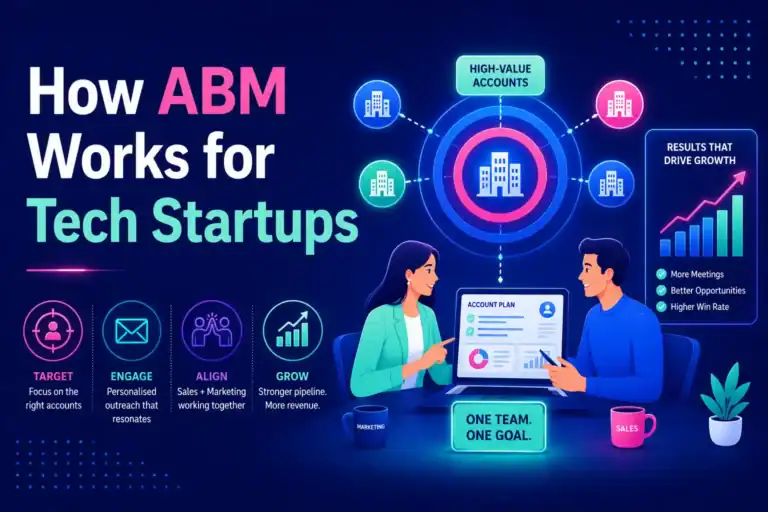
A GTM strategy must establish how the startup will reach, engage and convert its intended customers. Possible routes include direct sales, inbound marketing, outbound prospecting, product-led growth (PLG), channel partnerships, resellers, marketplaces and account-based marketing (ABM). The right choice depends on factors such as product complexity, contract value, buyer behaviour, implementation requirements and sales-cycle length.
For example, a relatively inexpensive SaaS product that business customers can adopt independently may benefit from a self-service model. A cybersecurity platform requiring technical evaluation, procurement approval and integration may need a more consultative sales approach.
Some startups will combine models. A free product may generate adoption while sales teams convert larger organisations into enterprise contracts. Marketing needs to recommend a route-to-market model based on customer research, commercial economics and the company’s resources. You must also establish which channels deserve priority rather than spreading the budget across every available option.
Responsibilities:
- Founder/CEO: Approves strategic priorities and provides access to relevant partners or customers.
- Marketing: Evaluates acquisition channels, demand generation opportunities and channel economics.
- Sales: Defines the appropriate sales motion and customer engagement process.
- Product: Ensures the product supports the intended adoption and purchasing model.
Founder Involvement: High
Founders must understand the trade-offs between different routes to market. They should not, however, insist on a channel simply because a competitor uses it or because they personally prefer it. Marketing must be able to explain why a channel suits the target audience, what it’s likely to cost and how its performance will be evaluated.
6. Develop the Commercial Plan and Customer Journey
A GTM strategy needs to describe what happens between the first customer interaction and a successful, retained customer. Marketing must map the buyer journey, including awareness, consideration, evaluation, purchase, onboarding and expansion. These stages are not always linear, particularly in B2B markets where several stakeholders may be involved.
The commercial plan identifies:
- Priority marketing campaigns and activities.
- Content required at each buying stage.
- Sales development and qualification processes.
- Demonstrations, trials or proof-of-concept requirements.
- Pricing and packaging considerations.
- Sales enablement materials.
- Onboarding and customer success processes.
- Responsibilities and handoffs between teams.
Marketing works closely with sales to ensure that prospects receive consistent messaging and appropriate information throughout their journey. The output should be an actionable plan with owners, deadlines, dependencies, budgets and measurable outcomes.
Responsibilities:
- Founder/CEO: Resolves strategic conflicts and ensures teams have the resources and authority to execute.
- Marketing: Develops the marketing plan, campaigns, content and customer-facing assets.
- Sales: Defines the sales stages, qualification criteria, demonstrations and closing process.
- Product and customer success: Support evaluation, implementation, adoption and retention.
Founder Involvement: High during planning, Moderate during execution
Founders ensure that the different functions work together, but should avoid becoming the central approval point or bottleneck for every activity. A GTM strategy will struggle to scale if routine decisions continually wait for the founder.
7. Resource the Strategy and Establish the Operating Model
A strategy is only useful if the business can execute it. Marketing needs to translate the GTM plan into a realistic resource model covering people, budget, technology, external expertise and time. This includes identifying the capabilities required for research, product marketing, content, demand generation, marketing operations, sales enablement and measurement. One person may cover several of these in an early-stage startup, but the responsibilities still need to be understood.
The team must also establish:
- A documented GTM strategy.
- A quarterly execution roadmap.
- A campaign calendar.
- A budget and resource allocation.
- Clear ownership for each activity.
- A CRM and reporting framework.
- A regular cross-functional review meeting.
- A process for recording decisions and assumptions.
Responsibilities:
- Founder/CEO: Approves investment, prioritises resources and removes organisational obstacles.
- Marketing: Owns the marketing plan, resourcing recommendations and execution framework.
- Sales: Confirms sales capacity and pipeline requirements.
- Finance and operations: Support budgets, forecasting and operational planning.
Founder Involvement: High
This is where founders must recognise that marketing is an investment in commercial growth, not a cost to be minimised. Marketing professionals need to explain what can realistically be achieved with the available resources, what additional investment would enable and what risks arise from underfunding the strategy.
8. Launch, Learn and Validate the GTM Strategy
A startup must not assume that the first version of its strategy will be correct or that things won’t change. The initial launch should be treated as a structured learning exercise. Start with the most promising customer segment, test the messaging and route to market, observe buying behaviour and assess whether the product delivers the expected value.
Marketing will establish a set of hypotheses to test. For example:
- Does this ICP recognise the problem?
- Does the value proposition resonate?
- Which channels generate meaningful engagement?
- Are prospects willing to pay the proposed price?
- Can sales convert qualified opportunities?
- Do customers adopt and retain the product?
A pilot or controlled launch can help answer these questions before the business commits heavily to scaling.
Responsibilities:
- Founder/CEO: Engages with important customers, makes strategic decisions and supports the learning process.
- Marketing: Runs campaigns, gathers market feedback and measures demand.
- Sales: Tests the sales motion and records customer objections and conversion outcomes.
- Product: Responds to product feedback and adoption issues.
Founder Involvement: High
Founders need to remain close to the market, particularly in the early stages. However, marketing must distinguish between individual opinions and repeatable patterns. One enthusiastic prospect does not establish product-market fit, just as one rejected deal does not necessarily invalidate the strategy.
9. Establish Performance Measurement and Reporting
A GTM strategy needs a measurement framework that connects marketing activity to commercial outcomes. Without one, the business risks rewarding activity rather than progress. Marketing must establish a baseline before launching major initiatives and agree on a manageable set of KPIs with the founder and sales leadership.
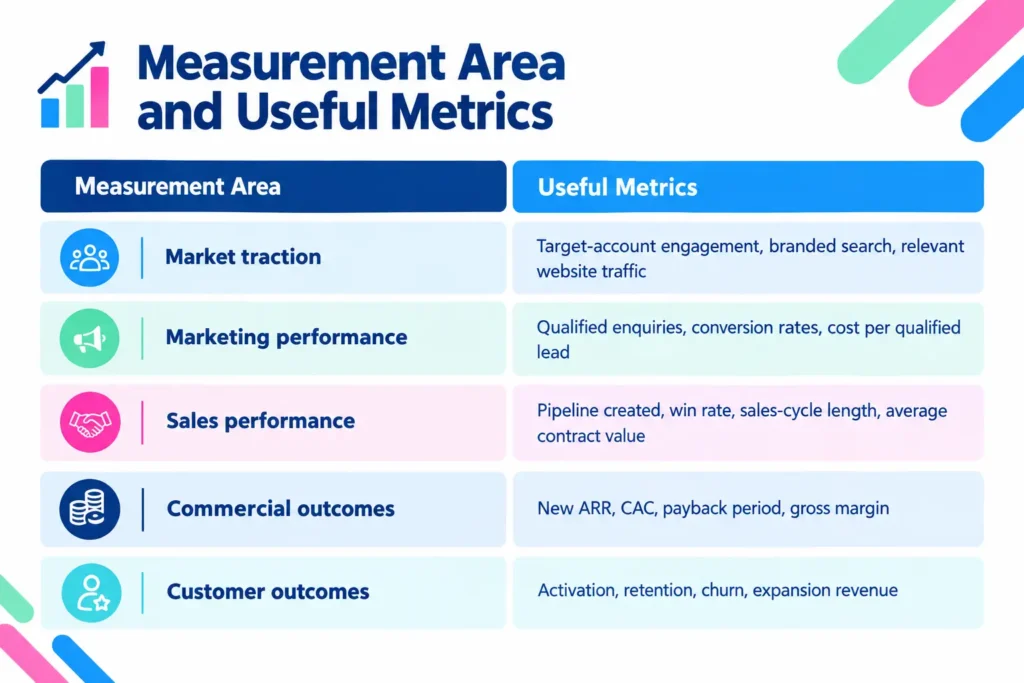
The metrics must fit the company’s stage. An early startup may need to prioritise evidence of customer demand, willingness to pay and successful product adoption. A more established business should place greater emphasis on predictable pipeline, acquisition economics and revenue growth. Marketing must also distinguish between leading indicators and lagging indicators. Engagement and qualified conversations may provide early evidence of progress, while revenue and retention often take longer to materialise. Attribution requires care, too. A customer may encounter an article, attend a webinar, receive an outbound email and speak to a partner before purchasing. No single interaction necessarily deserves all the credit.
Responsibilities:
- Founder/CEO: Reviews performance against business objectives and makes investment decisions.
- Marketing: Defines marketing KPIs, maintains campaign reporting and interprets performance.
- Sales: Provides reliable pipeline, conversion and revenue data.
- Finance/Operations: Validates commercial metrics and financial assumptions.
Founder Involvement: High
Founders must challenge the interpretation of the data, not just the numbers themselves. If lead volume increases but qualified pipeline doesn’t, the team needs to understand why. If pipeline grows but deals don’t close, the problem might be positioning, qualification, pricing or sales execution. Reporting should lead to decisions, not simply describe what happened.
10. Establish a Monthly and Quarterly Review Process
The GTM strategy should be reviewed continuously, with different levels of review for operational performance and strategic direction.
Monthly Review: What’s happening and what needs fixing?
Marketing needs to prepare a concise monthly report that includes:
- Executive Summary: What changed, what matters and what decisions are needed?
- Performance Against Targets: Actual results versus plan, including significant variances.
- Funnel Performance: Where prospects are entering, progressing or dropping out.
- Campaign Performance: Which activities are generating meaningful engagement and qualified demand?
- Sales Feedback: What objections, competitor activity and buying patterns are emerging?
- Experiments and Learning: What has been tested and what has been learned?
- Next Month’s Priorities: What will change, who owns it and what outcome is expected?
A useful report doesn’t bury the founder in dashboards. It explains the commercial implications of the data and highlights the actions required. For example, rather than reporting that a campaign generated 200 leads, marketing might explain that it generated 30 ICP-qualified opportunities, that conversion into sales meetings is below target and that the next experiment will focus on audience selection and qualification.
Quarterly Review: Is the strategy still right?
Quarterly reviews should examine the broader GTM strategy, not just campaign results.
Marketing and leadership must assess:
- Whether the ICP remains attractive.
- Whether positioning is resonating.
- Which routes to market are working.
- Whether acquisition economics are sustainable.
- Whether pipeline supports revenue targets.
- Whether product adoption and retention support growth.
- Whether competitors or market conditions have changed.
- Whether budgets, people or priorities need to change.
The team can then agree on the next quarter’s priorities, resource allocation and experiments.
Responsibilities:
- Founder/CEO: Chairs or sponsors strategic reviews, makes decisions and resolves competing priorities.
- Marketing: Produces the reports, interprets the evidence and recommends adjustments.
- Sales: Explains pipeline quality, conversion trends and market feedback.
- Product and Customer Success: Contribute evidence about product performance, adoption and retention.
Founder Involvement: High
Founders must insist on honest reporting and clear accountability but avoid turning monthly reviews into interrogations of individual campaigns. The purpose is to understand the commercial system, identify constraints and agree on corrective action.
11. Iterate the Strategy as the Business Learns
A GTM strategy is a set of informed decisions and hypotheses, not a permanent declaration of how the business must operate. The team should maintain a record of its most important assumptions, the evidence supporting them, the confidence level and the next action required to validate them. For example, if a startup believes mid-market companies will buy directly but customer conversations repeatedly reveal a preference for implementation partners, the route to market may need to change.
If one industry produces higher conversion and retention, marketing may recommend concentrating resources there. If prospects consistently misunderstand the product, the messaging or positioning may need revision. Not every disappointing result justifies a strategic pivot. The team must distinguish between a poor campaign, an execution problem, insufficient data and a genuine flaw in the underlying strategy.
Responsibilities:
- Founder/CEO: Approves material strategic changes and supports the resources required to implement them.
- Marketing: Identifies patterns, proposes experiments and recommends changes.
- Sales and Product: Supply customer evidence and assess the implications of changes.
Founder Involvement: Medium–High
Founders must allow marketing professionals to make tactical adjustments without requiring approval for every change. Equally, marketing should not hide material changes to the ICP, positioning or commercial model. Strategic decisions need shared understanding and explicit agreement.
Lesson:
A GTM strategy is the bridge between your solution and the market. You must take time to consider all aspects of the strategy and ensure its fit-for-purpose by having the right people on the team. Some information gaps will be filled by educated assumptions that will be confirmed or denied when executing the strategy and reviewing the data. That’s when adjustments can be applied to make the strategy more robust and battle-hardened with market evidence.
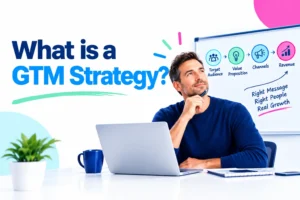
You may want to read: “What is a GTM Strategy?”