Leadership in a Tech Startup …
Leadership is one of the biggest determinants of whether a technology startup becomes a scalable business or remains a collection of talented people trying to keep up with its founder. That may sound harsh, but there is an important distinction between being the person who started a company and being the leader the company needs as it grows. Founders often begin with enormous energy, conviction and personal involvement. They make decisions quickly, know every customer, understand the technology and can probably tell you what almost everyone in the company is working on. This level of detail and involvement can be a huge advantage in the early days, but it can also become a significant liability.
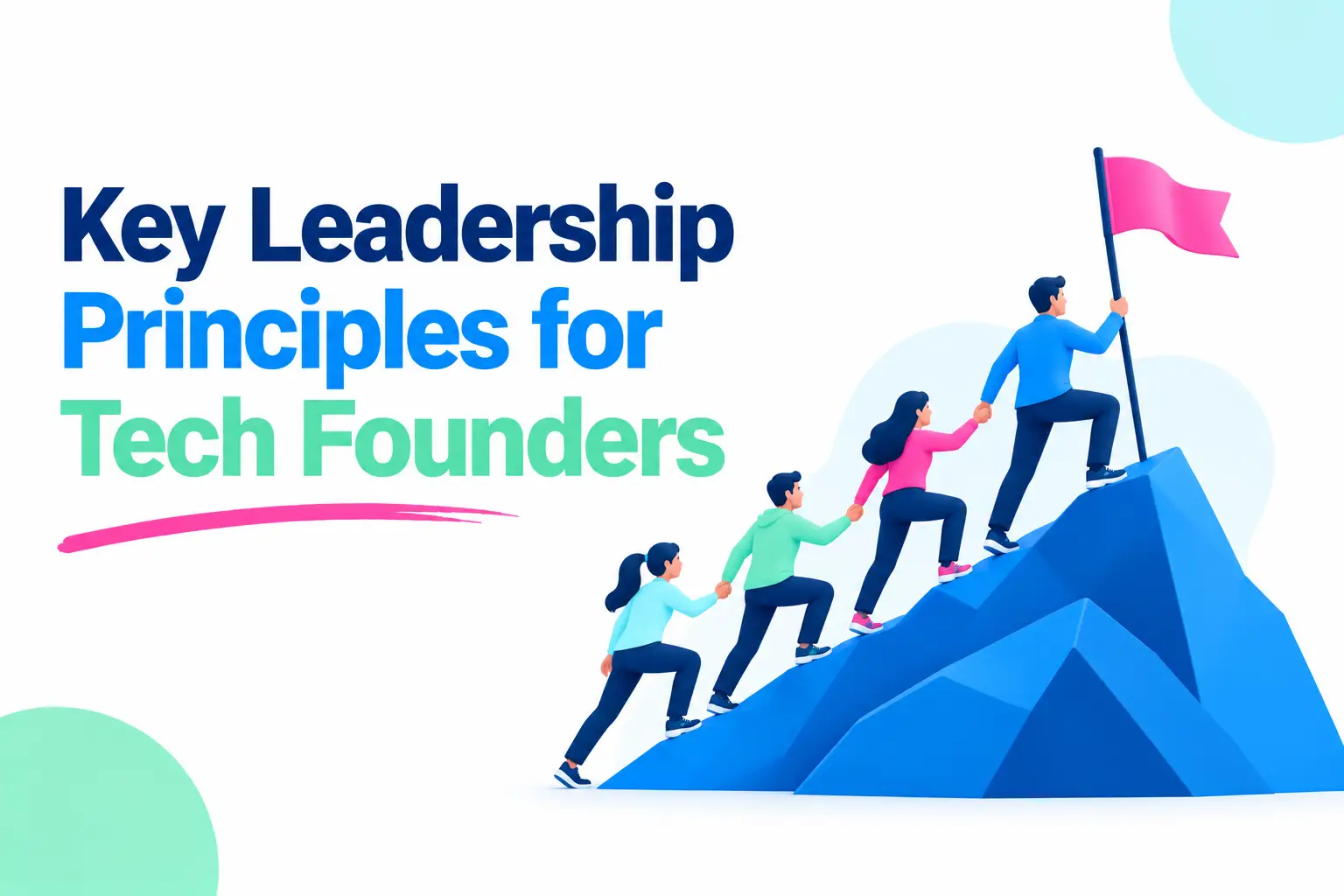
The Founder Sets the Leadership Standard
As a startup grows, the founder’s personality, behaviour, emotional responses and working habits increasingly inform the company’s culture. Employees watch what the founder does, not just what they say. If the founder remains calm under pressure, then people learn to be calm. If the founder blames people when things go wrong, blame becomes part of the culture. If the founder trusts people to make decisions, people become more confident. If every decision comes back to the founder, the organisation becomes dependent on them. Good startup leadership does not require you to have all the answers, but to create an organisation capable of finding the answers without you.
Here are 10 Key Leadership Principles
1. Control yourself before you try to control the business
A founder’s personality has an enormous influence on the working environment. That doesn’t mean founders need to become emotionless corporate robots. Passion, excitement, frustration and urgency are perfectly normal and certainly common. The problem comes when emotion controls behaviour. A founder who explodes when something goes wrong, sends angry messages late at night, publicly criticises employees or changes direction dramatically depending on their mood creates uncertainty throughout the organisation.
People start managing the founder rather than managing the business. They think about how the founder might react before making decisions. They avoid bringing bad news, wait before raising problems and become reluctant to challenge assumptions. This is a dangerous situation. Research into psychological safety shows that people need to feel able to speak up, ask questions, admit mistakes and raise concerns without fear of interpersonal consequences. Amy Edmondson’s foundational research found that psychological safety is associated with team learning behaviour and performance.
For a founder, emotional self-control is a critical leadership capability. When something significant happens, or a situation goes wrong, pause. Understand what happened and ask what can be learned, before deciding what needs to change. The fact that you are angry does not make your reaction more useful.
2. Set the direction, net every detail
Founders often struggle to relinquish control because they know the business better than anyone else. At the beginning, that is probably true, but it becomes increasingly problematic as the company grows. If employees need the founder’s approval for every pricing decision, marketing campaign, product change, recruitment decision or customer issue, the founder becomes the organisation’s bottleneck. Worse, employees learn not to make decisions themselves.
A scalable business needs distributed decision-making. The founder must establish the destination, define the boundaries and make the decisions that genuinely require founder-level authority. Then capable people must be trusted to determine how to get there. This is one of the biggest transitions a startup founder has to make: From being the person who makes things happen to being the person who enables other people to make things happen.
Google’s research into effective teams identified structure and clarity as one of five critical team dynamics: People need to understand their roles, goals and how their work contributes to the wider objective. The founder’s job is to provide clarity, rather than constant intervention.
3. Accept that people will make mistakes
A startup that never makes mistakes is probably not pushing very hard. Technology businesses operate in uncertain environments as they experiment with products, markets, pricing, channels, customers and technologies. Some decisions will be wrong, campaigns won’t work, hires won’t work out, customers will leave and product launches will fail. Mistakes will happen, but it’s what happens after they do. If the founder responds by looking for someone to blame, employees quickly learn to protect themselves. They will conceal problems, avoid taking risks, wait for approval and make conservative decisions. Eventually, innovation slows because nobody is prepared to push the boundaries and try something new.
Psychological safety doesn’t mean creating a workplace without accountability. Edmondson has been particularly clear that psychological safety is about making it possible to speak candidly, learn and improve. It isn’t an excuse for low standards. A good founder must distinguish between a mistake made while exercising reasonable judgement and negligence or repeated poor performance. The former should create a learning conversation, whereas the latter may require intervention.
4. Don’t shoot the messenger
One of the most damaging founder behaviours is punishing people for bringing bad news. Imagine a salesperson tells the CEO that a major prospect has decided to go with a competitor, the CTO explains that a product release has slipped or the marketing director admits that an expensive campaign hasn’t delivered the expected results. The wrong response is: How did you let this happen? The better question is: What happened, what do we know now that we didn’t know before, and what should we do next? If employees know the founder wants the truth, even when the truth is uncomfortable, the organisation becomes better informed. If they know bad news produces anger, they will eventually stop bringing it. That is a leadership failure, not an employee failure.
5. Build interdependency rather than dependence on you
There is a crucial difference between a team being dependent on one another and being dependent on the founder. Healthy organisations are interdependent. Marketing needs product, product needs engineering, engineering needs customer insight, sales needs marketing, customer success needs product and finance needs information from everybody. People must rely on one another to perform their roles effectively. However, if every function ultimately relies on the founder to resolve disagreements, approve decisions or provide direction, the company hasn’t built an organisation. It has built a network around one individual. That may work with ten employees, but it becomes disastrous with 50, 100 or 500. Founders must create strong leaders who can collaborate without constantly escalating issues upwards.
6. Treat people with respect – especially when things go wrong
It is relatively easy to be a good leader when everything is going well. The real test comes when revenue is below target, a customer is angry, a product fails or an important employee resigns. That’s when people see who you really are. A founder who remains respectful under pressure sends a powerful message. A founder who becomes aggressive, sarcastic, dismissive or vindictive sends an even more powerful one. Research consistently connects management quality with employee engagement.
Gallup’s latest research reports that managers account for around 70% of the variance in team engagement, while highly engaged teams show materially better business outcomes across areas including productivity, profitability, customer loyalty and turnover. That doesn’t mean every startup needs to turn itself into a corporate wellbeing programme. It means the person leading the team matters enormously. People notice how they are treated and make decisions about whether they want to remain in that environment.
7. Make people feel valued
People want to know that their contribution matters. That doesn’t mean handing out constant praise or telling everyone they’re brilliant. It means recognising good work, listening to people, giving credit appropriately and providing opportunities for people to develop. For a startup founder, this can be particularly important because early employees often make enormous contributions while operating with limited resources. Don’t assume they know you appreciate them. You must tell them. Give them responsibility, ask their opinion, recognise their achievements publicly and allow them to own something.
Gallup’s research identifies recognition, clear expectations, opportunities to use strengths and development as important elements of employee engagement. Deloitte’s 2024 research, based on more than 22,800 Gen Z and millennial respondents across 44 countries, similarly found that opportunities to learn, develop and progress are important to employee experience and retention. Making people feel valued can be a competitive advantage against larger companies when competing for talent.
8. Give permission for people to challenge you
A founder who is always the smartest person in the room has a problem. Not because they aren’t intelligent, but because the organisation needs people who are willing to tell them when they are wrong. This is especially important in technology companies, where founders may have deep expertise in the product but not necessarily in sales, marketing, finance, HR, operations or every market they enter. The best leadership teams create constructive disagreement.
People must be able to say:
- I don’t think that’s the right decision.
- The customer is telling us something different.
- The data doesn’t support that conclusion.
- We’ve tried this before and it didn’t work.
A founder who welcomes those conversations will make better decisions. A founder who takes disagreement personally will eventually surround themselves with people who always agree with them. That is a dangerous form of organisational decay. Harvard Business Review’s recent work on psychological safety reinforces the importance of creating environments where people can speak candidly and challenge assumptions, particularly when organisations face uncertainty and complex decisions.
9. Create clarity and then get out of the way
Delegation is often mistaken for handing somebody a task. Real and meaningful delegation also requires you to give them ownership.
That means defining:
- What needs to be achieved
- Why it matters
- What authority they have
- What constraints exist
- How success will be measured
- When you need to be informed
- When you need to be involved
Then let them do the job. Founders sometimes delegate responsibility without delegating authority. They tell someone: You own this. Then question every decision that person makes. That’s not delegation. It’s micromanagement with better vocabulary. The result is predictable: People stop taking ownership because they know the founder will eventually intervene anyway. Good leaders control direction and outcomes, not every activity between the two.
10. Remember that the buck stops with you
Leadership ultimately means accepting responsibility. That doesn’t mean the founder personally caused every mistake. It means the founder is responsible for creating the environment in which the mistake occurred and for deciding what happens next. If the wrong person was hired, leadership owns the hiring system. If priorities are unclear, leadership must own the fact there is a lack of clarity. If teams don’t communicate, leadership needs to examine the organisational structure. If employees are afraid to speak up, leadership has created an environment where speaking up feels risky. This is when mature leadership differs from blame. Blame asks: Whose fault is this? Leadership asks: What is our responsibility, what have we learned and what are we going to do differently? That doesn’t remove individual accountability but puts it into context.
As a Founder, You Set the Culture
Perhaps the most important lesson for a tech founder is that your behaviour is part of the product you’re building. You can write beautiful company values about collaboration, respect, innovation and trust, but employees will judge those values by what happens when the company is under pressure. If the founder says people should take risks but humiliates people when they fail, the real value is risk avoidance. If the founder says they trust their leadership team but overrides every decision, the real value is founder control. If the founder says people should be honest but reacts badly to bad news, the real value is self-protection. If the founder says employees are important but constantly treats their time as less valuable than their own, people notice. Culture isn’t what is written on the wall. Culture is what leadership consistently demonstrates.
Leadership Must Evolve as a Startup Scales
The leadership style that helped create a startup is not necessarily the leadership style that will help scale it. Early-stage companies often need founder energy, speed and direct involvement. As the business grows, it needs something different: structure, delegation, trust, accountability, collaboration and capable leaders who can make decisions without constant founder intervention. The founder’s role consequently needs to evolve.
You move from:
- Doing → directing
- Deciding → enabling
- Managing people → building leaders
- Solving problems → building problem-solving capability
- Being involved → creating accountability
- Reacting → thinking
That final transition may be the hardest. A founder who reacts emotionally to every problem creates an organisation that reacts emotionally to problems. A founder who pauses, considers the evidence and responds deliberately creates a more stable organisation. That stability can make the difference between success and failure. People want to know where the company is going, what is expected of them and that they can trust the people around them. They also want to know that making a reasonable mistake won’t destroy their reputation.
Google’s research into effective teams found psychological safety, dependability, structure and clarity, meaning and impact among the key dynamics associated with effective teamwork. The broader research literature continues to connect psychological safety with learning, performance and effective leadership in complex environments.
The Best Founders Build Companies That Don’t Need Them for Everything
The ultimate test of a founder’s leadership isn’t whether everyone asks them for the answer. It’s whether people know how to find the answer themselves. That requires trust, clear expectations, capable people, leaders who can control their emotions, an environment where people can challenge ideas without fear, accountability without blame and the founder to accept that giving people more autonomy doesn’t mean losing control of the business. Quite the opposite. The founder’s job is to control the direction of travel, the standards and the outcomes. They don’t need to control every mile of the journey.
Lesson:
A scalable technology company cannot depend on one person’s mood, memory, availability or decision-making capacity. The founder who understands that builds something much more valuable than a successful startup. They build an organisation capable of succeeding without being involved in every decision.
Sources and further reading
- Gallup — How Leaders Can Improve Employee Engagement and Company Culture: research showing managers account for around 70% of the variance in team engagement and linking engagement with important business outcomes.
- Amy Edmondson — Psychological Safety and Learning Behavior in Work Teams: the foundational 1999 study connecting psychological safety with team learning behaviour and performance.
- Harvard Business Review — What People Get Wrong About Psychological Safety: current guidance on psychological safety, candour, learning and leadership.
- Google — The Five Keys to a Successful Team: Google’s research identifying psychological safety, dependability, structure and clarity, meaning and impact as important team dynamics.
- Deloitte — 2024 Gen Z and Millennial Survey: global research involving 22,841 respondents across 44 countries on leadership, purpose, development, wellbeing and the employee experience.
- Annual Review of Organizational Psychology and Organizational Behaviour — Psychological Safety Comes of Age: review of the extensive research literature around psychological safety, learning, leadership and organisational performance.
You may want to read: “10 Leadership Lessons Every Tech Founder Must Learn.”