The Rise of ABM in B2B Tech Sales …
Account Based Marketing (ABM) represents the future of B2B tech marketing and sales; it’s just a shame about the name, which I find a little misleading. For startups with limited resources, it offers a way to focus efforts on the target companies that matter most, driving higher propensity to buy and ROI, resulting in more meaningful customer relationships. Following best practices and adopting emerging technologies can help tech startups successfully implement ABM and position themselves for success.
A Methodology of Collaboration
In B2B tech startups, it’s common to see ABM responsibilities distributed across existing marketing and sales teams. For ABM to work effectively, marketing and sales teams must collaborate closely to ensure plans are implemented effectively, with much of the work based on manual tasks that follow the ABM methodology. Tech startups can build up their ABM capability over time by hiring skills and implementing processes, while introducing supporting technology and automation as they grow. It’s good to start the ABM journey early and build on a solid foundation that embodies the philosophy.
Implementing ABM in B2B Tech Startups
For early stage, bootstrapped businesses, implementing ABM can be a daunting task, but it needn’t be. By following best practices, even small teams with limited resources can begin to implement processes that help focus marketing and sales activity on key accounts.
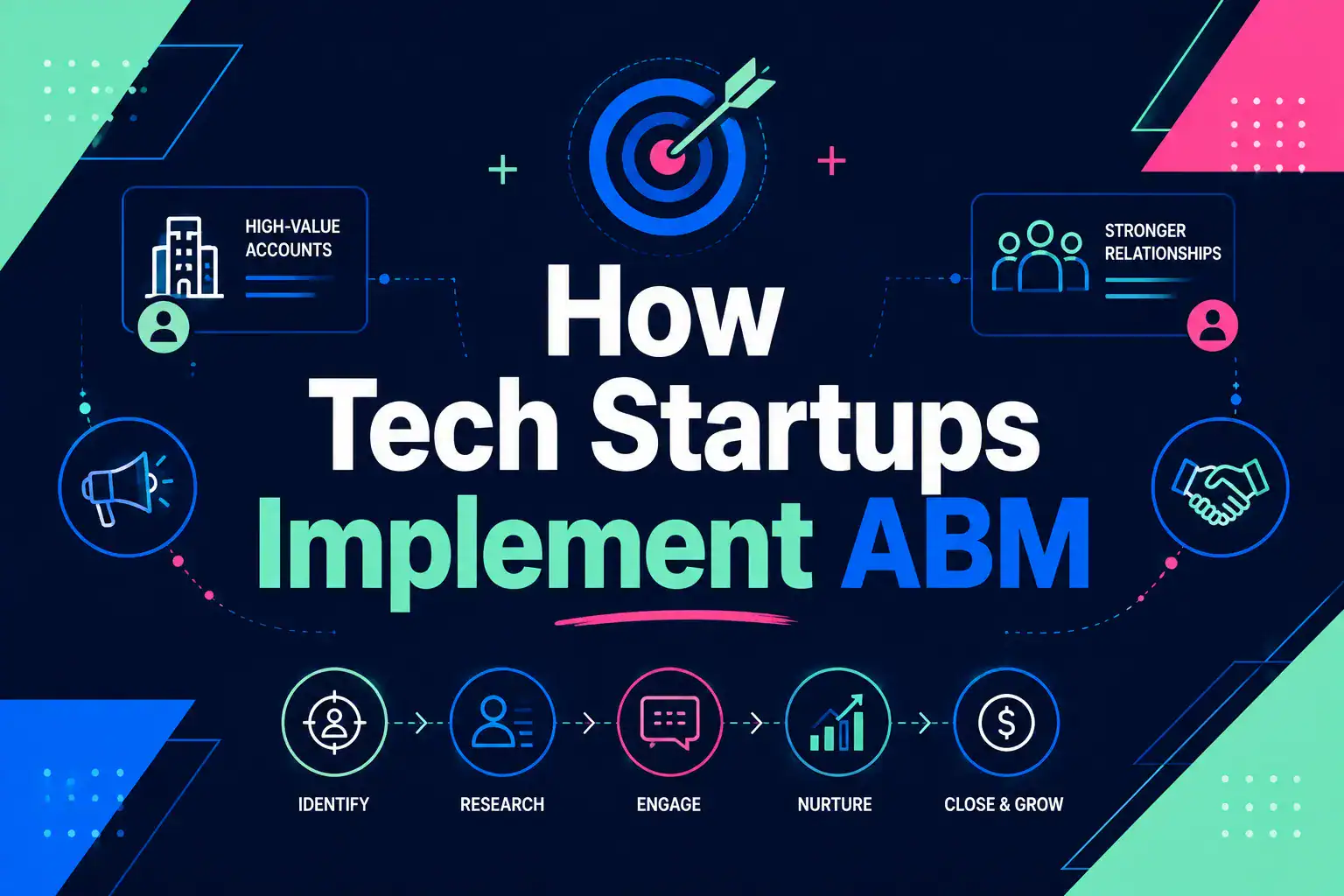
- Start Small and Simple: Begin by identifying a core number of high-value target companies that align as closely as possible with your ideal customer profile (ICP). Every tech startup must have a clearly defined ICP. This focused approach allows you to allocate resources effectively and learn from the process before scaling the business. Once you have your list, define all the properties you need to collect information about that will help you determine a target company’s propensity to buy.
- Align Marketing and Sales: ABM requires seamless collaboration between marketing and sales teams. You must ensure that both teams are aligned on the goals, messaging and approach for each target account. Regular communication and joint planning sessions can help achieve this alignment. Target account information must be collected and shared by both teams.
- Systems and Processes: Utilise tools to help you store information, put processes into place and automate tasks. AI and predictive analytics tools can help identify target accounts and gather insights into their needs and pain points. Platforms like HubSpot, Demandbase and 6sense offer ABM solutions tailored for startups, providing data-driven insights and automation capabilities.
- Personalisation at Scale: Use technology to personalise your outreach and content for each target account. This could include personalised email campaigns, targeted ads or customised landing pages. Even with limited resources, automation tools can help scale these efforts without sacrificing personalisation.
- Measure and Optimise: Continuously monitor the performance of your ABM campaigns and be ready to make continuous adjustments. Use metrics such as engagement rates, pipeline size and velocity and customer lifetime value to assess the effectiveness of your efforts and identify areas for improvement.
Dedicated ABM Teams
It’s not uncommon for large enterprises to have a dedicated ABM team. This is because ABM can be regarded as a separate discipline, one that requires a high level of coordination, personalisation and focus on a smaller number of specific accounts. This approach differs from traditional marketing, which may target a broader audience, but that is not always the case. For small tech companies, where the entire addressable audience may be a small number of high-value companies represented in a niche market, the entire go-to-market strategy and related resources are focused on ABM, and therefore no separate team is required.
A variety of names have been used to name ABM teams, such as Target Account Marketing, Key Account Marketing and so on. ABM teams are typically composed of marketing professionals who work closely with sales teams to identify and target high-value accounts through personalised marketing and sales strategies.
Roles You May Find in a Dedicated ABM Team:
- ABM Manager: Responsible for overseeing the strategy and execution of ABM campaigns, ensuring alignment with sales goals.
- Campaign Manager: Focuses on creating and executing specific ABM campaigns for targeted accounts.
- Content Strategist: Develops personalised content that resonates with the needs and pain points of specific accounts, as well as specific personas within those organisations.
- Data Analyst: Analyses account data to inform campaign strategies and measure the effectiveness of ABM efforts.
- Sales Liaison: Works directly with sales teams to ensure that ABM activities are aligned with sales objectives, orchestrating a seamless handoff from marketing to sales and provides oversight that sales tasks are executed in a timely fashion.
Limitations of ABM
The term ABM was coined due to the work often carried out by marketing; however, I don’t feel this is necessarily a good name for an activity that requires so much sales involvement in its execution to be successful. In fact, established sales teams may not fully embrace ABM because of this nomenclature. Although it requires significant inputs from marketing, it’s usually the salespeople who gather much of the account information and are required to execute on the insights gathered. If sales teams do not embrace ABM, it has already failed and will not achieve its objectives. For this reason, I find most of the descriptors used to name this function unhelpful and a potential barrier to widespread acceptance and adoption.
The Importance of Sales Teams in ABM
Without buy-in and engagement from sales teams, any ABM strategy will fail to deliver on its promises. This is why I favour names such as “Target Account Intelligence” and “Account Based Intelligence” or some similar term, as they do not presume the effort to be solely a marketing activity, even if some of it may be marketing-led. What you call it is important, because it must embody an approach that is cross-functional in its essence. I believe it’s desirable to avoid any unhelpful bias toward a single team, which may then discriminate against the other. The ABM name is the most used terminology for the discipline, perhaps because many tasks require marketing people to fulfil them. However, this causes more problems than it solves, so I would look to use one of the more inclusive alternative names.
The Power of Intelligence
The purpose of ABM, whatever you choose to call it, is to arm salespeople with account information that enables them to reach out to target companies at the right time and with the right message. Anything that discriminates against the relevance and importance of the sales team’s involvement can be an unnecessary hurdle and limiting factor. In a tech startup with a niche market, you don’t need a separate team or even a name for it; you just need to ingrain ABM practices into your daily marketing and sales practices from the start. However, in global tech businesses that sell to broad audiences, including enterprise clients, this can be more of a challenge. The adoption of ABM methodology into a startup environment is relatively straightforward, but it still requires intentionality and a relentless focus.
You may want to read: “How to Define Your Target Market.”