Match Your Demand Generation Engine to Reality …
For SaaS companies, demand generation is often described as a funnel: people become aware of the company, engage with its content, become leads, enter a sales process and eventually become customers. The reality is considerably more complicated. Modern B2B buyers can research vendors anonymously, compare competitors, consume content, ask colleagues for recommendations and use AI to investigate potential solutions long before they ever speak to your sales team. In fact, 6sense’s 2025 research, based on more than 4,000 B2B buyers, found that 94% of buying groups had ranked their vendor shortlist before engaging with vendors, while buyers initiated 79% of first interactions. That changes what a demand generation funnel needs to accomplish.
What Must Your SaaS Funnel Do?
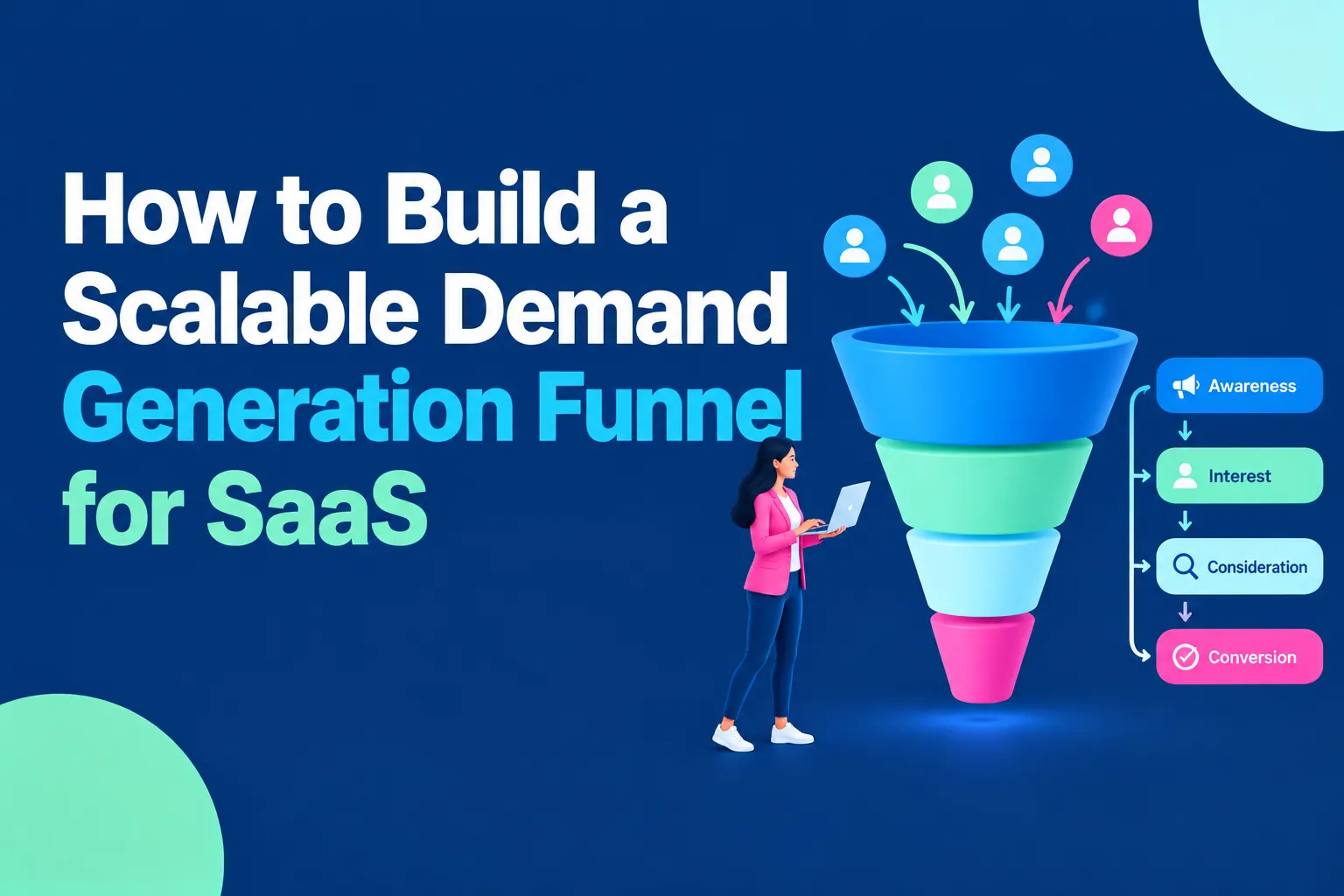
A scalable SaaS funnel cannot simply be a machine for producing leads. It needs to create awareness, build demand, capture existing intent, educate buyers, identify meaningful opportunities and give sales the information and assets needed to convert them. Importantly, it needs to do this repeatedly without requiring marketing to reinvent the process every time.
Tech Founders Have a Critical Role to Play
Every small business is different and in the early days of a startup, the founder may be involved in every part of the operation. Marketing and sales are two areas that require consistent and dedicated attention from every founder to support growth. No founder can extricate themselves from the go-to-market strategy and execution if they are to stand a chance of success. This chapter is dedicated to attempting to define just how much support is required.
In early-stage SaaS companies, founders are a major marketing asset because they:
- Speak at events.
- Create thought leadership.
- Appear in videos.
- Participate in webinars.
- Provide customer stories.
- Join strategic sales conversations.
- Help create credibility and trust.
Research from Edelman’s B2B Thought Leadership Impact research has consistently shown that senior executive thought leadership significantly influences supplier perceptions and purchase consideration. This means founder visibility can become an important demand generation asset when used appropriately. However, founder involvement must be structured.
A good founder will contribute:
- Market insight
- Strategic direction
- Customer access
- Industry credibility
- Budget support
These factors can significantly improve marketing effectiveness. On the other hand, a founder who repeatedly does the following can unintentionally reduce scalability:
- Rewrites every article
- Changes messaging weekly
- Requests random campaigns
- Judges marketing solely on immediate leads
- Overrides agreed processes
Many founders have strong opinions about marketing without necessarily having deep experience in modern SaaS demand generation. The most effective model for founder involvement is:
- Founders provide vision, customer understanding, credibility and resources.
- Marketing designs and operates the demand generation engine.
- Sales converts demand into revenue.
All three functions continuously exchange information to improve the system. This is important because founders often make one of two mistakes:
- Too little involvement: Treating demand generation as “marketing’s job” and becoming detached from customers, messaging and commercial decisions.
- Too much involvement: Micromanaging campaigns, changing messaging frequently, requesting tactical changes based on anecdotal feedback, or unintentionally disrupting repeatable processes.
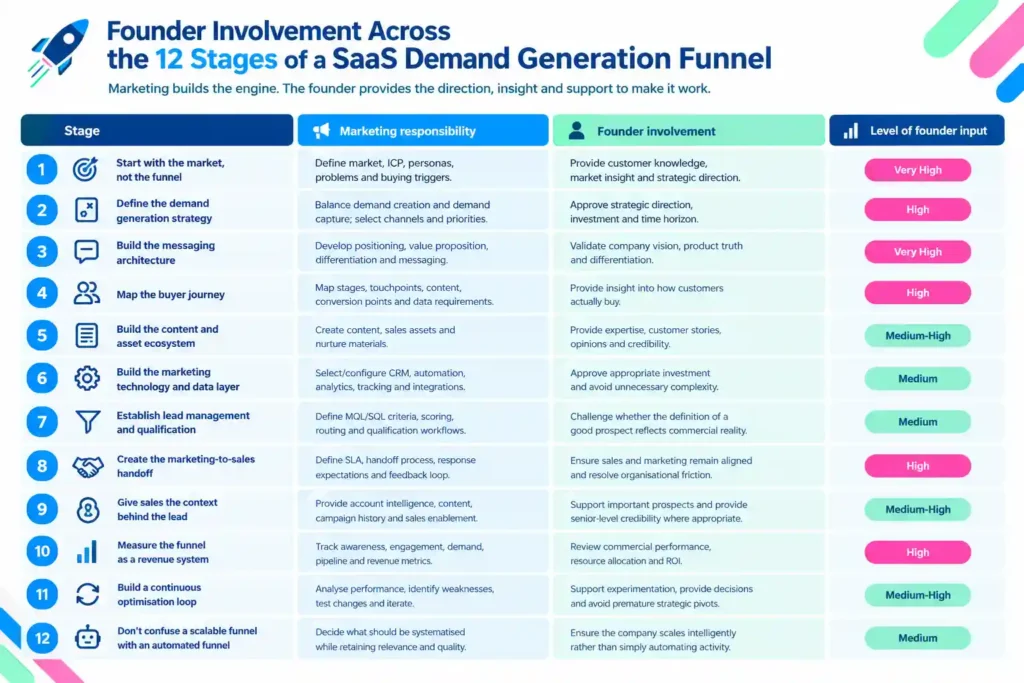
Below is a simple guide for every founder, which I have applied to the subsequent framework:
- High founder involvement: Vision, market understanding, customer insight, positioning, investment decisions and major strategic choices.
- Medium founder involvement: Thought leadership, customer meetings, product feedback, major campaigns and reviewing performance.
- Low founder involvement: Day-to-day campaign management, channel optimisation, marketing automation, content scheduling and operational execution.
Step-by-Step Framework for Building a Scalable Demand Generation Funnel
1. Start with the Market, Not the Funnel
The first mistake is to start by choosing marketing channels, such as running ads, webinars, creating eBooks or increasing website traffic. These are tactics, not strategy.
Before building the funnel, marketing needs to establish who it is trying to create demand with and why those people should care.
As a minimum, you must define:
- Target market
- Ideal Customer Profile (ICP)
- Target industries
- Company size by number of employees
- Company size by annual turnover
- Geography
- Buyer personas
- Buying committee
- Critical customer problems and pain points
- Business consequences of those problems
- Buying triggers
- Competitors and alternatives
- Customer outcomes
- Differentiators
- Relevant use cases
The ICP is particularly important, and you must take care to be as specific as possible. For this reason, a scalable funnel aimed at “B2B companies” isn’t particularly useful. A funnel targeted at UK technology companies with 100–500 employees that have a specific operational problem is much more actionable. Marketing must document this information in an ICP and buyer-persona framework that sales, product and leadership can all access.
Founder Involvement: Very High
The founder’s knowledge is extremely valuable at this stage because you are essentially bringing their vision to life. Founders often have direct customer knowledge, market relationships and a deeper understanding of why the company was created. Marketing must lead the process, but founders need to contribute heavily to define the problem, market and customer. The founder shouldn’t simply say, “Everyone could use this.” That’s precisely the assumption marketing needs to challenge.
2. Define the Demand Generation Strategy
Once the audience is defined, determine what demand generation needs to accomplish.
There are two fundamentally different jobs:
- Demand Creation: Builds awareness and preference among people in the target audience who aren’t ready to buy yet.
- Demand Capture: Identifies and converts people who are already researching a solution.
Both categories are relevant, and you cannot ignore one for the sake of the other. LinkedIn’s B2B Institute popularised the “95-5 rule”, arguing that approximately 95% of potential B2B buyers are out of market at any given time. The implication is important: a business that only targets people actively searching for a solution is ignoring the much larger pool of future buyers. This means the funnel shouldn’t be designed purely around bottom-of-funnel conversion.
For this reason, marketing needs a portfolio of activities:
Create Demand (the 95%)
- Brand
- Thought leadership
- Social content
- PR
- Events
- Video
- Industry education
- Advertising
Capture Demand (the 5%)
- Search
- Product pages
- Comparison content
- Case studies
- Reviews
- Demo requests
- Contact forms
- High-intent campaigns
- Retargeting
The balance between the two depends on a company’s category, sales cycle, maturity and available budget.
Founder involvement: High
Founders must understand and support the fundamental decision about how the company intends to create and capture demand. Marketing will recommend the appropriate balance between brand building, demand creation, demand capture, outbound activity, inbound marketing, events, partnerships and other channels based on evidence and expertise. The founder’s role is to provide strategic direction, approve appropriate investment and ensure the business has realistic expectations about the time required to build demand. Founders must resist the temptation to prioritise only short-term lead generation when the market also requires longer-term awareness and category education.
3. Build the Messaging Architecture
Before producing dozens of campaigns and assets, establish the messaging framework.
Marketing must create a hierarchy something like:
Company proposition → audience problem → value proposition → key benefits → proof → differentiation → calls to action
This gives every piece of marketing a common foundation.
The messaging must answer:
- What do we do?
- Who is it for?
- What problem does it solve?
- Why does that problem matter?
- Why should the customer care?
- Why us rather than an alternative?
- What evidence supports our claims?
This is especially important for SaaS companies because technology marketers can easily become trapped describing technology and features. Customers generally don’t buy “AI-powered workflow orchestration.” What customers buy is faster processes, reduced costs, lower risk or improved outcomes.
Founder Involvement: Very High initially, then Moderate
Founder involvement is needed to help establish the company’s fundamental story and differentiation. Once agreed, however, founders must allow marketing professionals to translate that positioning into campaigns and communications. Changing the core message every two weeks because the founder saw a competitor’s website is not a scalable process.
4. Map the Buyer Journey
A practical SaaS demand generation model might look something like this:
Awareness → Engagement → Education → Intent → Qualification → Sales opportunity → Customer
However, don’t assume that every person must progress neatly through these stages, as the buyers do not follow a linear path.
For example, a buyer might:
See your LinkedIn post → visit your website → disappear for six months → attend an event → read three case studies → speak to a salesperson.
Another buyer might:
Search Google → visit your pricing page → request a demo → become an opportunity.
The funnel is therefore a management framework, not a literal description of human behaviour. Marketing must map the content, channels, conversion points and data requirements associated with each stage.
Founder Involvement: High. Founders can provide valuable insight into how customers discover, evaluate and purchase the product, particularly in the early stages when they may have been personally involved in customer conversations. Marketing will use this knowledge to validate the buyer journey, but founders must avoid assuming their own experience represents every customer. Their role is to provide insight, challenge assumptions and help identify important buying triggers and decision points.
5. Build the Content and Asset Ecosystem
This is where demand generation becomes tangible. Marketing needs to create a library of assets that supports different buyer needs.
Awareness Assets:
- Social content
- Videos
- Articles
- Podcasts
- PR
- Research
- Thought leadership
- Industry commentary
- Brand advertising
Consideration Assets:
- Guides
- Webinars
- White papers
- Educational reports
- Product explainers
- Solution pages
- Comparison content
- FAQs
Decision-Stage Assets:
- Case studies
- Customer references
- ROI calculators
- Product demonstrations
- Pricing information
- Security documentation
- Technical documentation
- Implementation guides
- Competitive battlecards
Sales Enablement Assets:
- Presentation decks
- One-page summaries (datasheets)
- Objection-handling guides
- Email templates
- Persona-specific materials
- Competitive intelligence
- Discovery questions
- Demo scripts
- Proposal content
This needs to be treated as a system, not a collection of unrelated PDFs. Content needs to be mapped to personas, buying stages, use cases and commercial objectives. Research from the Content Marketing Institute illustrates the challenge. Its 2025 B2B research found that 45% of marketers lacked a scalable model for content creation, while only 35% said they had one. That is a significant warning for SaaS companies. If every asset requires a completely new brief, approval process, design exercise and distribution plan, the funnel will eventually become constrained by the marketing team’s capacity.
Founder Involvement: Medium–to-High.
Founders can be an important source of subject-matter expertise, customer stories and industry perspective, particularly for thought leadership content. Marketing will own the content strategy, editorial process and production, while founders contribute knowledge, opinions and credibility where they add genuine value. The objective is not for the founder to become the content producer, but to make their expertise available to marketing in a way that can be turned into scalable assets.
6. Build the Marketing Technology and Data Layer
A scalable funnel requires infrastructure.
At minimum, marketing needs:
- CRM
- Marketing automation
- Website analytics
- Conversion tracking
- Advertising platforms
- Email platform
- Landing-page capability
- Content management system
- Lead/contact database
- Attribution/reporting
- Consent and preference management
- Integration between marketing and sales systems
The technology must follow the process, not dictate it. First define the process and then automate it.
For example:
Visitor → content engagement → identified contact → lead score → qualification → sales routing → sales follow-up → opportunity → closed/won.
Marketing must document the workflow before implementing the automation.
Founder Involvement: Medium
Marketing will normally lead decisions about CRM, marketing automation, analytics, tracking and integrations because these systems need to support the actual demand generation process. The founder’s role is primarily to ensure that appropriate investment is available, and the company doesn’t under-resource the infrastructure or buy unnecessary technology. Founders must trust experienced marketing professionals to recommend the appropriate technology while remaining involved in significant investment and strategic decisions.
7. Establish Lead Management and Qualification
One of the most important parts of the funnel is determining when marketing should get sales involved, because not every lead is a sales opportunity. Someone downloading an introductory report isn’t necessarily ready for a sales call.
Marketing needs agreed definitions for terms such as:
- Lead
- Marketing-qualified lead (MQL)
- Sales-qualified lead (SQL)
- Accepted lead
- Opportunity
- Pipeline
- Customer
The definitions should be based on meaningful buying signals rather than arbitrary activity. For example, someone from the right company who attends a product webinar, visits several solution pages and requests pricing is materially different from someone clicking on a blog article. Lead scoring can help, but it must not become an overly complicated mathematical exercise.
A useful scoring model normally combines: Fit + behaviour + intent
- Fit asks: Is this the right type of company/person?
- Behaviour asks: What have they done?
- Intent asks: Does the behaviour indicate a genuine buying need?
Founder Involvement: Medium
Founders can provide an important commercial reality check when marketing and sales define what constitutes a qualified prospect. They must ask whether the agreed criteria genuinely identify organisations that are likely to buy, rather than simply producing large numbers of leads that look impressive in a marketing report. However, founders need to avoid overriding an agreed qualification process based on individual anecdotes. Over time, as customer and sales data grows, decisions must increasingly be informed by emerging patterns.
8. Create the Marketing-to-Sales Handoff
This is where most funnels break, and many marketing and sales relationships experience friction. What happens is that marketing generates leads, but the sales team complains they’re rubbish. Marketing responds that sales isn’t following them up, and the argument continues.
The solution is a documented marketing and sales SLA.
This will establish:
- What constitutes a qualified lead
- Who receives it
- How quickly sales responds
- What information sales receives
- What happens if the lead isn’t accepted
- How rejected leads are returned to marketing
- How feedback is recorded
- How lead quality is measured
HubSpot’s research on marketing and sales alignment found that only 35% of marketers and 30% of sales professionals described their teams as strongly aligned. That demonstrates why funnel design cannot stop at marketing. The funnel must continue into the sales process.
Founder Involvement: High
Founders need to ensure that marketing and sales operate as one commercial team rather than as separate functions competing over lead quality or revenue attribution. The leadership must agree on definitions, response times, responsibilities and feedback mechanisms, and the founder will intervene when organisational friction prevents the process from working. The founder doesn’t need to manage the handoff personally but does need to ensure that both functions are accountable for making it work.
9. Give Sales the Context Behind the Lead
A lead notification saying: “John Smith downloaded our eBook,” isn’t particularly useful.
Your sales team needs to know:
- Who John is
- His company
- His role
- ICP fit
- Content consumed
- Pages visited where appropriate
- Campaign source
- Stated interest
- Previous interactions
- Relevant account activity
- Recommended next action
Marketing is also responsible for creating and providing sales with appropriate content to use throughout the sales process. Research by 6sense is particularly relevant here. In 2025, 94% of buying groups reported that they had already created their vendor shortlist and ordered it before engaging with sellers. That means sales cannot rely on a great first call to create preference from scratch. Marketing needs to help create that preference before sales ever gets involved.
Founder Involvement: Medium–to-High
Founders can add considerable value when dealing with strategically important prospects, particularly in enterprise SaaS where credibility and senior relationships can influence a buying decision. They can also provide customer stories, product insight and industry knowledge that marketing can incorporate into sales enablement. However, founder involvement must be selective and appropriate. For example, routinely taking over sales conversations can undermine the sales team’s authority and prevent a scalable process from developing.
10. Measure the Funnel as a Revenue System
The biggest mistake is measuring demand generation exclusively through leads. Marketing must measure the funnel at multiple levels.
Awareness:
- Reach
- Share of voice
- Branded search
- Direct traffic
- Target-account awareness
Engagement:
- Website engagement
- Content consumption
- Event attendance
- Returning visitors
- Email engagement
- Account engagement
Demand Capture:
- Inbound enquiries
- High-intent conversions
- Demo requests
- Qualified leads
- Conversion rates
Pipeline:
- Marketing-sourced pipeline
- Marketing-influenced pipeline
- Opportunity creation
- Pipeline velocity
- Win rate
Revenue:
- New ARR/MRR
- Customer acquisition cost
- Revenue by channel
- Customer lifetime value
- Payback period
- Retention
- Expansion
The critical point is that not everything should be judged by the same timeframe. For example, a brand campaign might influence future buyers. A high-intent search campaign might generate immediate opportunities. A webinar might educate existing prospects. A case study and reference might help sales close a late-stage deal. Treating all these as though they should generate the same immediate conversion is poor measurement.
Founder Involvement: High
Founders will take an active interest in funnel performance because demand generation ultimately supports the company’s commercial objectives. However, they need to look beyond simple lead volumes and focus on whether the business is generating qualified demand, pipeline and revenue from the right customers at an economically sustainable cost. Marketing must provide the analysis and interpretation, while the founder helps make decisions about priorities, investment and resource allocation based on the evidence.
11. Build a Continuous Optimisation Loop
A scalable funnel isn’t “built” once. It is continually improved. Marketing will establish a regular funnel review covering:
- What is working?
- What isn’t?
- Where are prospects dropping out?
- Which audiences convert?
- Which channels create pipeline?
- Which content assists opportunities?
- Which campaigns produce poor-quality leads?
- What objections is sales hearing?
- What are customers saying?
- Where are competitors winning?
The answers should create experiments, such as:
- Change the landing page.
- Test different messages.
- Adjust targeting.
- Change the content offer.
- Improve the nurture sequence.
- Modify qualification criteria.
- Create new sales enablement.
- Reallocate media budget.
- Change the CTA.
Make these adjustments, then measure what happened. The objective isn’t to endlessly optimise clicks. It is to improve the economic performance of the entire customer acquisition system.
Founder Involvement: Medium–to-High
Founders must encourage experimentation and be prepared to support changes when evidence suggests that the strategy or execution needs improvement. At the same time, they need to avoid constantly changing direction because of an individual customer comment, competitor campaign or disappointing weekly result. Marketing needs sufficient consistency to identify meaningful patterns, run experiments and learn from them. The founder’s role is to support that learning process, make strategic decisions when required and provide stability.
12. Don’t Confuse a Scalable Funnel with an Automated Funnel
This difference between scalability and automation is important. Automation is useful for:
- Lead routing
- Email nurture
- Notifications
- Data enrichment
- Scoring
- Campaign execution
- Reporting
- Repetitive administration
However, automation doesn’t replace strategy. A completely automated funnel can simply automate bad targeting, poor messaging and irrelevant content at greater scale.
The goal and definition of scalability is: “How much of the repeatable process can we systematise without reducing relevance or quality?”
Founder Involvement: Medium
As the company grows, founders must ensure the business is building repeatable processes rather than simply adding more people and manual activity. Marketing will determine which activities can be systematised or automated while retaining relevance and quality. The founder’s role is to challenge whether automation is genuinely improving scalability, customer experience and economics rather than simply increasing the volume of activity. The objective is intelligent scale, not automation for its own sake.
What Founders Need to Understand
Founders have an important role in demand generation, but it isn’t to become the company’s chief campaign manager.
The founder must provide:
- Vision: Where is the company going?
- Customer insight: What are customers experiencing?
- Credibility: Can the founder participate in thought leadership, speaking events and important customer conversations?
- Resources: Does marketing have enough people, technology and budget?
- Access: Can marketing get access to customers and prospects?
- Decision-making: Can important positioning and commercial decisions be made quickly?
- Patience: Is the business prepared to invest in demand that may not convert immediately?
That last point is very important because B2B tech marketing cannot survive on direct response campaigns. Founders must resist the temptation to ask every Friday: “How many leads did marketing generate this week?” The real question is: “Are we building increasing awareness and preference within our ICP, while generating a sufficient volume of qualified demand to support our revenue objectives? That is a much more sophisticated question, and much closer to how a scalable SaaS demand generation engine must be managed.
What a Mature SaaS Demand Generation Funnel Looks Like
Ultimately, the objective is to create a system where:
- The right people see the brand
- Understand the problem
- Recognise the company’s expertise
- Engage with useful information
- Develop interest
- Demonstrate buying intent
- Are appropriately qualified
- Reach sales with context
- Receive relevant support throughout the buying process
- Become customers
- And generate insight that improves the next cycle
Marketing creates the infrastructure, content, campaigns, data, workflows and experiences. Sales converts demand into commercial outcomes. Product ensures the solution delivers what marketing and sales promise. The founder provides the strategic direction, customer insight, resources and leadership required to keep the entire system aligned. The most successful SaaS demand generation funnels are therefore not really funnels at all. They are integrated revenue systems.
Lesson:
Marketing owns the construction and operation of the demand generation engine. The founder owns the strategic conditions that allow that engine to work. The real measure of scalability isn’t whether marketing can generate 10,000 more leads. It’s whether the company can repeatedly create, capture, qualify, convert and learn from demand without costs, complexity and manual effort increasing at the same rate as revenue.
Useful Research and Reference Sources:
- 6sense — 2025 B2B Buyer Experience Report — Research covering more than 4,000 B2B buyers and their modern purchasing behaviour.
- LinkedIn B2B Institute — The 95-5 Rule — Research and explanation of the distinction between in-market and out-of-market B2B buyers.
- Content Marketing Institute — B2B Content Marketing Benchmarks, Budgets and Trends: Outlook for 2025 — Research into content performance, technology, processes and scalability among B2B marketers.
- HubSpot — Sales and Marketing Alignment Research — Research into alignment, systems and performance between sales and marketing teams.
You may want to read: “Key Leadership Principles for Tech Founders.”