
Keep Your Competitors Close …
No startup exists in isolation, although many would like to think they do. Whether you have developed a revolutionary SaaS platform, an AI-powered application or a cybersecurity solution, the reality is that your prospects are already solving the problem in one way or another. They may already be buying from an established vendor, using an alternative technology or simply relying on manual processes. Understanding who you are competing against and why customers make their purchasing decisions is one of the most important activities any founder can undertake.
Unfortunately, many startups treat competitor analysis as a one-off exercise completed for an investor presentation or business plan. This guide provides a practical framework for conducting competitor analysis in a B2B technology startup, enabling founders and marketers to build a clearer understanding of their market and develop a sustainable competitive advantage.
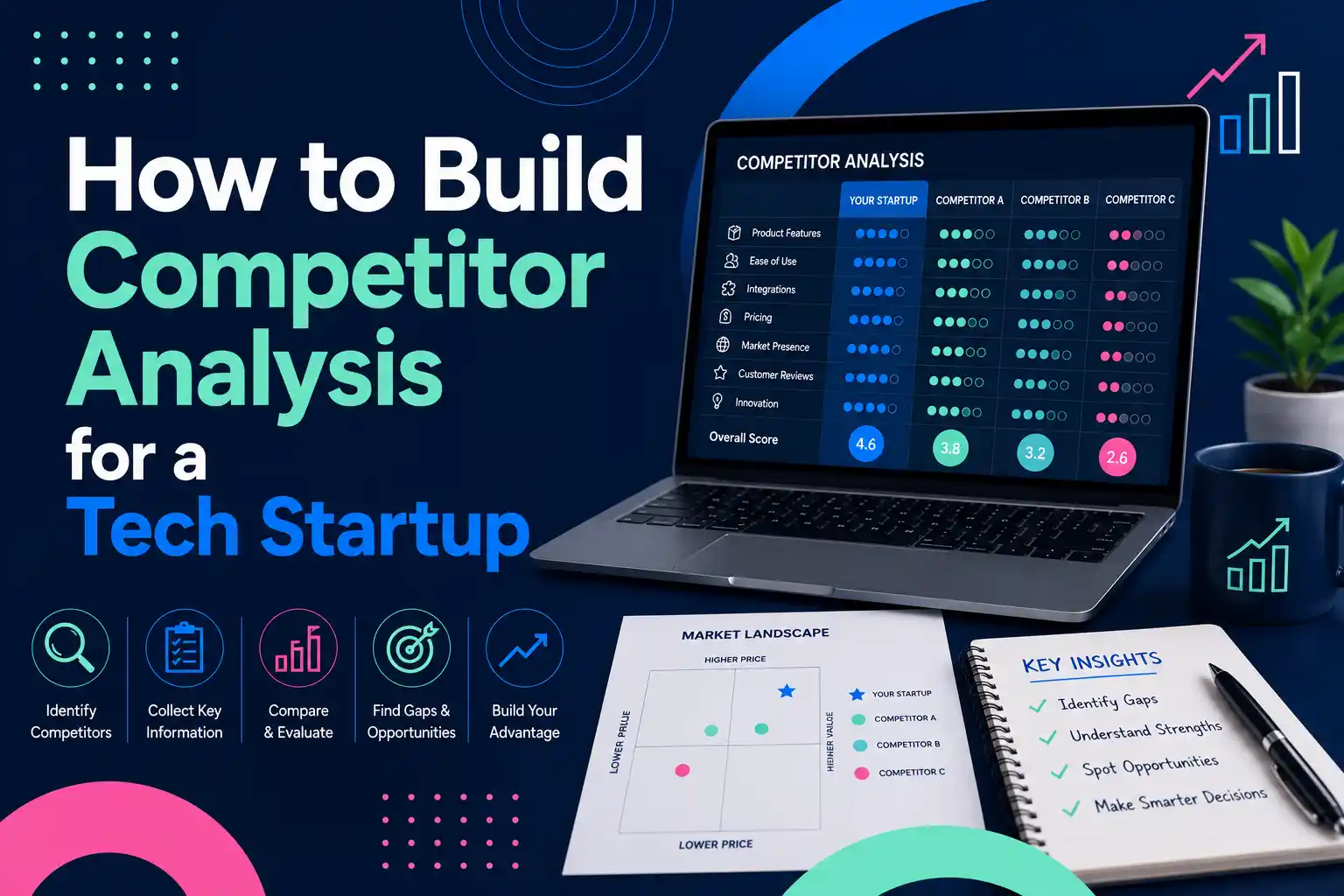
Why Competitor Analysis is So Important
Competitor analysis must become a living, breathing strategic process that influences every aspect of the business, from product development and pricing through to marketing campaigns, sales messaging and customer success. The startups that dominate their markets are rarely those with the best technology alone, but the ones that understand their competitors better than anyone else and use that knowledge to position themselves more effectively.
How Competitor Analysis Helps Your Startup
Competitor analysis is much more than monitoring rival businesses. It’s the process of gathering intelligence that helps your startup make better strategic decisions.
A well-executed competitor analysis enables you to:
- Understand where competitors are strong and where they are vulnerable.
- Equip sales teams with stronger competitive arguments.
- Refine your product roadmap based on market needs.
- Identify opportunities to differentiate your solution.
- Improve marketing messaging and positioning.
- Build confidence when entering new markets.
- Demonstrate market knowledge to investors.
Rather than copying competitors, the objective is to identify opportunities where your business can create greater value for customers.
Step 1: Identify Your Competitors
The first step is identifying exactly who you compete with. Many founders focus solely on businesses offering similar products, but competition extends much further than that.
Direct Competitors
These organisations offer products or services that solve the same problem for the same type of customer. For example, if you provide a cybersecurity Managed Detection and Response (MDR) service, other MDR providers would be considered direct competitors.
Indirect Competitors
Indirect competitors solve the same customer problem using different approaches.
For example:
- Internal IT teams
- Managed Service Providers
- Traditional antivirus software
- Alternative cybersecurity technologies
Your customer ultimately decides between all available options, not just those with identical products.
Step 2: Build Your Competitor Analysis Framework
Once competitors have been identified, develop a structured framework that captures information consistently across every organisation.
A useful framework includes:
- Company overview
- Products and services
- Target industries
- Ideal customer profile
- Geographic markets
- Company size
- Pricing model
- Technology stack
- Key partnerships
- Marketing approach
- Sales strategy
- Customer references
- Strengths
- Weaknesses
Using a standard template allows competitors to be compared objectively rather than relying on assumptions.
Step 3: Assess Products and Technology
Technology remains one of the biggest differentiators within B2B software.
Assess competitors across several dimensions, including:
- Feature depth
- Ease of use
- User interface
- Scalability
- Integration capabilities
- API availability
- Deployment model
- Cloud compatibility
- Security certifications
- AI capabilities
- Reporting functionality
- Customer support
Don’t simply record whether a feature exists. Consider how effectively it solves customer problems. Sometimes a competitor may offer hundreds of features, while your startup wins because it delivers a simpler, more intuitive experience.
Step 4: Analyse Market Positioning
One of the most revealing exercises is studying how competitors describe themselves.
Ask questions such as:
- What problems do they claim to solve?
- What language do they use?
- Who are they targeting?
- What benefits do they emphasise?
- What emotional triggers do they use?
Visit their website, read customer case studies, watch webinars, review product demonstrations, study LinkedIn content and look for recurring themes. This analysis often reveals opportunities where your startup can occupy a clearer and more compelling market position.
Step 5: Understand Their Got-to-Market Strategy
Technology alone rarely wins markets. Execution wins markets. Understanding how competitors generate demand provides valuable insight into their commercial strategy.
Review areas including:
- Pricing model
- Free trials
- Product demonstrations
- Sales-led versus product-led growth
- Channel partners
- Resellers
- Customer success model
- Sales process
- Buying journey
Consider how long their sales cycles appear to be and whether they rely on outbound sales, inbound marketing or strategic partnerships. Understanding these patterns helps startups decide how to compete more effectively.
Step 6: Evaluate Marketing Performance
Modern startups leave a significant digital footprint. Numerous tools allow founders to analyse competitor marketing activity.
Review areas such as:
- Website quality
- Organic search rankings
- Blog content
- SEO performance
- Paid advertising
- LinkedIn engagement
- Webinar activity
- Email marketing
- Video content
- Customer testimonials
Platforms including SEMrush, Ahrefs, Similarweb, Google Keyword Planner, Capterra and G2 provide valuable insight into competitor visibility, keyword rankings, customer sentiment and market perception. Reviewing customer feedback on G2 or Capterra is particularly valuable, as customers often reveal exactly what they like and dislike about competing products. These insights frequently uncover opportunities that marketing teams can immediately use in their messaging.
This is an area where you can spend a great deal of time, but it can also become a distraction from business as usual. I would suggest you put a cap on how much time and information is really needed and make sure you only focus on the areas that really matter–don’t monitor and measure everything all the time just because you can.
Step 7: Build a Competitor Scorecard
Rather than collecting pages of notes, create a competitor scorecard that allows direct comparison.
Typical scoring categories might include:
| Category | Score (1–5) |
| Product capability | |
| Innovation | |
| Ease of use | |
| Integrations | |
| Brand awareness | |
| Website quality | |
| SEO visibility | |
| Pricing competitiveness | |
| Customer reviews | |
| Sales maturity | |
| Partner ecosystem | |
| Market presence |
This provides an objective way of identifying market leaders, emerging challengers and areas where your startup can outperform competitors.
Step 8: Turn Intelligence into Competitive Advantage
Competitor analysis only creates value when it influences business decisions.
The insights gathered should feed directly into:
- Product Development: Identify feature gaps worth closing and opportunities where competitors are over-engineering their solutions.
- Marketing: Develop messaging that highlights genuine differentiators rather than generic claims.
- Sales Enablement: Create battle cards that help sales teams confidently explain why your solution offers a stronger fit than competing products.
- Pricing Strategy: Understand where premium pricing is justified and where alternative commercial models may provide a competitive advantage.
- Customer Success: Monitor competitor weaknesses to identify opportunities for customer retention and upselling.
Demonstrate Market Understanding to Investors
Investors expect founders to understand their competitive landscape in detail.
Simply stating that there is “no competition” is one of the quickest ways to undermine credibility.
Strong competitor analysis demonstrates:
- Deep market understanding
- Clear product differentiation
- Realistic commercial awareness
- Defensible competitive advantages
- A credible route to market leadership
Investors are far more interested in how you intend to beat established competitors than pretending they do not exist.
Competitor Analysis Must Never Stop
Competitor analysis is a dynamic and continuous activity because markets evolve constantly, new startups emerge, established vendors acquire competitors, products evolve and customer expectations change. For this reason, it must become an ongoing discipline rather than an annual exercise. Many successful B2B tech businesses review competitor intelligence quarterly, updating product comparisons, pricing models, messaging, customer reviews and market positioning as part of their regular strategic planning process.
Insights That Help Build Your Strategy
Competitive analysis is never about copying competitors; that is a facile strategy. This is about understanding your competitors well enough to outmanoeuvre and outperform them. The most successful B2B technology startups build structured frameworks that continuously monitor competing products, positioning, pricing, marketing activity and customer sentiment. These insights help founders make smarter decisions across product development, marketing, sales and investment planning. Ultimately, startups that understand both their customers and their competitors place themselves in the strongest position to dominate their category. By transforming competitor intelligence into actionable commercial insight, founders can sharpen their value proposition, focus investment where it delivers the greatest return and build a business that is not only differentiated today but capable of sustaining long-term growth in an increasingly competitive market.
You may want to read: “Startups Must Understand Buyer Personas.”