Focus Is a competitive Advantage to Be Nurtured …
Focus is a simple rule that applies to every early-stage technology startup. Not because focus sounds good in a strategy presentation, but because startups have limited money, people, time and almost no margin for wasted effort. A startup cannot afford to be everything to everyone. You cannot realistically pursue five different customer segments, three product strategies, multiple business models and a collection of tempting opportunities while expecting to execute them all brilliantly. Yet this is exactly what many founders do. They see an adjacent market with massive revenue potential, or they receive an enquiry from a large company outside their Ideal Customer Profile (ICP). What could be the harm in exploring such opportunities?
Shield and Protect Your Startup from Unwanted Distraction
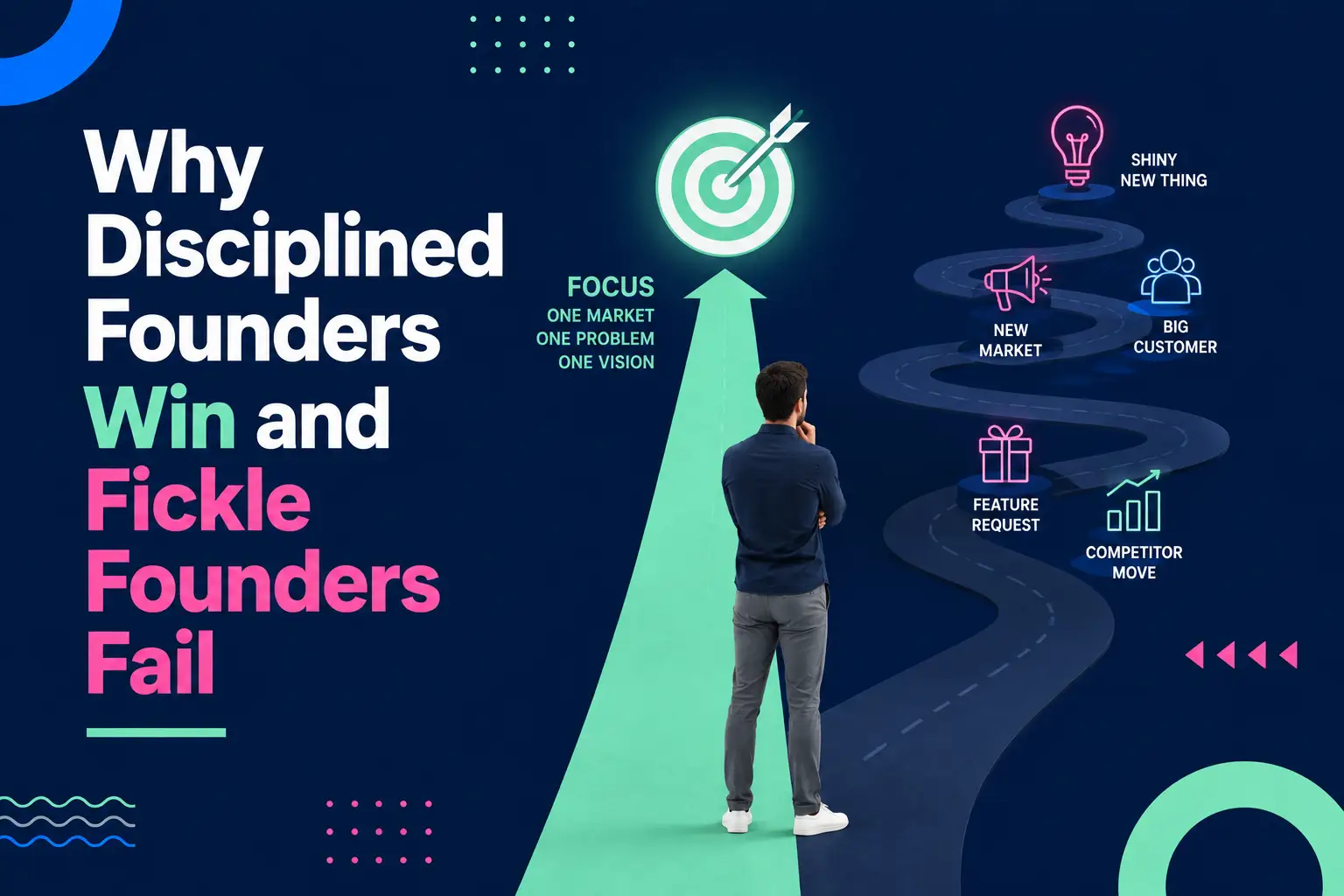
A prospect asks for a feature that would make the product attractive to another sector. An investor suggests another opportunity. A competitor launches something interesting. Suddenly the strategy starts warping and shifting all by itself, as if it had a mind of its own. Before long, your clear proposition, one market and one customer problem, is chasing several rabbits at once. As the saying goes: “Chase one rabbit, catch one rabbit. Chase two rabbits, catch none.” The principle is simple but following it requires extraordinary discipline.
The Temptation to Chase Everything
Early-stage founders are naturally optimistic by nature. They have built something they believe can solve a real problem, and it is perfectly understandable that they want to maximise the opportunity. If the technology can theoretically serve manufacturing, financial services, healthcare, retail and professional services, why limit it to one? Surely more markets mean more revenue? Unfortunately, it rarely works that way at the beginning. Targeting multiple audiences reduces relevance because each audience has different needs, use cases and buying considerations. The result is broader messaging, weaker relevance, higher acquisition costs and more competition. The operational consequences of multiple products, markets, customer types and business models create weak results from higher cash burn, slower execution, confused employees and customers and lost momentum.
Strategic Complexity Creates Operational Complexity
Operational complexity is expensive. This is why tech startups must focus on one solution, one market and one problem. The strongest early-stage startups usually begin with a remarkably simple proposition:
- One core product.
- One clearly defined market.
- One customer type.
- One compelling problem.
- One value proposition.
This is the “success pattern” and all tech startups must master one thing before scaling into others. That doesn’t mean the founder believes the company will serve only one market forever. It means the founder understands sequencing. There is a huge difference between saying: “We will eventually serve several markets,” and: “We will try to serve several markets simultaneously.” The first is a growth strategy and the second is often a distraction.
Focus Creates Depth – Depth Creates Relevance
There is a valid reason for concentrating on one audience. When a startup knows exactly who it serves, it can build its product, marketing, sales process, customer experience and brand around the needs of that customer. You must aim for depth, with the product, features and branding built around the core ICP. Increased relevance can improve acquisition, retention and customer satisfaction. This is particularly important for technology startups competing against established vendors. It provides differentiation that can be matched with customer preferences.
Your small tech startup cannot normally beat a large incumbent through scale, because:
- The sales team is small.
- The marketing budget is bootstrapped.
- The brand is unknown.
So how does a B2B tech startup compete? By being more relevant.
A startup that understands one market exceptionally well can build something that feels purpose-built for that market. The messaging becomes sharper, sales conversations become easier, content becomes more useful, the product roadmap becomes more coherent, references become more relevant and customer stories become more compelling. The team develops specialist knowledge relevant to the target market and that depth can become an almost impenetrable competitive moat.
More Markets Do Not Automatically Mean More Revenue
One of the most seductive assumptions in startup strategy is that increasing the addressable market automatically increases the opportunity. It doesn’t. If expanding from one ICP to four means that the startup becomes 75% less relevant to each audience, the theoretical increase in market size may be meaningless.
More audiences mean broader targeting, reduced relevance, increased acquisition costs and weaker appeal and retention. This is particularly dangerous because a founder can convince themselves that they are making the company bigger when they are making it weaker.
For example, a startup entering a new market now has:
- More competitors.
- More customer problems to understand.
- More messages to create.
- More product requirements.
- More sales objections.
- More content to produce.
- More marketing campaigns.
- More customer expectations.
- More implementation complexity.
- More internal debate.
- More budget demands.
However, the startup in this example hasn’t necessarily created more competitive strength; it may simply have diluted it.
The Killer Distraction: The Big Customer
Perhaps the most dangerous temptation is the large customer that doesn’t fit your ICP. Imagine a startup has deliberately chosen manufacturing companies as its target market, then a huge financial services company appears. It wants something resembling your technology, and it has a substantial budget. The contract could be worth millions, so your founder starts thinking: “We would be mad not to respond to this RFP.” Perhaps, but perhaps not. The question is not whether the company can win the customer, which is highly unlikely anyway. It must be whether winning the customer helps the company execute its strategy.
A large customer outside your ICP will demand:
- A different sales process.
- A new business model.
- Bespoke functionality.
- Integrations that nobody else needs.
- Dedicated support.
- Changes to the technology roadmap.
- New compliance capabilities.
- All-consuming attention from the senior management team.
When a large client is paying so much money, everyone feels obliged to listen, and suddenly the roadmap now belongs to the customer. The product begins evolving around one unusual customer rather than the broader target market. The sales team starts looking for similar opportunities and marketing begins creating new messaging. The company hires people to support the new requirements, so the manufacturing strategy gets quietly pushed into the background. Existing customers no longer feel the startup is for them, as it has morphed into something else. The startup has just allowed one customer to redefine its strategy, and that may be the beginning of a messy ending.
The Best Outcome Might Be Saying No
This is one of the hardest lessons for founders to learn: Not every good opportunity is a good opportunity for your company. Sometimes the best outcome is to say no. That sounds counterintuitive when cash is tight, but strategic discipline means understanding the opportunity cost of every decision. The big financial services deal might generate £2 million, but what if serving it prevents the company from developing the product needed to win £20 million of repeatable business in its chosen market?
The £2 million deal isn’t necessarily a success, because it’s more likely to be an expensive distraction disguised as short-term revenue. This is where founders need the courage to distinguish between revenue and strategic revenue. The former attempts to put money into the bank from opportunistic deals you have no right to win; the latter helps build the business you intended to create. The best founders know when to say no, protecting the strategy and the business from false opportunities. Saying no immediately when an opportunity does not fit your ICP is important, because while you delay, the sales team is pursuing an all-encompassing tender process that could distract them for weeks.
Stripe Understood the Power of a Narrow Wedge
Stripe provides a useful example. The company is now a vast financial infrastructure business, but its early proposition was extraordinarily focused. Stripe’s own history describes how its early developer experience became associated with the idea of “seven lines of code” — a deliberately simple representation of the complexity it was abstracting away for developers wanting to accept payments. The important lesson isn’t literally the number seven. It’s the clarity of the wedge:
- Payments
- Developers
- Simple integration
That focus created a powerful starting position and once Stripe had established itself, it could expand. The mistake would have been trying to become payments infrastructure, banking infrastructure, identity infrastructure, lending infrastructure and enterprise financial infrastructure simultaneously before it had established its core. The sequence matters to every tech startup.
Amazon Didn’t Start by Trying to Conquer Everything
Amazon provides another useful example. Jeff Bezos’ original 1997 shareholder letter described Amazon’s initial focus on books and the company’s intention to build market leadership before expanding further. The results were extraordinary: sales grew from $15.7 million in 1996 to $147.8 million in 1997, an 838% increase. Customer accounts increased from 180,000 to 1.51 million. Bezos explicitly linked long-term value creation to extending and solidifying market leadership and said Amazon would continue to measure itself through indicators including customer growth, revenue growth, repeat purchasing and brand strength. Amazon obviously became much broader, but it didn’t begin broad. It established a strong position before systematically expanding.
Focus First. Expansion Second
Focus doesn’t mean you will never consider changing strategy, and this argument should not be confused with stubbornness. A disciplined founder isn’t someone who refuses to change; they are someone who changes deliberately and appropriately. A startup must be constantly learning and challenging its own assumptions. Sales data, product usage, customer conversations, competitive intelligence and market conditions are always being monitored and considered. If the evidence shows that the original ICP is wrong, then change it. If the product is solving a different problem than expected, investigate it. If an adjacent market demonstrates overwhelming demand and the company has a genuine right to win, consider it.
However, there is a massive difference between strategic evolution and founder mood swings. A strategy must not change because one prospect said something interesting on Tuesday, a competitor launched a feature, an investor suggested another market or the founder had a brilliant idea at 2 am. Strategic changes must be treated like well-considered chess moves. Understand the position, assess the consequences, consider the alternatives, and only then make the move, making sure you align the entire organisation behind it.
The Evidence Supports Sequencing Expansion
Importantly, the argument for focus does not mean businesses should never expand into adjacent markets. Research from McKinsey shows that adjacent markets can become important sources of growth — but the critical issue is how and when companies expand. McKinsey found that, on average, about 80% of growth in its analysis came from companies’ core industries, with around 20% coming from secondary industries or expansion into new areas. More revealingly, its research into advanced industries found that companies pursuing one adjacency over five years outperformed companies pursuing two or more by three percentage points. McKinsey’s conclusion was not to never expand; it was to execute adjacency moves with continued focus and conviction. That is exactly the point startup founders must understand.
Expansion Is Not the Enemy
I’m not saying expansion is the problem, but premature expansion can be very dangerous because the cost of distraction is always greater than founders realise. The financial cost of distraction is more obvious, but the cultural cost can be even greater. When priorities continually change, employees stop knowing what matters. Confusion becomes frustration; that frustration turns into a lack of motivation; a lack of motivation shows up as poor financial performance.
For example, if marketing doesn’t know which audience to target, sales doesn’t know which prospects to prioritise, product doesn’t know which roadmap to follow, customer success doesn’t know which use cases to build around, and engineering receives competing demands, then everyone starts doing a little bit of everything. The result is nobody knows why they are doing what they are doing anymore and nobody does anything exceptionally well.
Here are four warning signs every founder must be mindful of:
- Multiple roadmaps.
- Scattered meetings.
- Unclear priorities.
- Team confusion.
This is how momentum disappears, and once momentum disappears, a startup can burn through months or years trying to recover it.
Your Strategy Must Become Organisational Discipline
The founder’s responsibility is therefore much bigger than writing the strategy; they must protect it at all costs while guiding the business and the team.
Every senior leader must understand:
- Who are we targeting?
- What problem are we solving?
- Why does it matter?
- Why are we different?
- What are our current objectives?
- What are we deliberately not doing?
- What evidence would justify changing direction?
That last question is particularly important. A strong strategy needs defined conditions under which it will be reconsidered; otherwise, flexibility becomes an excuse for chaos. The preferred approach is to start strongly with one ICP and then scale to others after establishing the business, rather than dividing attention from the beginning. This is a sensible and well-proven model for early-stage growth.
Earn The Right to Expand After Mastering One Market
Don’t let what competitors say and do dictate your strategy, because they can be another enormous source of distraction. A startup sees a competitor enter a market and immediately wants to respond. A competitor launches a new feature, and the founder wants to build it too. A competitor changes its pricing, and you feel compelled to match it. A competitor starts selling to another sector, so you want to follow them. This is strategically lazy, because your competitor’s strategy is not your strategy.
Your job is to understand your customer better than they do and execute your own plan. Jeff Bezos’ 1997 letter is instructive here because Amazon acknowledged aggressive competitive entry but emphasised moving quickly to solidify and extend its own market leadership, while continuing to focus relentlessly on customers. That is a much healthier response to competition. Don’t panic, copy or chase; just execute.
A Founder’s Job Is to Say NO!
Perhaps the greatest strategic weapon available to an early-stage founder is the ability to say NO to:
- Adjacent markets.
- Distracting prospects.
- Unnecessary features.
- New business models.
- Competitor roadmaps.
- The temptation to try and become everything to everyone.
That doesn’t mean becoming arrogant or inflexible. It means understanding that every time you say yes, it consumes resources. Every yes has an opportunity cost, every new priority competes with an existing priority, and startups don’t have enough resources to pursue everything. Y Combinator’s advice is remarkably aligned with this philosophy. Founder Tikhon Bernstam has argued that early-stage teams must focus intensely on finding product-market fit and building a product that customers love rather than spreading themselves across multiple projects. YC’s Michael Seibel similarly argues that founders often move into hiring and optimisation before they have genuinely established product-market fit, and that the market should pull the product rather than founders becoming overly attached to their initial solution.
The Discipline of Saying “Not Yet”
There is another phrase founders must learn: Not yet. An adjacent market might eventually be attractive, a new product might eventually make sense, a major enterprise account might eventually fit, an international market might eventually become strategically important, but saying “not yet” is a legitimate strategic decision. It allows the company to preserve the opportunity without allowing it to consume today’s attention and resources. Create a strategic parking space, capture the opportunity, record the assumptions, define what evidence would make it worth pursuing, then get back to work.
You Must Become Boringly Consistent
One of the most powerful things a startup can achieve is consistency. The same target customer, core problem, value proposition, strategic narrative, commercial priorities and definition of success, week after week, month after month and year after year. That consistency creates compounding advantages. The sales team becomes better at selling, marketing becomes better at communicating, product becomes better at solving the problem, customer success becomes better at supporting the use case, references accumulate, case studies accumulate, knowledge accumulates, reputation accumulates and the company becomes increasingly difficult to dislodge.
This is the Benefit of Depth:
Increased relevance can improve competitiveness, allowing a smaller company to compete without needing the scale of larger rivals. That is precisely what a startup needs.
When Must a Startup Expand?
The answer is based on evidence, not boredom of being focused on the right things.
Consider expansion when you meet the following criteria:
- The Core ICP Is Working: You have repeatable demand from a clearly defined market.
- The Proposition Is Repeatable: Sales aren’t dependent on heroic founder intervention every time.
- The Product Is Mature Enough: Supporting a new market won’t destabilise the existing customer base.
- The Economics Work: You can fund expansion without starving the core business.
- The Adjacent Market Has a Genuine Right to Win: There is a logical connection between what you already do well and what the new customers need.
- The Organisation Can Absorb the Complexity: You aren’t simply adding another strategy to an already overloaded team.
Only then does expansion become a strategic move rather than a negative distraction.
Discipline Beats Brilliance
There is a romantic idea that successful startups are built by visionary founders who see opportunities nobody else can see. There is some truth in that, but vision without discipline is dangerous. The founder who sees ten opportunities may be less successful than the founder who sees ten opportunities but chooses only one to focus on and then gives it his relentless attention. The ability to recognise opportunity is valuable, but the ability to ignore opportunity or set it aside can be even more valuable.
This is why startup strategy is as much about subtraction as addition. Successful founders constantly ask themselves:
- What must we stop doing?
- Which customers will we not pursue?
- Which markets will we ignore?
- Which features won’t we build?
- Which opportunities will we deliberately reject?
Those decisions create focus, and focus creates the conditions for excellence.
The Biggest Startup Mistake May Be an Innocent One
Startups rarely derail themselves with one obviously catastrophic decision. More often, the damage comes from a series of apparently benign decisions, such as:
- Let’s just try this market.
- Let’s take this customer.
- Let’s build this feature.
- Let’s respond to this competitor’s move.
- Let’s launch this product.
- Let’s pursue this partnership.
Each decision looks harmless, but collectively they change the company. The strategy becomes blurred, the team becomes confused, the roadmap becomes overloaded, the customer proposition becomes weaker, the burn rate increases and the startup slowly stops being the company it originally set out to build. That is why founders need discipline. Not rigidity, arrogance or blind faith, but disciplined conviction.
Stay Focused Until the Evidence Tells You Otherwise
The best founders don’t pretend they know everything, because nobody does. They recognise that startups are experiments and that the original strategy may need to evolve, but they don’t confuse learning with random movement. They establish a hypothesis, test it, collect evidence, decide, communicate and execute. That is fundamentally different from changing direction every time something shiny appears. The most successful startup teams understand that focus is not a limitation; it’s a superpower.
Focus is a superpower because:
- When resources are concentrated, the product becomes better.
- When the product is better, relevance increases.
- When relevance increases, sales become easier.
- When sales become easier, growth becomes more predictable.
- When growth becomes predictable, the company earns the right to expand.
- When expansion finally happens, it can be deliberate rather than desperate.
That is the real lesson behind the advice to focus on one audience and not chase two rabbits.
Don’t Try to Win Everything
Find somewhere you can win, win decisively, build depth, create momentum and then and only then use that position to expand. The startup that does this may look smaller than its competitors at first, but that is exactly the point. It is concentrating its resources where they can have the greatest impact. The fickle founder sees opportunity everywhere and ends up spreading the company too thin. If a founder lacks respect for their own strategy, then guess what, so will everyone else. The disciplined founder sees opportunity everywhere too but knows that most of it must wait.
The hardest thing about building a successful startup isn’t finding opportunities. It is having the discipline to ignore the ones that don’t belong in the plan.
You may want to read: “Is Lead Scoring a Good Idea for Tech Startups?.”