Understand Who Your Key Personas Are …
Every B2B tech startup must understand the key individual profiles that make up the buying team in prospective companies. After researching and clearly defining the Ideal Customer Profile (ICP) in your target audience, you must then determine who the individuals are in those organisations you must market and sell to. This understanding allows you to develop targeted strategies to engage each key player effectively, appropriately and at the right time.
Define Your Marketing and Buyer Groups
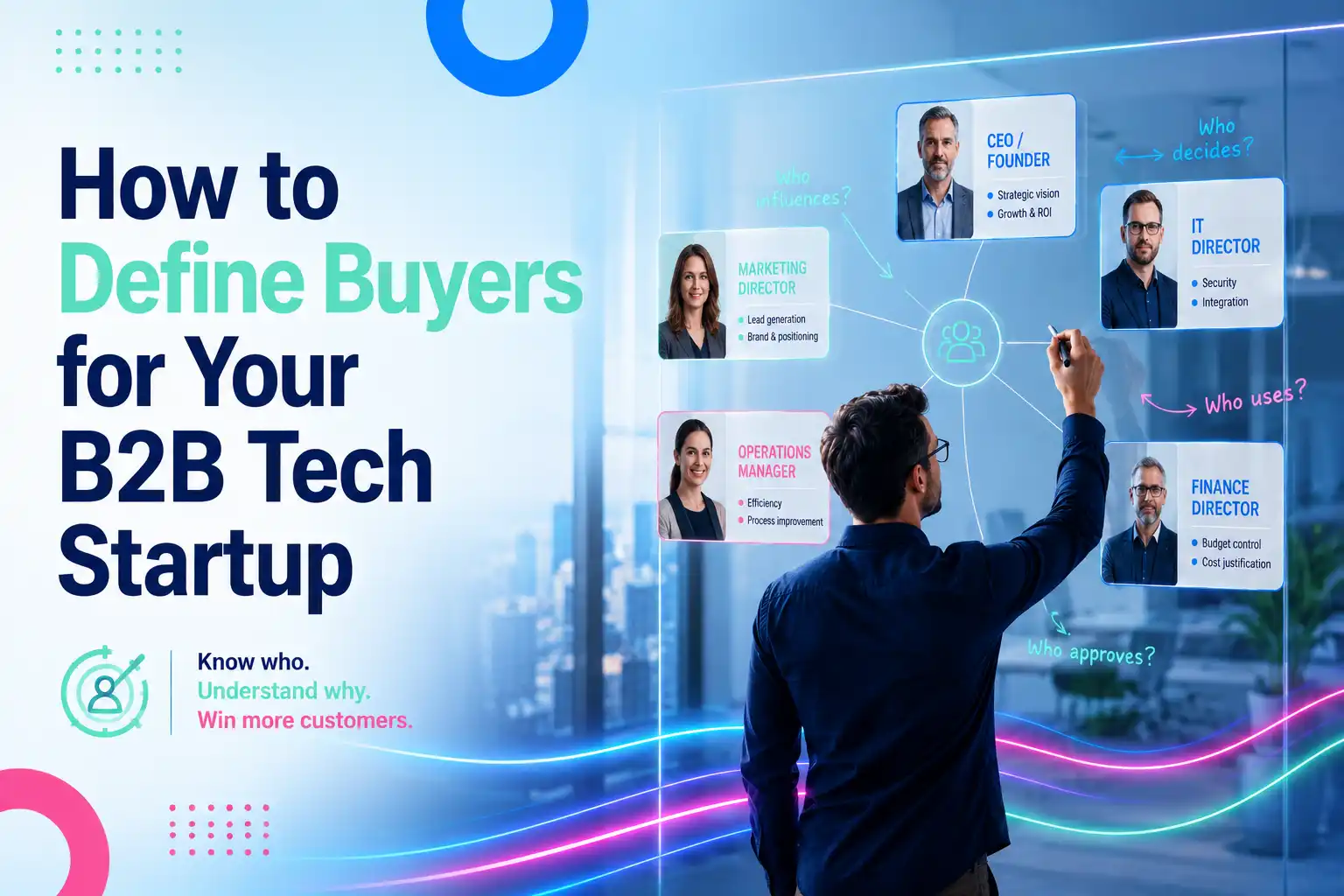
Whether they form part of your marketing group or a wider buying team, it’s important for your marketing and sales teams to determine where each persona fits, as well as when and how to engage each one. Addressing the specific needs and concerns of the marketing group will get their attention via your outbound marketing campaigns. You can then stimulate a sales engagement with the wider buying team to facilitate a successful sale.
Persona Definitions
Please note that these definitions are generic in nature, but they give you a better understanding of the individuals you need to target and engage with. In specific cases, each buyer persona could be rolled up into one individual representing all of them, while in others they may be represented by multiple people; there are nuances in every company. This is because a persona definition encapsulates the job roles and their responsibilities. Job titles tend to be individual, whereas responsibilities can vary and be shared across multiple job roles, which often depends on the size of any given company and its organisational structure.
Situational Diversity
It’s important to allow for and accommodate situational diversity, as target companies may have their own ways of working. Some organisations may interpret job roles and responsibilities differently, usually to suit their specific management style and structure. However, we can still use broad definitions to build processes and campaigns that maintain targeting accuracy. This gives you the ideal starting point that scales with growth, but is adaptable as you engage with each specific company and adapt to their specific ways of working. Always be flexible enough to adapt your marketing and sales approach to each prospect company’s buying team once you start talking to and learning about them.
How to Define Common Buyer Personas for the B2B Tech Industry
1. Champion:
A champion is an enthusiastic supporter of your solution within a target company. Through research, you will have determined that they are most likely to be both interested and responsive to your marketing and messaging, while having enough influence to introduce you to other colleagues and instigate a buying conversation. This person may have other roles to play in the buying team, such as the technical buyer, but is likely to be involved throughout the sales process.
You may decide you have more than one potential champion you will need to target, and this is fine, provided they have the necessary influence. They will be the advocates for your solution and help navigate internal processes and stakeholders. To fulfil this role, they must be passionate about your solution and not only see the value but also understand it enough to inspire others to talk to you.
2. Economic Buyer:
The economic buyer is the person, or persons, who control the budget and will have the final say on financial decisions. They will evaluate the overall financial feasibility of your proposition, paying specific attention to the return on investment (ROI) and total cost of ownership (TCO). This will usually be a senior executive or high-level manager focused on financial operations and cost-effectiveness. You could have everything in place to close a sale, but the economic buyer can sabotage the entire deal with a single question or observation you have not fully addressed. This individual may not be involved in the entire buying process, but will certainly be involved at the critical decision stage.
You must be ready to work with this member of the buying team and construct a narrative around your solution that works for the financial, as well as business and technical motives of the prospective client. Winning sales deals is a multifaceted activity that must accommodate many factors and opinions from different viewpoints. Simply being the best technical solution without having a convincing financial and business proposition is not enough to win. Selling a B2B tech solution is hard, and if you are not fully prepared, the economic buyer will remind you just how difficult it can be.
3. Technical Buyer:
When marketing and selling a B2B tech solution, there will almost always be a technical buyer involved to assess your solution’s capability, and they are one of the most important members of the buying team. They need to be convinced that the product meets their technical requirements now and into the future and that you have good compatibility with other systems. Any new solution must at least meet or improve their company standards and offer smooth integrations. This person will be an IT or engineering lead and may even be a highly knowledgeable subject matter expert in your field. Their job is to fully understand technical details and systems architecture. It’s also common that technical buyers may be your champion and a member of your target marketing group.
As this individual understands technology, this buyer will often present information to other members of the team on how your solution aligns with their needs to achieve their business goals in a better way. Be warned, as this buyer could also stop your sales process dead in a heartbeat before it has even begun. If they are not convinced of your solution or converted to your way of thinking, you will have work to do to educate them with your story, positioning and proposition. When you manage to get a champion on your side, they may be the difference that helps you win the deal. Your sales strategy must be to turn this buyer into a friend. To achieve this, you will convincingly demonstrate your solution, its function and business benefits in such a way as to make them one of your advocates.
4. User Buyer:
This is the user group who will interact daily with your solution. They will assess and analyse the functionality and overall customer experience before providing feedback on usability. They will focus on ease of use, productivity and practical benefits. They may only be involved at the later stages of a deal, as part of the due diligence before completing a purchase. If your product meets all the other buying criteria, then this is typically when the user buyer is introduced. Their job is to ensure the new technology can be easily adopted by the people who will use it.
5. Influencer:
The influencer has expertise, reputation and authority that impacts the decision-making process. For this reason alone, you may add them to your marketing group to try converting them into an advocate of your solution. This will improve your chances of success. The influencer could be a full-time employee or a trusted advisor, such as a non-executive director, investor or consultant. They will offer insights, advice and recommendations based on their knowledge and experience. Understanding the influencer landscape is important throughout the sales process.
6. Decision Maker:
The final purchasing decision must be made by someone and again this role can sometimes be fulfilled by an individual who also represents one or more of the other personas, such as the economic or technical buyer. This is normally a senior leader or executive, focused on the overall benefit and strategic alignment of the purchase. They take input from all members of the buying team, and in larger organisations, this could be a small leadership team with a director or CEO at its head.
They may meet to discuss your proposal multiple times before deciding together, with the leader orchestrating and concluding the conversation. Their endorsement of your proposition is vital to completing the sale. This buyer’s role is to take a more strategic view, balanced by input from all stakeholders, before authorising the final decision. A decision maker may not be involved in the early selection process, but will certainly be introduced at the latter stages. They are instrumental in the final selection of who wins the sales deal from a short list of options.
7. Gatekeeper:
A gatekeeper can be someone to work around or to work through, as they usually control access to other stakeholders, influencing the flow of information. You may have to take a view based on each situation. If they seem particularly obstructive, you may need to consider an introduction via a different channel, but it will help if the gatekeeper is at least open to providing support, if not aligned with your goal. This individual may manage much of a vendor’s interactions, screening initial proposals and facilitating or restricting access to decision makers.
If they can advocate for you and play the dual role of a champion, then life will be much easier. The job role of this buyer can vary between an executive assistant or procurement officer. Their focus is usually on process efficiency and initial vetting, so you want to make the best impression possible. This means being as responsive to them as possible if they communicate questions or make requests for additional information.
Take Them on a Journey
Company buyers are unlikely to understand your startup’s proposition in any detail, especially for a complex solution or an unfamiliar technology. Be prepared to take them on a journey of discovery as part of your sales process. This is where you educate them about the relevance of your proposition, why it’s desirable for companies like theirs, where you fit in the market, how your company vision is aligned to them and the specific business outcomes and value you will deliver.
Enrich Your Sales Process
It’s also important to accommodate each persona with the information they need at every stage of the buying cycle. The job of your sales team is to be the conductor of these relationships by architecting and managing a workable sales process that pulls in data, information and subject matter experts to help move the deal along from enquiry to close. Use market information and gathered intelligence about the prospect to show you understand them, their business, the challenges they face and have demonstrable experience in solving those issues.
You may want to read: “Startups Must Understand Buyer Personas.”