Don’t Let Competitors Control You …
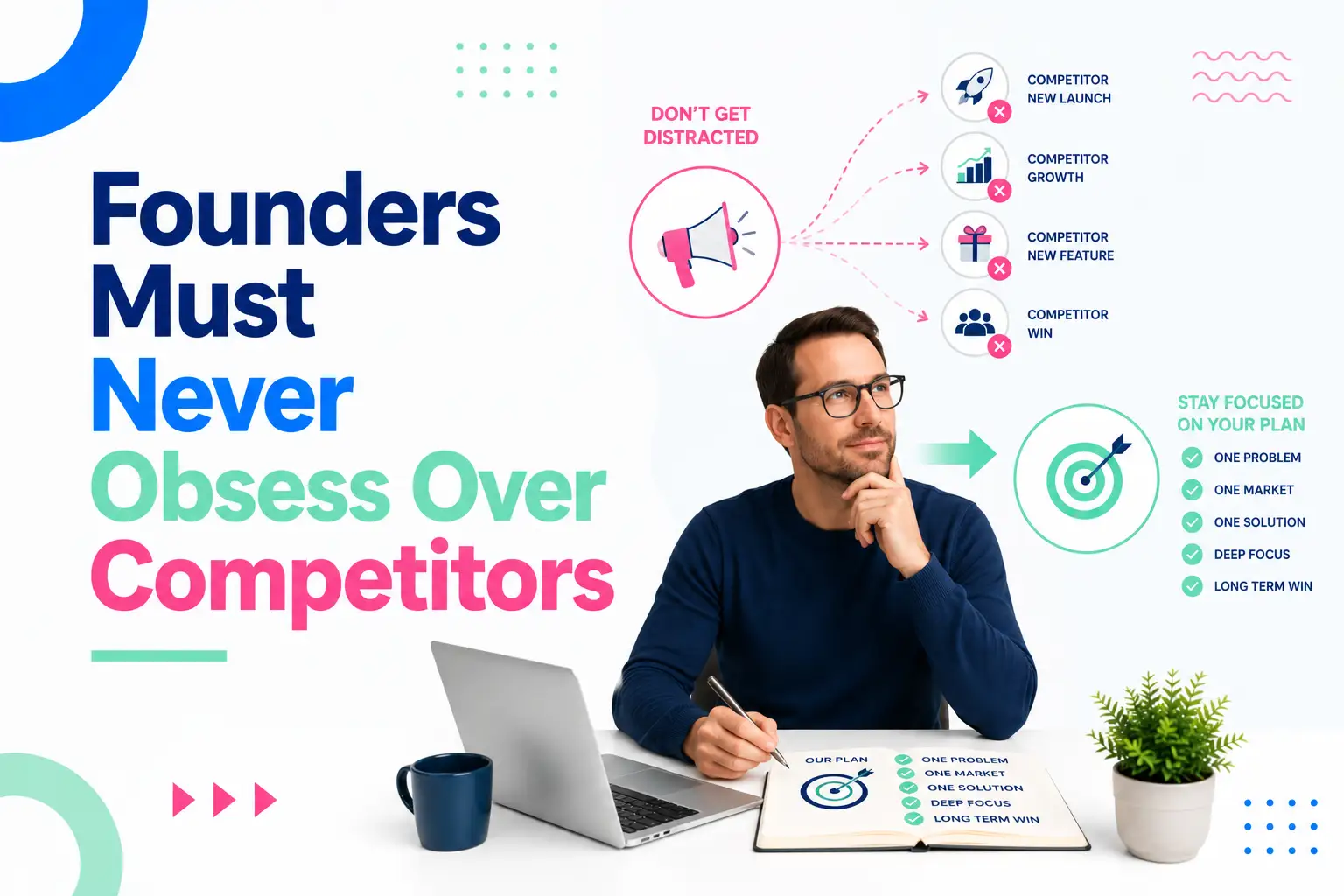
There is a difference between understanding your competition and being obsessed with it. Every technology founder must know who else operates in their market, what those businesses offer, where the market is moving and what customers are being promised. That is simply good commercial hygiene, but there is a point at which competitive awareness becomes competitive obsession. When that happens, it can become one of the most expensive distractions a startup can create for itself. Competitor obsession encourages reactive decisions, while customer focus, deliberate growth and distinctive positioning create strategic clarity. That’s where founders must focus.
The danger is particularly acute in B2B technology markets. Every morning brings another funding announcement, product launch, feature release, acquisition, partnership, price change, keynote, rebrand, AI announcement or LinkedIn post from a competitor. It is incredibly easy for a founder to wake up, see what somebody else has done and immediately ask:
- Do we need to respond?
- Why didn’t we do something like that?
- Why is their content, messaging, marketing better than ours?
- Why can’t we do thought leadership like that?
- …and so on and so boring.
Usually, the better question is: “Does this change anything that actually matters to our customers, our strategy or our ability to execute?”
If the answer is no, get back to work.
Why Customer Focus is Better than Competitor Focus
Your customers can tell you where the pain is, what isn’t working, what they would pay for, why they buy, why they leave, which feature matters and which feature doesn’t. A competitor’s website cannot tell you those things.
Competitors Don’t Define Your Strategy
A startup with a clearly defined vision must not allow another company’s press release to rewrite its strategy. Your strategy exists precisely because you have made choices about where you will compete, whom you will serve, what problem you will solve and how you intend to create value. If every significant competitor announcement causes you to reconsider those choices, you don’t really have a strategy. In that scenario, what you have is a collection of disconnected reactions. That doesn’t mean being stubborn or overly blinkered is a good idea either. Things in your market will change and competitors sometimes reveal information that genuinely matters.
However, changing direction should be the consequence of evidence, not anxiety. A disciplined founder establishes the conditions under which the strategy will be reviewed. Perhaps a competitor takes a meaningful percentage of your target customers, a new technology makes your core proposition obsolete, or customer research demonstrates that the problem you are solving has changed. Those are legitimate reasons to reconsider. “Competitor X has launched a feature that looks a bit like ours,” isn’t necessarily one.
Your Customers Are the Target
The most important audience for your startup isn’t competitors; it’s customers. Research strongly supports this fact. A large study of more than 7,500 French firms by Pekovic and Rolland on customer orientation and profitability was published in Management magazine in 2012. It found that customer orientation significantly improved profitability measures including profit per employee and EBITDA per employee. The relationship was particularly strong in growing, competitive and uncertain markets.
There is a strong positive relationship between market orientation and sales growth, while overemphasising competitive influences can be at the expense of distinctive capabilities. Customer orientation is far more likely to positively affect business performance, whereas competitor orientation does not necessarily have a similarly direct positive effect. The lesson here isn’t that competitors don’t matter. It is that knowing what competitors are doing is not the same thing as knowing what customers need.
Your Team Is the First Priority
There is another group founders need to protect from competitive distraction: their own people. Every unnecessary strategic pivot creates work.
Here’s an example we would all do well to avoid repeating:
- A competitor launches a new feature.
- Product changes direction.
- Engineering reprioritises.
- Marketing rewrites messaging.
- Sales needs new collateral.
- Customer success needs to understand the new proposition.
- Roadmaps change.
- Meetings multiply.
- And then, six weeks later, everyone discovers that the competitor’s announcement wasn’t particularly relevant after all.
That isn’t strategy; it’s organisational whiplash. Your team needs clarity and alignment. People do their best work when they understand what the company is trying to achieve, why it matters and what their priorities are. Constantly changing direction because somebody outside the organisation did something vaguely interesting destroys that clarity. The founder’s job is therefore partly to protect the organisation from noise. Not all noise is external; some of it comes from the founder.
Bigger Competitors Are Dangerous Distractions
One of the worst mistakes a startup can make is trying to compete feature-for-feature with a much larger incumbent whose product has years of development behind it. Startups falling into this trap are on a hiding to nothing. A major technology company may have thousands of engineers, enormous marketing budgets, established distribution, global brand recognition, existing customer relationships and vastly greater access to capital. Trying to beat that company at its own game is often a terrible strategy.
If a competitor has 500 engineers and you have 12, copying its roadmap isn’t going to magically give you the same resources. You are simply allowing a much larger organisation to dictate how you spend your limited resources.
Your advantage is likely to be elsewhere. For example, your small startup can be:
- Faster.
- Able to provide a dramatically better experience.
- Better positioned to understand a particular customer segment.
- Experienced in solving a narrow problem that the incumbent doesn’t care about.
- Optimised to experiment in weeks while the larger business takes months.
Startup strategy becomes interesting when you don’t try to be a smaller version of the large incumbent. It’s a far better strategy to focus on what you can do exceptionally well that the incumbent either cannot or won’t do.
Apple Provides a Useful Lesson
When Steve Jobs returned to lead Apple, he repeatedly articulated a new product philosophy centred on building excellent products, rather than continuing to respond to competitors. Contemporary reporting on Apple’s turnaround highlighted the company’s unusually small number of product lines and its emphasis on focus. Apple didn’t ignore competitors, but it didn’t allow them to determine what excellence meant for the company.
Amazon Makes the Same Distinction
Amazon’s leadership principles say that leaders must pay attention to competitors but obsess over customers. The principle is Customer Obsession: start with the customer and work backwards. That is an excellent formula for startups. Watching competitors and obsessing over customers is not contradictory. In fact, that is the correct balance. Amazon’s own description of its culture also emphasises invention, long-term thinking, ownership and delivering results. They don’t simply respond to whatever another company happens to announce.
Don’t Confuse Awareness with Obsession
There is a sensible competitive intelligence process.
You must know:
- Who your major competitors are.
- What they are launching.
- How their pricing changes.
- What customers say about them.
- Where they are gaining or losing traction.
- What technological developments could affect your market.
- Where your proposition is genuinely differentiated.
Then put that information somewhere useful. A monthly competitive review may be enough for some businesses. A weekly dashboard might make sense for others, but the information must be used to inform decision-making, not to feed anxiety. Focus on this question if a customer play is causing you concern: “Does anything they are doing change our strategic assumptions?” If not, carry on.
Competitors Can Hijack Your Roadmap
Your product roadmap must be driven primarily by customer problems, strategic priorities, evidence and your own capabilities. Have you ever found yourself saying: “They’ve just launched this, so we need it.”
That is the time to stop and ask better questions, such as:
- Which customers are asking for this?
- What problem does it solve?
- Does it support our strategy?
- What would we have to stop doing to build it?
- What evidence suggests it deserves priority?
Those questions introduce discipline and expose how often competitive reactions are based on fear rather than opportunity. Businesses don’t necessarily need to outdo competitors and can instead deliberately choose a different position. That is an important concept for founders to understand: You don’t have to win somebody else’s race.
Focus is a Competitive Advantage
Startups have limited money, people and time; that means attention itself is a scarce resource. Every hour spent monitoring competitors is an hour that could have been spent talking to customers. Every unnecessary product pivot consumes engineering capacity. Every reactive marketing campaign consumes creative and management resources. Every strategic panic creates uncertainty and confusion inside the organisation. Focus therefore isn’t just a nice leadership quality; it’s your superpower, so don’t waste it. This is why focusing on executing your plan must be the priority, not chopping and changing based on the weather. Successful startups must understand their market and adapt, but adaptation is not the same as uncontrolled reaction.
The Competitor is in Your Peripheral Vision
The best founders don’t drive while staring into the rear-view mirror. They know what is happening around them, but they keep their eyes on the road ahead. Competition sits in your peripheral vision, while customers must be directly in front of you. Your team must always be beside you, and the strategy tells you where you are going. Execution will determine how quickly you get there. Competitors will launch products, raise money, hire people, change their pricing and make bold announcements. Some of them will disappear as others become enormously successful.
That is the nature of a dynamic market, and you cannot control any of that. What you can control is how you respond, and an important discipline a founder can develop is the ability to say: “That’s interesting. Let’s understand it and monitor it, but does it change anything that we need to do?” If it doesn’t, move on. Your customers aren’t waiting for you to beat your competitors; they’re waiting for you to solve their problems, and that is where your attention belongs.
The Founder’s Competitive Distraction Test
Before changing your strategy, roadmap or priorities because of something a competitor has done, ask five questions:
- Has this materially changed our customers’ needs?
- Does it invalidate one of our strategic assumptions?
- Do we have evidence that customers want us to respond?
- What would we stop doing if we responded?
- Are we responding because of evidence or because we’re afraid?
If you cannot answer those questions convincingly, don’t react.
Instead, stay focused, keep learning, watch the market, listen obsessively to customers, protect your team and execute your strategy. That combination is one of the startup founder’s greatest advantages.
Lesson:
Proactive competitor orientation can contribute to innovation and performance, while responsive competitor orientation can also have benefits through organisational learning. The point is therefore not to ignore competitors, but to prevent competitor awareness from becoming reactive, disproportionate and strategically dominant.
You may want to read: “Why Disciplined Founders Win and Fickle Founders Fail.”