How Difficult Is It to Implement Lead Scoring? …
Technically, it can be surprisingly easy to set up a lead-scoring system. Modern CRM and marketing automation platforms can automatically calculate scores, apply rules, create segments and trigger workflows. Salesforce, for example, supports Einstein Lead Scoring, which can use historical conversion data to generate scores and make those scores available to sales teams. The difficult bit isn’t necessarily the technology, which can be both a blessing and a curse. The difficult bit is deciding what the technology must do. You need agreement between marketing and sales teams about what constitutes a worthwhile prospect – that conversation alone could take weeks.
This Is a Job for Marketing and Sales
You need to determine which signals matter and to establish what happens when somebody crosses the threshold. Then you need to check whether the model is working, which is where many programmes fail. Research by Openprise found that getting widespread sales adoption was the single most common scoring challenge, cited by 31% of respondents. A score that sales doesn’t trust is basically an expensive decoration on the CRM.
Tips on Getting Started with Lead Scoring
The research and practitioner experience point towards a few recurring lessons. It’s important to take your time and be considered with your thinking and planning.
- Start with Outcomes: Start with outcomes rather than assigning points. Don’t begin with “How many points should a webinar attendance be worth?” Start with “What characteristics and behaviours do our successful customers have in common?”
- Historical Evidence: Use real historical evidence wherever possible. Salesforce’s own lead-scoring guidance recommends analysing previous deals and combining lead attributes with behaviour rather than simply inventing rules from scratch.
- Keep it Simple: Keep the model understandable. If nobody can explain why a lead has a particular score, trust will disappear quickly.
- Review and Refine: Review it regularly. Markets change. Products change. Buyers change. Your ICP changes. A behaviour that correlated with purchasing two years ago may not mean the same thing today.
- Permission: Allow salespeople permission to challenge the model. The best scoring system isn’t the one a marketing leader thinks is cleverest. It’s the one that Sales believes helps them make better decisions, saves time and closes deals.
When Can a Startup Start?
Probably later than many marketing technology vendors would suggest, and earlier than many founders might expect. If you’re still figuring out product-market fit, refining your ICP and trying to understand who buys your product, a sophisticated lead scoring model is premature, because you are still learning what a good lead looks like. Once you have enough customers and opportunities to identify meaningful patterns, a lightweight scoring system can be useful. Don’t wait until you have thousands of leads; you just need enough evidence to make your assumptions better than guesses.
Should You Do It?
Yes, but not because a score makes a lead more qualified. Lead scoring is useful because it can create a consistent, repeatable way of prioritising attention, optimising workflows and ensuring prospects are followed up, not left behind. This can be a significant benefit for B2B tech startups.
If you have a small number of high-value prospects, personal judgement and account-based selling may be far more valuable than an elaborate scoring engine. However, if you have hundreds or thousands of leads moving through a relatively predictable funnel, scoring can make the process much more manageable. When you eventually have enough data to build a genuinely predictive model, it can become considerably more sophisticated, but all of that takes time and commitment.
Start with something simple that provides an approximation of reality but becomes progressively more accurate and helpful as you build up more data and evidence over time. Everyone in marketing and sales needs to be on the same page and have realistic expectations. Both must understand what lead scoring is trying to do and what the limitations are. Don’t fall into the trap of believing that a lead with 87 points is inherently better than one with 63.
The number isn’t the insight. The relationship between the number and actual commercial outcomes is the insight.
Why Startups Implement Lead Scoring
For an early-stage B2B tech company, I’d therefore treat lead scoring as an operational tool rather than a marketing objective.
You can use it to:
- Bring order to a growing pipeline.
- Help sales decide where to look first.
- Test your assumptions about what good prospects look like.
- Keep asking whether it is improving your results.
If your lead scoring system has become a sophisticated way of organising a spreadsheet that nobody trusts, you haven’t built a better marketing engine. What you now have is a more complicated spreadsheet. Lead scoring can be useful, but it isn’t magic. If the assumptions behind the scoring model are wrong, automating those assumptions allows you to make the wrong decisions faster.
The best time to start lead scoring is when you have reached the point where lead scoring can solve a genuine operational problem. Treat it as something that needs to be tested and improved rather than a finished piece of marketing infrastructure. It must become a bespoke system, only relevant to your business. Only your team can do this, but you must be patient and allow it to develop and mature over time.
Start With the Problem, Not the Technology
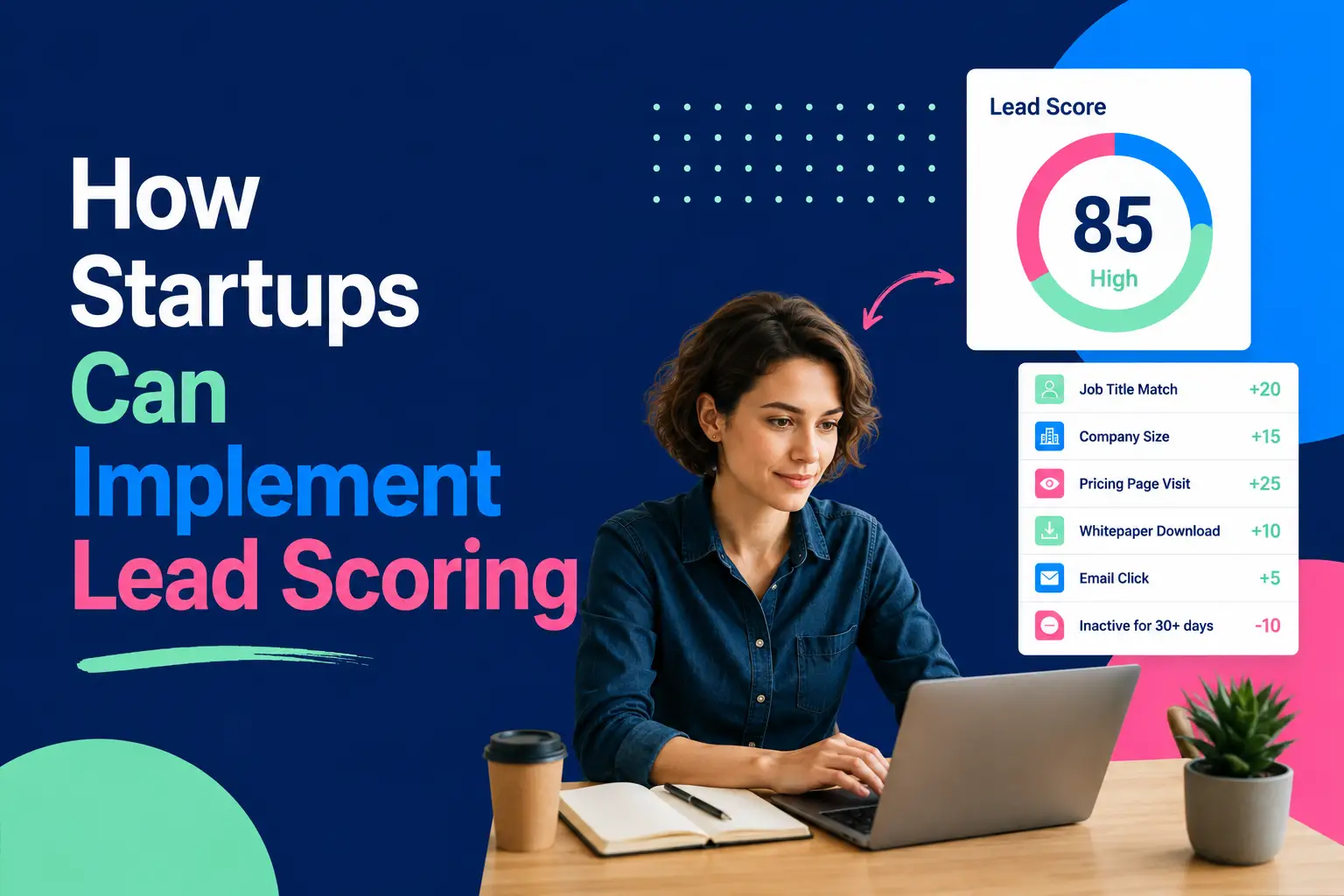
One of the easiest mistakes to make is to begin with the CRM. Your marketing automation platform has a lead-scoring function, so you turn it on, then someone starts creating rules: a job title is worth 10 points, a website visit is worth five, a content download is worth 15, a demo request is worth 50 and visiting the pricing page twice is worth another 20. Before long, you have a beautifully engineered scoring model. The only problem is that nobody has established whether any of those behaviours correlate with what buying customers really do.
Start somewhere else, by asking what problem you are trying to solve. Perhaps the sales team has 300 leads sitting in the CRM and doesn’t know which ones to follow up first. Perhaps marketing is generating enough leads that manual qualification is becoming difficult. Perhaps sales believes that marketing is sending too many poorly qualified leads. Perhaps nobody has a consistent definition of what constitutes a good lead. Those are legitimate reasons to introduce lead scoring. Doing it for no other reason than your CRM has the feature is to be avoided at all costs.
Lead Scoring Starts with Your Definition of a Good Customer
Before assigning a single point, go back to your existing customers and ask yourself:
- Which companies have bought and what makes them different?
- Which ones became successful customers?
- Which characteristics do they share?
Look at company size, industry, geography, technology environment, business model and the role of the person involved.
Then look at behaviour to understand what happened before those companies became opportunities:
- Did they request a demo?
- Did they attend an event?
- Did they repeatedly visit specific web pages?
- Did they speak to sales?
- Did several people from the same company become engaged?
- Did they spend three months researching your category before contacting you?
This is much more useful than sitting around a conference table trying to imagine what a hot lead looks like. The principle is simple: Start with evidence wherever you have it and use assumptions only where you don’t. Make a note of which is which.
Don’t Confuse Engagement with Intent
Although the popularity of the word intent in marketing circles can be problematic, it is used extensively in lead scoring so we must indulge it. Perhaps this is part of the reason why lead scoring can be a controversial and difficult topic for both marketers and sales teams to agree on. One person’s intent is another person’s waste of time. In any case, the distinction between engagement and intent is particularly important for tech startups. Someone who downloads your “Ultimate Guide to Cloud Security” has demonstrated interest in cloud security, but they have not necessarily demonstrated an intention to buy your product. Indeed, at this stage you have no idea what the reason behind their action really is.
Likewise, someone who opens six emails may just be interested in your content. Someone who visits your pricing page may be researching competitors. Someone who fills in a form with a personal email address may be a student, researcher, consultant or competitor. This doesn’t mean these behaviours are useless. They are signals, and they need to be treated as signals rather than proof of purchase intent. That distinction must influence and direct your scoring model.
A useful starting point is to separate the fit of the prospect company from engagement.
- The fit answers: Does this look like the sort of organisation and person we sell to?
- The engagement answers: Are they showing signs of interest?
A good lead must ideally score well on both.
Keep Your First Model Ridiculously Simple
There is a temptation to make lead scoring sophisticated from the start, something that must be resisted. Your first model doesn’t need 40 criteria and 17 exceptions. It might have just three components:
- Fit: Does the company resemble our ICP?
- Engagement: Has the person or account demonstrated meaningful interest?
- Recency: Is that interest happening now?
That may be enough to create a useful first version that you can route into three practical categories:
- Priority: Sales must contact immediately.
- Nurture: Worth keeping engaged, but not necessarily ready for sales just yet.
- Low Priority: Keep in the database but don’t actively pursue.
Notice what isn’t there: a complicated 0–100 score. There is nothing inherently wrong with numerical scoring, but don’t assume that 82 is meaningfully different from 79 simply because your CRM tells you it is. The number is a mechanism for prioritisation; it isn’t a measurement of human buying intent.
Use Your Historical Data If You Have Enough of It
As your business matures, historical data becomes increasingly valuable, and this is where predictive lead scoring starts to become interesting and possible. Salesforce’s Einstein Lead Scoring, for example, analyses historical lead data and identifies patterns associated with previous conversions. It can then score current leads according to how closely they resemble those historical patterns. That is fundamentally different from manually deciding that “webinar attendance = 15 points”.
The system is asking: What did the leads that converted have in common? That’s a much more interesting question, but there is an important caveat for startups. You need enough data, but if you don’t have it, then predictive analysis of this type is not feasible. Salesforce’s current documentation, for example, specifies at least 1,000 leads created in the previous 200 days and at least 120 converted leads for its own Einstein Lead Scoring model. That doesn’t mean every startup needs 1,000 leads before it can implement lead scoring, but it does demonstrate the fundamental problem with predictive scoring. You can’t reliably discover patterns in data you don’t have.
So, don’t be tempted to go down the predictive scoring route if you don’t have the historical data to support it. Stick to a more basic approach for now. If your startup has generated 150 leads and converted 12 customers, don’t pretend you have the statistical certainty of a company processing tens of thousands of prospects, because you don’t, and that’s fine. Use a simple rules-based model until you have enough evidence to do something more sophisticated.
Make Sales Part Of The Design
This is the most important implementation rule. Don’t build the scoring model in marketing and then throw leads over the wall to sales after implementing a half-baked concept.
You must ask your sales team:
- What makes a lead worth calling?
- Which types of prospects tend to become opportunities?
- Which marketing activities do they care about?
- Which leads look good in the CRM but turn out to be useless?
- Which leads look unremarkable but frequently turn into good conversations?
This last question can be particularly revealing. Sales may tell you that some of the leads marketing considers low-quality are in fact excellent prospects because they come from a particular industry or have a particular commercial problem. That is exactly the kind of information your scoring model needs.
The research suggests that buy-in from the sales team is one of the biggest challenges. Demand Gen Report’s 2016 Lead Scoring Survey found that 86% of marketers were using lead scoring, but fewer than two in ten considered their programmes highly effective. Even more revealing, only 15% said their salespeople would rate leads as real opportunities, even though their scoring thresholds categorised them as highly qualified. That’s an enormous warning sign. A scoring system that marketing loves, but the sales team ignore is a failure.
Agree What Happens When Someone Reaches the Threshold
A score is only useful if it changes something, and this is another area where startups can overcomplicate things. You don’t necessarily need a sophisticated sequence of automated actions. Start with one clear rule.
For example: When a lead reaches the agreed threshold, a salesperson reviews it within one business day. That’s it. You can then decide what happens next. Sales might accept it, reject it, request more nurturing, identify it as an existing customer or an irrelevant contact. Those outcomes are incredibly valuable because they give feedback about whether your scoring assumptions are working.
The important thing is to design a closed-loop system:
- Marketing sends a lead to sales because the scoring prioritises it.
- Sales acts on it.
- The outcome is recorded in the CRM.
- Marketing analyses the outcome.
- The scoring model improves.
That is a system. Without the feedback loop, it is just a ranking exercise.
Don’t Make Implementation More Onerous Than Necessary
Technically, implementing lead scoring can be surprisingly easy. Modern CRM and marketing automation platforms can automatically calculate scores, apply rules, create segments and trigger workflows. Salesforce, for example, provides both rules-based behaviour scoring and predictive Einstein Lead Scoring. Einstein can use historical conversion patterns to help your sales team prioritise current leads, while its reporting can show conversion rates by lead-score range and compare converted and non-converted leads. The technology isn’t the difficult part. The difficult bit is deciding what the technology must do.
You need agreement between marketing and sales on what constitutes a worthwhile prospect, which signals matter, what happens when somebody crosses the threshold and then you need to check whether the model is working. This is why I’d resist turning lead scoring into a major technology project. Start with the smallest version that solves the problem. You can always develop the process from there and make it more sophisticated in time and when appropriate.
Build The Model Around Outcomes
One of the best ways to avoid the usual lead scoring traps is to start with outcomes rather than points. Don’t ask: “How many points should we give somebody who attends a webinar?” Instead ask: “Do people who attend our webinars actually become customers?” If they do, investigate why, but if they don’t, stop rewarding the behaviour simply because it looks like engagement. The same principle applies to every scoring criterion.
Instead of asking whether something sounds like a buying signal, look at whether it has historically been associated with meaningful commercial outcomes. That could be an opportunity created, an opportunity won, a qualified meeting or whatever milestone matters to your business. Salesforce’s approach is instructive here: its predictive scoring analyses historical conversion patterns rather than simply relying on arbitrary manually assigned values.
Use Logic Everyone Can Understand
There is another reason to avoid complexity: people need to trust the system. If a Sales rep asks: “Why is this lead rated highly?” you must be able to give them a sensible answer. Perhaps the company fits your ICP, the contact is in the right function and the prospect has recently engaged with high-value product content. That all sounds good, but if the answer is: “The algorithm says 87,” you have a problem.
Even sophisticated predictive models need to provide useful explanations. Salesforce’s Einstein Lead Scoring, for example, surfaces the fields that have the strongest positive and negative influence on an individual score. For a startup using a simple rules-based model, transparency is even easier. Make the logic obvious. If people understand how the system works, they are more likely to challenge it constructively, and that is exactly what you want.
Review Regularly
Lead scoring is not something you build once and put in a drawer. Factors change, such as products, markets, ICPs, sales processes and buyer behaviour. A webinar that attracted excellent prospects two years ago may now attract mostly students. A visit to your pricing page may be a much stronger signal after you change your website. A particular job title might stop being relevant as your product moves upmarket. Your scoring model therefore needs a regular health check.
I would review it at least quarterly once it becomes operational, and more frequently while you’re learning. Look at the conversion rates of different score bands, and determine:
- Are high-scoring leads converting more frequently?
- Are low-scoring leads being unexpectedly successful?
- Are specific sources producing large numbers of high-scoring leads but very few real sales opportunities?
- Are salespeople accepting the leads?
- Are they following them up?
- Are they telling you the scores are useful?
Those answers matter more than the score itself.
What You Can Expect from Lead Scoring
Don’t expect it to transform your sales pipeline overnight. That’s not the objective. A good first lead scoring system should make your process more organised, consistent and measurable. The objective is to help the sales team decide where to look first. It must help marketing understand which characteristics and behaviours appear to correlate with good opportunities. The benefit is you have a mechanism for separating leads requiring immediate attention from those that need longer-term nurturing. As your evidence improves, it should eventually become better. Think of the first version as a hypothesis. You are effectively saying: “Based on what we currently know, these are the characteristics and behaviours that appear to matter.” Then you test that hypothesis against reality.
Don’t Mistake a Scoring System for a Marketing Strategy
This is an important lesson to take away. Lead scoring is an operational tool that provides an approximation of reality; it is not a marketing strategy. It doesn’t compensate for a weak ICP, fix poor messaging, make an unattractive product more desirable, solve a broken sales process or make every lead with a high number worth pursuing. What it can do is bring order to a growing sales pipeline. For a startup with ten highly valuable prospects, that may not be particularly important. For a business receiving hundreds or thousands of leads, it can become extremely valuable, and that is the best way to think about when to implement it.
Implement lead scoring when the cost of manually prioritising leads becomes greater than the cost of building and maintaining a sensible scoring process.
Follow the process:
- Start simple.
- Use real evidence.
- Get sales involved from the start.
- Make the rules understandable.
- Measure actual outcomes.
- Review the model regularly.
- Don’t be afraid to change it or even abandon it if the evidence says it isn’t helping.
The goal isn’t to create a clever lead-scoring system. The goal is to help your team spend more time converting the prospects that matter, and if your scoring system does that, it is doing its job.
You may want to read: “Is Lead Scoring a Good Idea for Tech Startups?.”