What Does a Customer Look Like? …
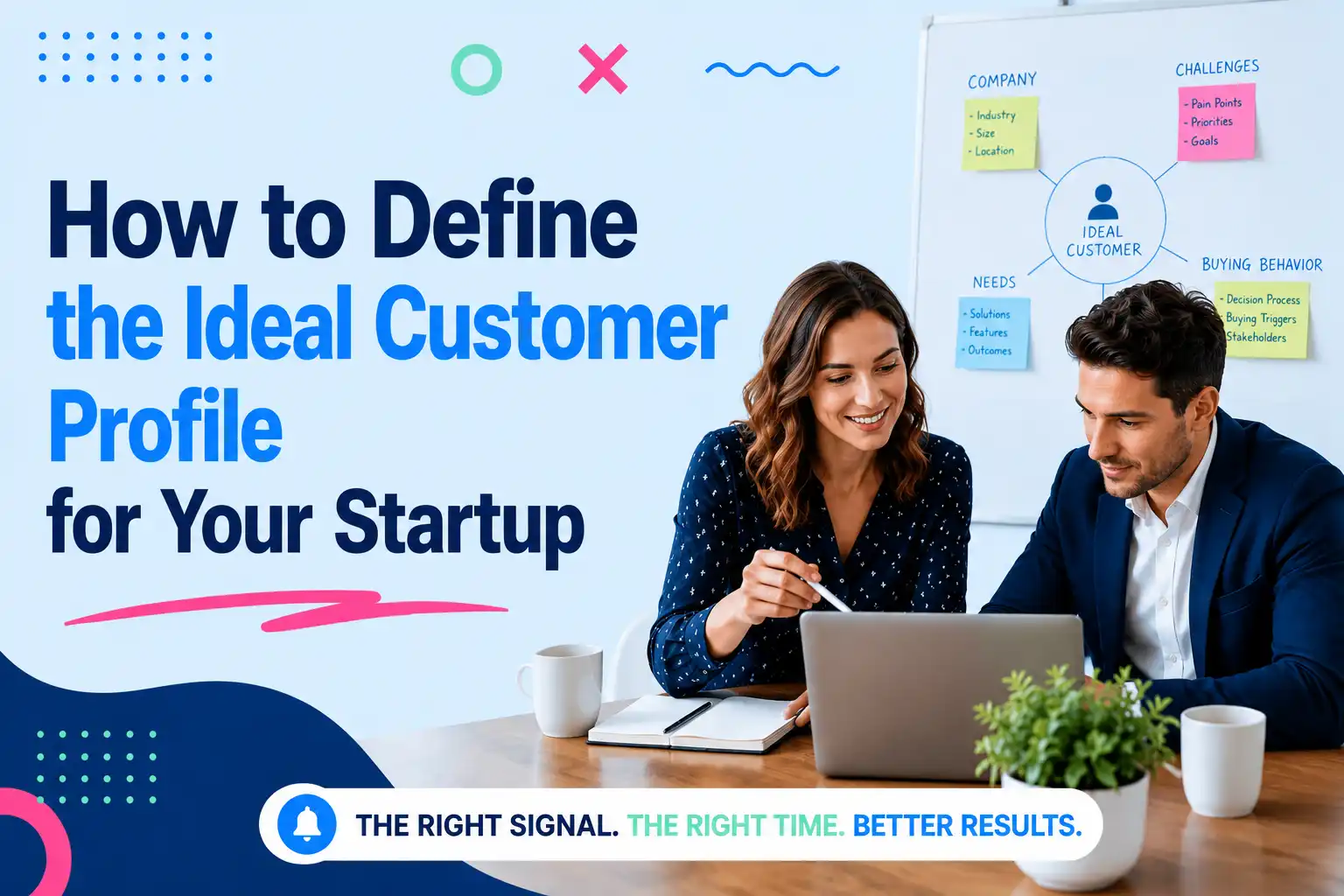
New B2B tech startups have finite resources and big challenges ahead. As a founder, to give yourself a fighting chance, you must make the best use of all you have at your disposal by being highly relevant and targeted. This means having a very clear and well-defined Ideal Customer Profile (ICP). To create your ICP, first you must be clear about who your most successful customers are or are going to be if you haven’t sold to them yet.
Defining Your ICP
Defining your ICP involves identifying their common characteristics so you can group, target and manage them in the following way:
1. Demographics:
Define characteristics like company size (# employees), industry and location.
2. Firmographics:
Then consider factors, such as annual revenue and financial performance, ownership structure (public, private, partnership, trust, PE backed, etc.) and technology stack.
3. Behavioural Data
Enrich this company information with buying patterns, including renewal dates for competing solutions and product usage, website visits, event attendance, search etc.
4. Trigger Events
Define the specific events, such as organisational change, that may cause companies in your target market to be more likely to buy your solution or one like it.
The Most Powerful Trigger Events
These events generally indicate that something important has changed inside the prospect organisation—and change is usually what creates buying opportunities. A useful rule in B2B sales is that companies rarely buy technology because they want to. They buy because something changed and the old way of working is no longer good enough. The best buying signals are therefore indicators of organisational change.
If you could only monitor ten buying signals for a B2B tech startup, I would suggest:
- Funding announcement
- New C-level appointment
- Rapid hiring growth
- Merger or acquisition
- International expansion
- New product launch
- Technology platform change
- Regulatory/compliance change
- Website intent activity
- Competitor adoption
To learn more about trigger events, please read this blog article: Top Buying Signals Every Startup Must Monitor
Research Your Audience
Consider the specific challenges and pain points target customers face and how your solution uniquely addresses them in terms of the outcomes you deliver – not features and benefits. Think about what your solution allows customers to do that they couldn’t do, or would struggle to do, before. Gathering insights from sales and customer success teams can provide a deeper understanding of common use cases and what makes certain customers or their specific circumstances ideal. By synthesising this data, you can develop a detailed ICP that guides targeted marketing and sales efforts, ensuring resources are focused on the highest-value prospects at the right time.
Know Which Individuals to Target
Part of your analysis is also knowing who the key decision makers and influencers are – the buyer group – in each company, because they are the people you will need to market and sell to. These individuals are your target personas, critical among which is the Champion, who will be your first point of contact and therefore the main target of your marketing campaigns. Other personas in the buyer group will then be introduced by the Champion as part of the buying process, some of which you may choose to market to prior to this, others you may not. Over time, you want to build relationships with as many key decision-makers as possible in your target audience.
How Big is Your Buyer Group?
For small transactional purchases, there could be just one individual who is the Champion, decision maker and budget holder. For large, expensive tech solutions, things can be far more intricate and complex. For example, there could be up to 12 individual personas involved, each with different roles across the business who are introduced to the buying process at different stages. Each will have their own agenda, opinion of your solution and varying degrees of seniority and influence on the final decision. You will need to know them all, what their role is in the buying process and how to navigate around and nudge them in the right direction.
Understand Your Personas
Personas are normally identified by their job title or job responsibility. Usually, one determines the other, but not always and there can be differences between individual companies, so you must be flexible with your definitions and understand how your market works. It may not be necessary, cost effective or even appropriate to target all of them with your marketing campaigns, but you must understand the importance of each one so you can determine the right selection for your marketing outreach activity. This means going down to the detail of who they are by name and what their contact information is. For large solutions that requires a high level of sophistication, you may determine a larger buying group responsible for reviewing and making a buying decision, and a core marketing group to target to get the sales process started.
Create Your Target List
Once you have clarity of who your target market and personas are, an important job for marketing is to build your target list of companies and the relevant individual contacts at each of them. Only once you have your target list is it possible to engage them directly to generate leads and track your progress with each one. There are various ways to build your list, both of which require an investment. Some of this can be done by investing time researching individual companies from available registers, which is time-consuming, potentially requiring hundreds of man hours. Alternatively, the quickest and easiest way to get most of the data you will need is to write a detailed brief and source it through a data broker, which you can then enrich with further information. It’s important for every B2B tech company to dedicate time and budget to building and continually maintaining a target list that ideally resides in a customer relationship management (CRM) system.
Segment Your Data
After acquiring your data and building your target list, you will have a more detailed understanding of the audience for your solution. You may be able to segment prospects into different levels of priority, based on the information you have garnered, which may help identify those that sit in different categories as relates to your ability to reach them and their readiness to buy from you. For example, companies that are the closest match to your ICP, easy for you to reach, and that your analysis tells you have the greatest propensity to buy, could be put in a priority shortlist. They are the ones you want to target first and most comprehensively, closing enough sales to hit your new business targets. It will help to get as up close and familiar with them as possible, using every available communications channel and campaign tactic. The three segments to start with are your Total Addressable Market, Serviceable Available Market and the Serviceable Obtainable Market. Follow this link to read about this in more detail in the blog article titled: How to Define Your Target Market
Focus Available Resources on Your Defined Audience
Having a priority category of prospects doesn’t mean you won’t market to the other members of your ICP target group at the same time; you must do that too. Some of them may be ready to buy, but you won’t know who they are until you start reaching out. What it does mean is that, as well as marketing to the wider target list, you may also have a more co-ordinated effort between sales and marketing teams to engage the prospects in your priority shortlist more dynamically.
Stay Narrow and Deep – Not Shallow and Wide
Avoid committing resources to proactively marketing to less relevant businesses that sit outside your target list, because you want to make the biggest impact possible and cannot afford to dilute your efforts. Successful marketing requires relentless focus, which is a skill and discipline you must instil into your entire team. All your planning, tactics, energy and budget must be focused on the goal of turning as many of the companies in your target list, that you know you can serve, into paying customers. Any outliers who come to you and can be served as easily as target customers, without any special considerations, can also be sold to, but never allow yourself to be distracted by them.
More Data Points
You may also decide to analyse customer lists from your competitors, as they can provide information on which businesses in your target market already buy and use solutions similar or regarded as alternatives to yours. You will need to have a convincing proposition to convert them to your product, but if you have done your research and developed something that demonstrably delivers more value, supported by engaging messaging, it’s possible to do this. It helps to attend industry events and network with industry experts to further enrich your target list with information you gather in your own research. By prioritising prospects that exhibit the highest alignment with your ICP, you can focus marketing and sales efforts more efficiently, resulting in higher conversion rates and more effective use of resources.
Integrated Marketing and Sales Effort
When promoting your solution to a priority shortlist, marketing and sales teams must use personalised 1-2-1 targeting methods, such as outbound emailing and calling, supported by other channels. When doing so, it’s important to use the intelligence gathered in your data to craft communications specific to each persona’s individual situation and their company’s needs. This increases the relevance of your messaging and the opportunity that prospects may respond positively. To help them engage with you by taking that next step to find out more, invite them to your events such as webinars, roundtables, exhibition stands, corporate hospitality, and so on.
Continuous Intelligence Gathering
The process of enriching the information in your priority shortlist continues as you start to build relationships with your target companies, and it must be a combined effort by marketing and sales. The emphasis is to gain more detailed knowledge about the people, their roles, internal structures and workings of those businesses, allowing you to more accurately predict and be ready when they may be ready to start a buying process for your solution.
If you have done a good job of making target personas familiar with your brand and messaging and have strong relationships with key decision-makers, they will be more likely to engage when they are ready to talk. When this happens at the beginning of a buying process, you stand a significantly higher chance of winning a sale than if you get involved at a later stage. The statistical chances of closing a sales deal increase exponentially the earlier you get involved in a procurement process. As 70-80% of the buyer journey is completed before a prospect speaks to sales, if you don’t make the shortlist, then you’re not in the game.
Get Involved Early
Research from Forrester says that companies engaged early in the buying cycle, ideally before it has even started, have a 74% higher chance of closing the deal. Early involvement means your sales team can build trust and establish themselves as valuable partners rather than another vendor making up the numbers. Conversely, joining a sales process later means you will face more ingrained competition and have less influence over the buyer’s decision-making process. If you are just being invited along for the ride and have little influence on the direction, this massively reduces your chances of success. Getting involved early in the buying cycle is crucial for tech companies aiming to close more deals and helps build stronger relationships with clients. This strategic approach not only enhances understanding of customer needs but also positions your solution more favourably, positioning your company as a trusted advisor, ultimately leading to higher sales success rates.
You may want to read: “Why Tech Startups Offer Equity to Employees.”