Before Growth Gets Serious, Make Sure You Have These Documents …
Tech startups are built on ideas, technology, ambition and an enormous amount of energy. There can also be much hype and unrealistic expectations involved, so a good way of understanding how serious to take a business is how well it has documented its intentions. Documentation is rarely what gets founders excited but is often what catches them out if ignored or not done properly. In the early days, there is always something more urgent to do, and sometimes there’s not enough money to do things correctly.
Founders are focused on building the product, finding customers, raising money, hiring developers, launching the website, getting the first deal, fixing the product and pitching investors. Paperwork can feel like an administrative distraction, but there’s a point when a startup stops being an idea and starts becoming a business. At that point, documentation becomes much more than administration. Documents are the infrastructure that allows the company to operate, make decisions, raise money, protect itself and scale.
Be Alert to the Danger
The danger is that many founders only discover the importance of their documentation when someone else asks for it. For example, an investor wants to see the financial model, a customer wants to see the contract, a potential acquirer wants evidence of intellectual property ownership, a new employee wants to understand their responsibilities, or a lawyer asks for the company’s constitutional documents. If a due-diligence process starts, will everyone be frantically searching through the filing system trying to work out where everything is? A startup without quick and easy access to these documents is not a scalable business.
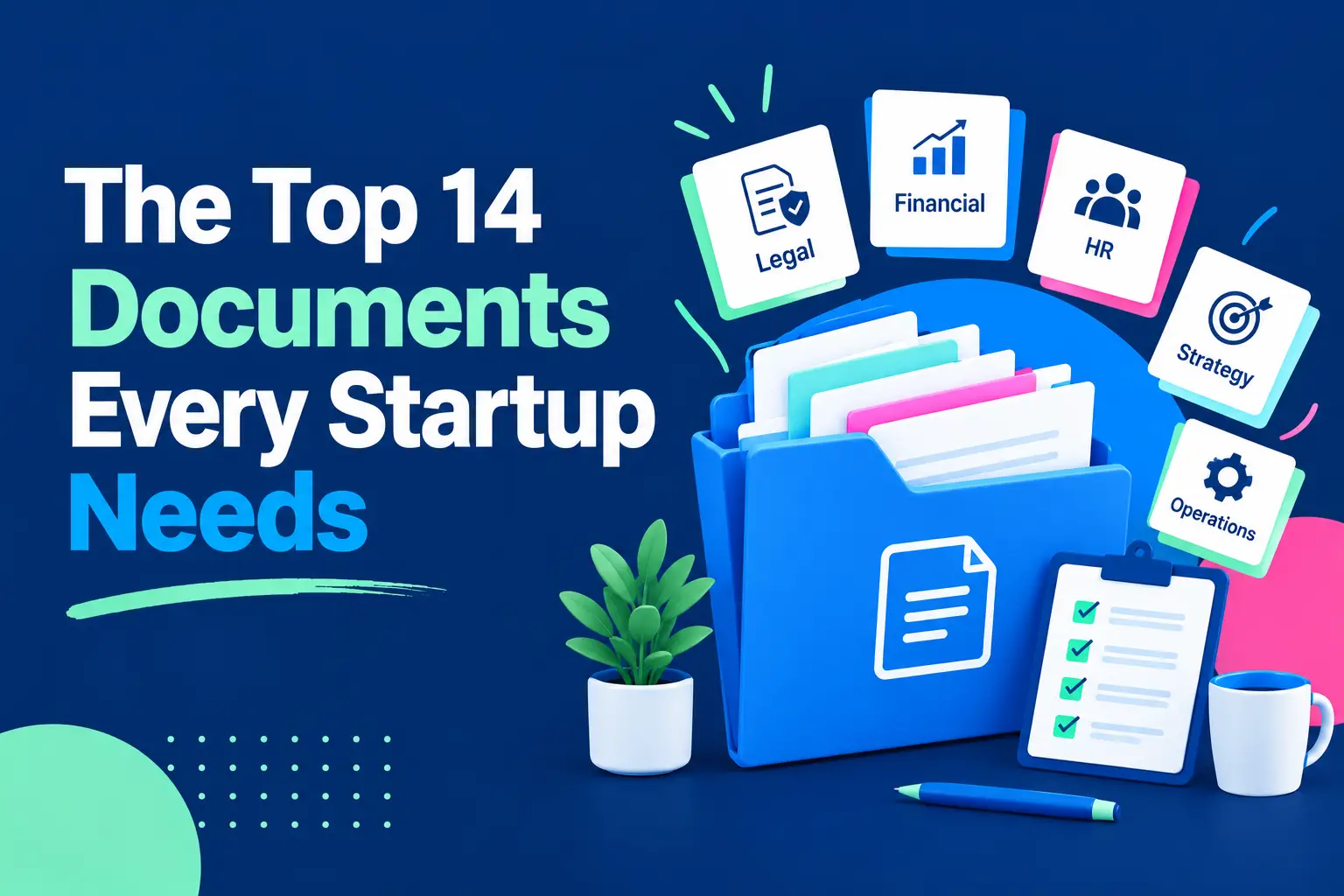
Top 14 Documents Your Startup Must Have
1. Company Overview
Start with the simplest documents: the executive summary and latest pitch deck. The executive summary explains what the company does, who it serves, the problem it solves, how it makes money, its market opportunity, competitive positioning, current traction and future ambition. The pitch deck tells the same story in a format designed for investors, partners or other stakeholders. The important point is consistency. For example, your website should not say one thing, your pitch deck another and your sales team something completely different.
Who Owns it? The founder or CEO must own the narrative, with marketing responsible for turning it into clear, consistent messaging.
Common Pitfall: Founders often create a pitch deck for fundraising and then leave it untouched for 18 months. The result is an increasingly inaccurate representation of the business. The pitch deck must evolve as the company evolves.
2. Company Basics
A startup needs its core company documentation properly organised. This includes the certificate of incorporation and business registration documents, together with the relevant statutory information. In the UK, Companies House confirms that the certificate of incorporation is evidence that the company has been registered and includes information such as the company name, registration number and date of incorporation. These aren’t exciting documents, but they are fundamental ones.
Who Owns it? The company secretary, finance lead, accountant or founder should ensure that the records are maintained correctly.
Common Pitfall: A founder may incorporate the company and then forget that corporate information must always be accurate as directors, shareholders, registered addresses and other details change. The result can be unnecessary complications during investment, banking, due diligence or other corporate transactions.
3. Founding Documents
The company’s articles of association and company bylaws, where applicable, establish how the company is governed. Terminology varies by jurisdiction. In the UK, the articles of association are the legally binding rules governing the relationship between the company and its members, covering matters such as how decisions are taken and how shares operate. These documents deserve considerably more attention than simply downloading something from the internet and filing it.
Who Owns it? A qualified corporate lawyer must advise on anything beyond straightforward standard documentation. Do not rely on your accountant. This is particularly important where founders have different ownership positions, investors are involved, special share rights exist or there are complex arrangements around control.
Common Pitfall: Founders sometimes treat constitutional documents as boilerplate. They aren’t. Poorly considered arrangements can become extremely difficult to unwind once money, shareholders and competing interests enter the business. Not paying proper attention can be the difference between a business that is investable and one that investors will not touch.
4. Team Information
A startup must maintain short biographies or CVs for key team members, together with a clear team structure showing titles, responsibilities and reporting lines. This becomes increasingly important as the company grows. At five people, everybody probably knows what everyone else does. At 25 or 50 people, assumptions start creating confusion. A simple organisational structure establishes accountability. It also helps investors and potential partners understand why the leadership team was selected to execute the strategy.
Who Owns it? The CEO or COO, supported by HR or people operations, when appropriate. Marketing can help ensure biographies and external profiles are crafted correctly and consistent, but it shouldn’t invent someone’s credentials or responsibilities.
Common Pitfall: Founders often create impressive job titles before they have properly defined the job. The result can be overlapping responsibilities, gaps in ownership and internal conflict.
5. Cap Table and Founder Equity
Few documents become more important — or more politically sensitive — than the cap table. Your startup must maintain a clear record of founder equity, shareholder ownership and relevant vesting arrangements. The cap table must be treated as a living financial and legal record rather than a spreadsheet that somebody updates occasionally.
Who Owns it? Finance maintains the working record, but legal advisers must be involved whenever shares are issued, transferred, options are granted or ownership arrangements change.
Common Pitfall: Founders can become surprisingly casual about equity in the early days. Giving away shares to employees, advisers or early supporters without understanding dilution can create significant problems later. The important question a founder must ask is: “What will everyone own after the next funding round, option pool and future investment?”
6. Product and MVP Documentation
Your startup must also document its initial product, MVP or product demonstration. This doesn’t have to be an enormous technical manual. You must explain what the product does, who it is designed for, the problem it solves, its key functionality and its current limitations. For a technology company, this becomes increasingly valuable as employees join and the product evolves.
Who Owns it? The product leader or CTO, with marketing and sales contributing customer-facing language.
Common Pitfall: The founder becomes the only person who can explain the product. That may work at the beginning but becomes a serious bottleneck later.If your salespeople, marketers, investors and new employees all need the founder to explain what the product does, you don’t have a documented product proposition. The most successful businesses ensure they avoid this kind of founder dependency.
7. Early Contracts
Even very early startups may have contracts, NDAs, partnership letters and other agreements. These must be stored centrally and systematically. Don’t rely on someone’s email inbox to prove what was agreed.
Who Owns it? A legal professional must create or review legally significant agreements. Commercial and sales teams can manage the operational process, but they are not best placed to casually rewrite legal clauses because a prospect asks for “a quick change.”
Common Pitfall: The biggest mistake is often using an inappropriate template.For example, an NDA designed for one situation may not protect the business in another, a partnership letter may accidentally create commitments nobody intended, or a customer contract may omit important provisions around intellectual property, liability, payment or termination. Legal documents aren’t marketing templates because they can create enforceable obligations.
A credible startup must maintain its market analysis, competitive analysis and customer evidence, including feedback and testimonials. This documentation provides the evidence behind the business proposition, including:
- Why does the market exist?
- Who buys?
- Why do they buy?
- Who are the competitors?
- What alternatives do customers have?
- What evidence suggests customers actually care?
This is particularly important for technology startups because enthusiasm for a product is not the same thing as evidence of product-market fit.
Who Owns it? Marketing generally leads market and competitive intelligence, working closely with sales and product. Customer feedback must be collected continuously across functions, rather than created retrospectively for an investor presentation.
Common Pitfall: Founders frequently build a market narrative around what they believe rather than what customers have demonstrated. A compelling TAM slide does not prove that anyone will buy the product. Customer evidence is considerably more valuable.
9. Compliance and Privacy
Your startup must document its basic data-protection practices and privacy policy. This is particularly important for technology companies because personal data can flow through websites, CRM systems, analytics platforms, email systems, applications, support tools and third-party services. The ICO states that organisations generally need to provide privacy information when processing people’s personal data and that the information should explain matters including what data is collected, why it’s used, who it’s shared with and how long it’s retained.
Who Owns it? Legal counsel or a suitably qualified data-protection professional should advise on the requirements. Marketing, IT and operations must then implement the agreed processes.
Common Pitfall: Never copy a privacy policy from another website. The policy needs to describe what your business does with personal information. The ICO also recommends that privacy information is regularly reviewed and updated when processing activities change.
10. Financial Projections
This may be the most important document category in the entire list. Your startup needs a 12-month financial plan, revenue forecast and budget covering the next 12–18 months. Importantly, founders need to understand the numbers rather than simply possessing the spreadsheet. This is where many startups get themselves into trouble with optimistic revenue projections, underestimated costs, aggressive hiring plans, increased marketing budgets and accumulated software subscriptions. Then suddenly the company discovers that the cash runway is considerably shorter than expected. Running out of cash is often the final event, rather than the original problem. The point of financial planning isn’t to predict the future perfectly. It tries to understand what happens to the business when the assumptions change.
Who Owns it? This is where I strongly believe startups should consider having access to a management accountant, even if only part-time. The founder must understand the numbers, but the founder shouldn’t necessarily be building and independently validating every financial model. A good management accountant can provide management accounts, cash flow analysis, forecasting, scenario modelling and financial interpretation. That can be invaluable when the business starts hiring. A founder sees an opportunity to recruit five people.
When considering hiring five new people, the management accountant will ask: “Can we really afford to carry those five salaries for the next 18 months if revenue arrives six months later than expected?” The UK government’s Business.gov.uk guidance states that the cost of employment includes more than salary — including National Insurance, pension contributions, leave, insurance, equipment and training — adding significantly to the total cost of employment. Recruitment decisions must appear in the financial model, not just the organisational plan.
Common Pitfall: The classic startup mistake is hiring ahead of revenue without modelling the consequences. When headcount becomes the highest cost in the business, the founders then spend their time fundraising just to maintain the team they hired during a period of optimism. It’s growth that must increase capacity. Never increase fixed costs faster than the business can support them.
11. Intellectual Property
Where relevant, every startup must maintain documentation covering its intellectual property, including trademark applications or registrations. For a technology startup, IP can be one of the most valuable assets in the business. That may include software, technology, trademarks, designs, patents, proprietary processes, data or other forms of intellectual property. The UK IPO recorded 212,547 trademark filings in 2025–26, demonstrating the scale of activity around registered IP rights.
Who Owns it? Use an IP lawyer or suitably qualified specialist where protection matters commercially. Marketing can identify brand assets and potential trademark issues, while product and engineering should identify technical IP.
Common Pitfall: A founder assumes that creating something automatically means the company owns everything associated with it. That can become complicated when contractors, agencies, employees, founders or third parties have contributed to the work. Ownership must be properly documented.
12. Technology Overview
All startups must maintain a basic overview of the technology stack and list of software and tools used. This may sound mundane, but technology sprawl happens quickly, including systems such as:
- CRM
- Marketing Automation
- Analytics
- Cloud Infrastructure
- Development Tools
- Customer Support
- Accounting
- Security
- Collaboration
- Data Platforms
A year later, nobody remembers why half of them were purchased or what the passwords are.
Who Owns it? The CTO or technical lead must maintain the core technology inventory, with finance and operations tracking commercial subscriptions.
Common Pitfall: The company doesn’t know what technology it owns, who administers it or when contracts renew. This creates security, cost and operational risks.It can also become a due-diligence problem.
13. Organise the Data Room
All these documents need to be organised. You must have a clear folder structure comprising areas such as financials, contracts, team information, company documents, IP and technology. It’s also helpful to maintain an index, document checklist and clear naming conventions. This is where a startup can look considerably more mature than its size suggests. A well-organised data room tells investors, customers, partners and advisers that the company knows what it owns, what it has agreed to and how it operates.
Who Owns it? The COO, CFO, finance lead or founder can establish the structure, with individual functional leaders responsible for keeping their sections up to date.
Common Pitfall: The folder exists, but the documents are six months out of date. A data room isn’t useful just because it contains hundreds of files. A data room is useful because someone can find the right document swiftly and trust that it is current and correct.
14. The Checklist
The final document should be the checklist itself. Your startup must maintain a simple checklist showing what exists, who owns it, when it was last reviewed and whether it needs updating. That turns documentation from a one-off exercise into a management process.
Documentation isn’t Bureaucracy – it’s Infrastructure
The most successful founders tend to move quickly. They make decisions with incomplete information, test ideas, change direction and constantly push the business forward. Documentation must not slow that entrepreneurial spirit down. It needs to make it safer by being more considered, prepared and organised. Nobody wants to produce hundreds of pages of corporate paperwork unnecessarily. The objective here is to ensure that the critical knowledge, agreements, financial assumptions, ownership structures, market evidence and operational information don’t exist only in the founder’s head. This becomes increasingly important as the business grows.
Your startup must be able to:
- Survive an employee leaving.
- Explain its proposition without the founder.
- Show an investor how it makes money.
- Know what it owns.
- Calculate what it owes.
- Quickly reference what it has agreed to.
- Understand whether it can afford the decisions it is about to make.
Documents Help You Run the Business
The UK’s own guidance on business planning makes the same fundamental point: A business plan must cover objectives, strategy, sales, marketing and financial forecasts, while helping founders identify potential problems and measure progress. For startups seeking funding, the financial model becomes even more important. UK government guidance for founders and leadership teams describes a robust financial model that must explain how the business makes money, manages costs, mitigates risk and scales profitably, while giving investors visibility into revenue, cash flow, runway, costs and resourcing. That is ultimately what good startup documentation must do.
Lesson:
Documentation makes a business easier to understand and manage and harder to break. The founders who treat documentation as something to sort out later or when the investor arrives are already too late. The smart move is to build the documentation while the business is still small enough to do it properly, because one day somebody will ask for it, and when they do, you want the answer to be: “Yes. It’s all here.” You do not want to make this up as you go along, because if you try to do that with legal documents, you will create a mess that may take a great deal of pain and cost to unravel later.
You may want to read: “Why Startups Must Take Target Data Seriously.”